CDS Preservation Policy

Principles
Digital preservation ensures that valuable digital assets remain usable and accessible over time, even as technology evolves and renders original hardware and software obsolete. The CERN approach is defined by the Operational Circular 3 (OC3) "Rules applicable to archival material and archiving at CERN", which governs the scope, responsibilities and access to the institutional archives. It determines which materials must be preserved.
Responsibilities
The responsibility of defining which records must be preserved and when they can be accessible for historical research belongs to the CERN Archives (link to the SIS website), in consultation with the CERN departments.
The responsibility of preserving digital assets belongs to the Preserve service, part of the Digital Memory project. This service follows the Open Archival Information System (OAIS) reference model, which provides a conceptual framework for long-term preservation. Long-term preservation is the process of maintaining digital information over extended periods to ensure it remains accessible, authentic, and usable despite technological, organizational, or environmental changes. By adhering to these rules and principles, we can prevent the loss of critical institutional knowledge and avoid the prohibitive costs associated with restoring degraded data.
Scope
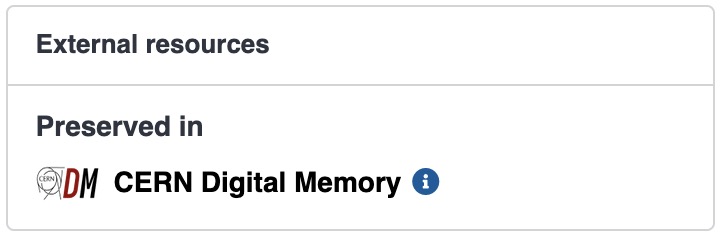
All CDS content is preserved for the long-term. In the CDS interface, records that have been already successfully long-term preserved are marked with a specific "Digital Preservation" logo on the right sidebar of the landing page.
Duration and access
The content archived in CDS, through the Preserve service, is preserved for the lifetime of the laboratory.
All content remains available in CDS. The long-term preserved copy in Preserve is under the custody of the CERN Archives, and not directly accessible to users.
Any embargo rules, which may restrict access for a specified period, are governed by the CERN-wide Operational Circular 3 (OC3).
Procedures and operations
Content that is in scope is automatically and periodically preserved. Content is archived in Preserve after a grace period (duration might change), which allows modifications in case of mistakes or corrections.
The preservation process includes, but is not limited to, numerous steps, such as virus checking, file characterization, format normalization, file name uniqueness, checksum calculation.
The preserved data is duplicated onto different storage media, specifically on tape. This approach has multiple benefits: it diversifies the storage risk by using different physical media, and it is a more environmentally friendly solution for long-term cold storage.
For more details on the technical aspects and workflows of the preservation process, please consult the Digital Memory project website.
Contact
For any question related to content and CERN Archives, please contact archive.enquiries@cern.ch.
If you have questions or require support regarding technical aspects, please contact the Preserve team via the following link:
https://cern.service-now.com/service-portal?id=functional_element&name=Open-Archival-Information