New links between Ecuador and CERN
Authors/Creators
Description
A new protocol recently signed in Quito opens the way to stronger links between the Ecuadorian scientific community and CERN. The operational framework provided by the protocol will enable scientists from Ecuador to take part in CERN’s projects, supported by the Ecuadorian authorities.
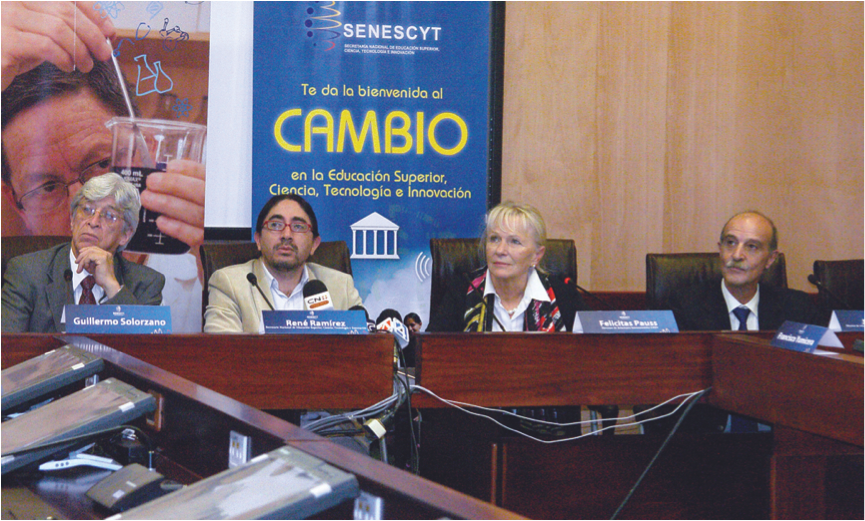
Picture taken during the signing ceremony at SENESCYT (Quito, Ecuador) on 12 July 2011. From left to right: Guillermo Solórzano, Minister for Coordination of Knowledge and Human Talent, Rene Ramirez Gallegos, National Secretary for Higher Education, Science and Technology - SENECYT, Felicitas Pauss and Jose Salicio from CERN.
Ecuador’s involvement with CERN dates back to 1999 when a first International Co-operation Agreement was signed. However, despite these early beginnings, only a few scientists from Ecuador, affiliated to non-Ecuadorian institutes, have since been directly involved in CERN’s projects, in particular the CMS experiment at the LHC. The situation is now about to change thanks to a new protocol, which gives a better-defined framework to the collaboration between CERN and Ecuador. “We were extremely pleased by the very positive spirit of the Ecuadorian authorities at the signature ceremony,” says Felicitas Pauss, Head of International Relations at CERN. “Uniting people from different countries and cultures is part of CERN’s mission and I hope that, thanks to the new agreement, the number of Ecuadorian scientists and educators visiting CERN will soon increase.”
The new agreement will benefit both the scientific and the educational communities in Ecuador as it concerns not only physicists, engineers and specialized technicians from universities, but also high-school teachers and students. “One teacher from Ecuador has already participated in an early High-School Teacher programme at CERN,” confirms Felicitas Pauss. “The agreement also foresees the selection and funding, by the Ecuadorian National Secretariat for Higher Education, Science, Technology and Innovation, of students participating in the Summer Student programme.” One Ecuadorian student has already participated in this year’s Summer Student programme.
The protocol also promotes the development of undergraduate and graduate programmes in physics at Ecuadorian universities. These courses should increase the number of qualified students who can participate in CERN’s scientific activities. Scientists from Ecuador will be involved in all aspects of these activities, from theoretical physics to experimental physics, GRID computing, electronics, etc. “The collaboration with Ecuador also aims at developing human skills that can better enable the local community to grow by building and strengthening research groups in the country’s institutions,” adds Jose Salicio, CERN’s Advisor for Latin American Countries. “There are scientists from Ecuador interested in becoming members of the CMS Collaboration, and this new protocol will play an important role in facilitating their efforts to stay on here,” confirms Felicitas Pauss.
Other (French)
Un nouveau protocole, signé récemment à Quito, ouvre la voie à des liens plus étroits entre la communauté scientifique équatorienne et le CERN. Le cadre opérationnel mis en place par cet accord permettra aux chercheurs équatoriens, avec le soutien des autorités nationales, de participer à des projets du CERN.

Photo prise lors de la cérémonie de signature dans les locaux du SENESCYT (Quito, Équateur) le 12 juillet 2011. De gauche à droite : Guillermo Solórzano, ministre chargé de la Coordination du savoir et du talent humain, Rene Ramirez Gallegos, Secrétaire national chargé de l’enseignement supérieur, des sciences, de la technologie et de l’innovation (SENECYT), Felicitas Pauss et Jose Salicio, du CERN.
La participation de l’Équateur aux activités du CERN remonte à 1999, année de signature d’un premier accord de coopération internationale. Pourtant, seul un petit nombre de chercheurs équatoriens, affiliés à des institutions non équatoriennes, a jusqu’à présent réellement pris part à des projets du CERN, notamment à l’expérience CMS au LHC. La situation va maintenant changer grâce à un nouveau protocole qui établit un cadre de collaboration plus structuré entre le CERN et ce pays d'Amérique latine. « Nous avons été très satisfaits de l’excellent état d’esprit qu’ont montré les autorités équatoriennes lors de la cérémonie de signature, souligne Felicitas Pauss, responsable des relations internationales au CERN. Unir des personnes issues de cultures et de pays différents fait partie de la mission du CERN et j’espère que, grâce à ce nouvel accord, nous verrons davantage de chercheurs et d’enseignants équatoriens venir au CERN ».
Le nouvel accord sera bénéfique tant au secteur des sciences qu'à celui de l'éducation en Équateur puisqu'il ne concerne pas uniquement les physiciens, les ingénieurs et les techniciens spécialisés des universités, mais aussi les enseignants et les étudiants du secondaire. « Un enseignant équatorien a déjà participé à l’une des premières éditions du programme du CERN destiné aux professeurs de l’enseignement secondaire, confirme Felicitas Pauss. L'accord prévoit également la sélection d’étudiants par le Secrétariat national équatorien de l’enseignement supérieur, des sciences, de la technologie et de l'innovation, qui financera leur participation au programme des étudiants d’été ». Un étudiant équatorien a déjà participé au programme des étudiants d’été de cette année.
Promouvoir le développement de programmes universitaires en physique fait également partie des objectifs du protocole. Grâce à ces cursus, davantage d’étudiants qualifiés auront la possibilité de prendre part aux activités scientifiques du CERN. Les chercheurs équatoriens seront associés à tous les domaines liés à ces activités : physique théorique et expérimentale, calcul sur grille, électronique, etc. « La collaboration avec l’Équateur vise également à favoriser le développement d’un savoir-faire qui permettra à la communauté scientifique locale de s’agrandir par la création ou le renforcement de groupes de recherche au sein des institutions du pays », ajoute Jose Salicio, conseiller du CERN pour les États d'Amérique latine. « Des chercheurs équatoriens souhaitent être membres de la collaboration CMS et ce nouveau protocole jouera un rôle important dans cette voie », précise Felicitas Pauss.
Files
Untitled_image.png
Files
(1.1 MB)
| Name | Size | Download all |
|---|---|---|
|
md5:1d62030d2815ee43710fc510a3334530
|
1.1 MB | Preview Download |
Additional details
Identifiers
- CDS
- 1376433
- CDS Report Number
- BUL-NA-2011-209
Related works
- Is published in
- Periodical issue: 3c1s3-b1535 (CDS)
- Periodical issue: 5vmag-zf177 (CDS)