Simon van der Meer (1925-2011)
Authors/Creators
Description
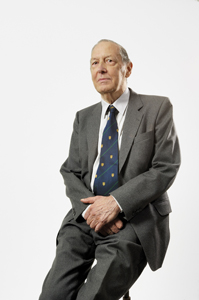
Simon van der Meer was a true giant of modern particle physics, though a gentle one. His contributions to accelerator science remain vital for the operation of accelerators such as the LHC today. Simon was an electrical engineer who grew up in The Hague, moving on to Delft University to study electrical engineering. After a short stint with Philips, he came to CERN in 1956, just two years after the lab opened, and remained with us until his retirement in 1990.
Simon was an incredibly inventive man. When confronted with a problem, he would sink into deep reflection, rarely emerging until he had a solution. One of us, Steve Myers, remembers him as a man who did not suffer fools gladly, and who was extremely taciturn. Simon would never use two words where one would suffice. But that one word would invariably be the right one.
Simon is best known for his contribution to the SPS collider project, for which he was awarded the Nobel Prize, jointly with Carlo Rubbia, in 1984. Stochastic cooling, the innovation that made the SPS collider possible was typical of a Simon van der Meer invention: deceptively simple at first sight, but to anyone who truly understands accelerators it was nothing less than a stroke of genius.
Stochastic cooling is a technique used to keep intense beams of like-charge particles together. Essentially it involves measuring the size and momentum distribution of the beam particles at one point on the accelerator ring, and sending the information needed to corral the beam across the middle of the ring so that it arrives early enough to be used to apply the necessary corrections.
This may have been Simon’s greatest contribution to modern physics, and it was justly rewarded with the Nobel Prize, but in the early days, Simon took some convincing that this idea was so important. To our knowledge, Simon first mentioned the possibility of stochastic cooling at an ISR group leaders’ meeting in 1968. Wolfgang Schnell, who was group leader of the RF and beam instrumentation group, had a devil of a time convincing Simon to write up his ideas, but eventually he did and so began his journey to Stockholm.
The next step on the road was ICE, the Initial Cooling Experiment, designed to put stochastic cooling to the test. The idea worked beautifully, and ICE proved a key element in persuading the CERN Council to go ahead with the SPS collider project. It was then a natural choice that Simon should be one of the leaders of the Antiproton Accumulator project, which used stochastic cooling to accumulate enough antiprotons for the collider. That too was an unqualified success, and the rest, of course, is history.
Simon came to CERN as a specialist in power converters, and he was responsible for building those used for the world’s first hadron collider, the ISR, and later for the SPS. He also developed a device known as the magnetic horn, versions of which today allow laboratories on three continents to direct focused beams of neutral particles – neutrinos – through the earth for hundreds of kilometres to underground particle detectors. And another part of his legacy is the technique he developed for measuring beams that bears his name. Without “van der Meer scans”, the precision of the calibration of the luminosity in the LHC would be much lower. At CERN today, it’s fair to say that Simon’s contributions continue to play a significant role in projects from the LHC to the CERN neutrinos to Gran Sasso project, and the Antiproton Decelerator – whose 2010 results were honoured with the distinction of breakthrough of the year by Physics World magazine. Simon was a brilliant all round technologist and scientist, well respected at CERN and around the world. A true giant of our field.
Rolf Heuer and Steve Myers
Other (French)
Simon van der Meer était, dans tous les sens du terme, un géant de la physique des particules moderne. Sa contribution à la science des accélérateurs reste capitale pour le fonctionnement des accélérateurs d’aujourd’hui tels que le LHC. Simon van der Meer, ingénieur électricien, avait grandi à La Haye, avant de faire des études d'ingénieur à l'Université de Delft. Après un passage chez Philips, il est arrivé au CERN en 1956, deux ans à peine après l’ouverture du Laboratoire, et il est resté avec nous jusqu’à sa retraite, en 1990.
C’était un homme extrêmement inventif. Confronté à un problème, il se plongeait dans une réflexion profonde, dont il ne sortait pas tant qu’il n’avait pas trouvé de solution. Steve Myers se souvient qu'il était très exigeant, et aussi extrêmement taciturne. Simon van der Meer n’aurait pas utilisé deux mots quand un seul suffisait. Mais ce mot-là était toujours le mot juste.
Simon van der Meer est surtout connu pour sa contribution au projet SPS, pour lequel il a reçu le prix Nobel conjointement avec Carlo Rubbia, en 1984. Le refroidissement stochastique, l’innovation qui a rendu possible l’existence du SPS, est un exemple typique de l’inventivité de Simon van der Meer : une idée toute simple à première vue, mais pour quiconque comprend le fonctionnement des accélérateurs, c'était véritablement un trait de génie.
Le refroidissement stochastique est une technique utilisée pour focaliser des faisceaux intenses de particules de charge semblable. Cette technique consiste pour l’essentiel à mesurer la distribution par taille et par impulsion des particules du faisceau en un point de l’anneau de l’accélérateur, et à envoyer l’information nécessaire de l’autre côté de l’anneau suffisamment tôt pour pouvoir appliquer les corrections nécessaires.
Cette invention est sans doute la plus grande contribution de Simon van der Meer à la physique moderne, et c’est à juste titre qu’elle a été couronnée par un prix Nobel. Et pourtant, au départ, il a fallu du temps à Simon pour se convaincre que son idée avait une telle importance. À notre connaissance, Simon van der Meer a mentionné pour la première fois la possibilité du refroidissement stochastique lors d'une réunion des chefs de groupe des ISR, en 1968. Wolfgang Schnell, chef du groupe chargé des RF et de l'instrumentation des faisceaux, a eu beaucoup de mal à convaincre Simon d’écrire sa proposition, mais il a fini par écrire quelque chose. C'était la première étape d'un voyage qui devait l'amener à Stockholm.
L’étape suivante a été l’Expérience initiale de refroidissement (ICE), destinée à faire l’essai du refroidissement stochastique. L’essai a été concluant, et cette réussite d’ICE a été déterminante dans la décision du Conseil du CERN de lancer le projet SPS. Dès lors, il était logique que Simon devienne l'un des responsables du projet d'Accumulateur d'antiprotons, dans lequel le refroidissement stochastique était utilisé pour accumuler en nombre suffisant des antiprotons pour le collisionneur. Ce projet-là a lui aussi été un grand succès, et on connaît la suite.
Simon est venu au CERN en tant que spécialiste des convertisseurs de puissance, et c’est lui qui a été chargé de la construction des convertisseurs utilisés pour le premier collisionneur de hadrons du monde, les ISR, et ensuite pour le SPS. Il a également mis au point un dispositif appelé corne magnétique, utilisé aujourd’hui par des laboratoires de trois continents différents pour diriger des faisceaux focalisés de particules neutres – les neutrinos – en leur faisant traverser l'écorce terrestre sur des centaines de kilomètres pour atteindre des détecteurs de particules souterrains. Il nous a également laissé en héritage la technique qu'il a inventée pour mesurer les faisceaux, et qui porte son nom. Sans la méthode van der Meer, la précision de l'étalonnage de la luminosité dans le LHC serait bien moindre. De nos jours, les contributions de Simon van der Meer continuent à jouer un rôle important dans les projets du CERN, qu’il s’agisse du LHC ou du projet CNGS (Neutrinos du CERN vers le Gran Sasso), ou du Décélérateur d’antiprotons – dont les résultats en 2010 ont été considérés comme l’avancée de l’année par la revue Physics World. Simon était un savant et un inventeur brillant, très respecté au CERN et dans le monde entier. C’était un géant dans notre discipline.
Rolf Heuer et Steve Myers
Files
vanderMeer(1)_image.jpg
Files
(101.0 kB)
| Name | Size | Download all |
|---|---|---|
|
md5:ebbb5ab1629e9fae90e78b4cdb287ccd
|
50.5 kB | Preview Download |
|
md5:ebbb5ab1629e9fae90e78b4cdb287ccd
|
50.5 kB | Preview Download |
_image.jpg?download=1)
Additional details
Identifiers
- CDS
- 1335088
- CDS Report Number
- BUL-NA-2011-065
Related works
- Is published in
- Periodical issue: rxjzd-9ms56 (CDS)
- Periodical issue: tn4w2-5kf94 (CDS)