Major Refit for CERN's 400 kV Substation
Authors/Creators
Description
The 400 kV substation on the Prévessin site brings in the electricity that powers CERN's accelerators and the majority of the Laboratory's installations. It was originally built in the 1970s for the SPS, and is one of only five privately owned 400 kV sub-stations in France. Three of the others belong to the national railway company, SNCF, supplying the Paris-Marseilles TGV line, the other is at the Cadarache research centre near mouth of the Rhone. After nearly thirty years of service, CERN's substation has just undergone a complete overhaul.
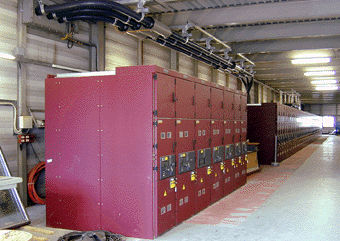
The new main 18 kV switchboard for the SPS pulsed network.
The electricity supply for the original Prévessin substation was from the 400 kV EDF network, delivered through three 90 MW transformers at 18 kV to the SPS pulsed network, With the arrival of LEP, two 110 MW transformers were added to supply the new accelerator. Now, as CERN gears up for the LHC, additional pulsed power capacity is needed to supply the transfer lines carrying protons from the SPS to the LHC. That would not have been possible with the topology of the substation as it was, and with much of the original equipment coming to the end of its prospective lifetime, an overhaul was scheduled for the 2000-2001 winter accelerator shutdown.
The overhaul began last November after the closure of LEP, and was completed by the end of June. Work started with the dismantlis of the existing systems. All the 400 kV switchgear that transports electricity to the big transformers was refurbished and one of the 18 kV transformers was renovated.
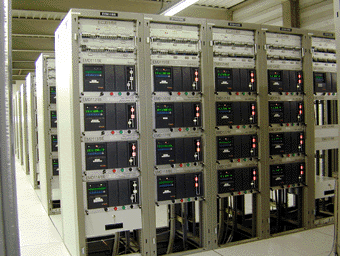
Part of the new control and protection system for the 18 kV side.
Indoors the changes are most evident. Gone are the analogue dials and electromechanical relays, replaced by an all-digital system with microprocessor-based control and protection. A so-called SCADA system - Supervisor Control And Data Acquisition - makes detailed monitoring and control of the substation possible from CERN's technical control room and from the offices of the electrical service.
The concept for the refitted substation was developed by Michel Delidais of the ST-EL group, who knows the substation very well. 'My first work at CERN was to take part in putting this substation into service in 1974,' he explains. The main customer for electricity at CERN, the SL-PO group took part in the design, since it needs direct operational control of the power input to the SPS power converters.
A total of 16 companies from eight Member States carried out the work in conjunction with CERN personnel from ST-EL, the transport and the civil engineering groups. Work could not begin until after the LEP shutdown, and had to be complete before SPS start-up this year. For that reason, components were acquired and tested in advance, ready to be installed as soon as the substation became available. This approach resulted in an extremely rapid installation. 'The original installation took two years,' explains Delidais, 'and was followed by six months of testing.' The refit took just seven months from start to finish.
Other (French)
La sous-station de 400 kV sur le site de Prévessin alimente en électricité les accélérateurs du CERN et la majorité des installations du Laboratoire. Initialement construite pour le SPS dans les années 70, elle est l'une des cinq sous-stations privées en France ; trois autres appartiennent à la SNCF et alimentent la ligne Paris-Marseille du TGV et la dernière est implantée au centre de recherche de Cadarache proche de l'embouchure du Rhône. Après presque trente ans de service, la sous-station du CERN vient d'être entièrement remise en état.
Le nouveau tableau de distribution principal de 18 kV pour le réseau pulsé du SPS.
A l'origine, la sous-station de Prévessin, raccordée au réseau EDF de 400 kilovolts, alimentait le réseau pulsé du SPS à 18 kV par l'intermédiaire de trois transformateurs de 90 Mégawatts. En prévision de la mise en service du nouvel accélérateur LEP, deux transformateurs de 110 MW furent ajoutés. Aujourd'hui, dans la perspective du LHC, l'alimentation des lignes de transfert des protons du SPS au LHC nécessite un supplément de puissance pulsée que n'aurait pas pu fournir la sous-station dans sa configuration actuelle. Un grand nombre d'équipements d'origine arrivant au terme de leur durée de vie prévisible, une rénovation avait été programmée au cours de l'arrêt hivernal 2000-2001.
Les travaux, commencés en novembre dernier après la fermeture du LEP, se sont achevés fin juin. Les systèmes en place ont été démontés et tout l'appareillage de connexion de 400 kV qui transporte l'électricité jusqu'aux gros transformateurs et l'un des transformateurs de 18 kV ont été remis à neuf.
Une partie du nouveau système de commande/contrôle et de protection du secteur18 kV.
A l'intérieur, les changements sautent aux yeux. Disparus les cadrans analogiques et les relais électromécaniques ! Ils ont été remplacés par un système entièrement numérique dont la commande et la protection sont assurées par des microprocesseurs. Un système appelé SCADA programme directeur de commande/contrôle et d'acquisition des données permet la surveillance et la gestion de la sous-station depuis la salle de commande technique du CERN et les bureaux du service électrique.
La conception de la sous-station rénovée revient à Michel Delidais du groupe ST-EL, qui connaît parfaitement son affaire. « Mon premier travail au CERN a été de participer à la mise en service de cette sous-station en 1974 » explique-t-il. Le groupe SL-PO, principal consommateur d'électricité du CERN a pris part à l'étude technique car il doit pouvoir assurer la régulation opérationnelle directe de la puissance transmise aux convertisseurs de puissance du SPS.
Au total 16 entreprises de huit Etats membres ont réalisé les travaux en liaison avec du personnel des groupes ST-EL, du transport et du génie civil du CERN. Ces travaux ne pouvaient pas commencer avant la fermeture du LEP et devaient être terminés avant la remise marche du SPS cette année. C'est pourquoi des éléments ont été achetés et mis à l'essai à l'avance, de manière à pouvoir être installés dès que la sous-station serait hors service. La mise en service a donc été extrêmement rapide. « L'installation initiale avait pris deux ans, explique Michel Delidais, et avait été suivie de deux mois d'essais. » La rénovation n'a, elle, duré que sept mois en tout et pour tout.
Files
na-2001-058_013402.gif
Files
(124.1 kB)
| Name | Size | Download all |
|---|---|---|
|
md5:6ee2e183d7274c072e91edbab90db8ab
|
57.3 kB | Preview Download |
|
md5:5763dd946c10da23f76e004daeaf2668
|
66.8 kB | Preview Download |
Additional details
Identifiers
- CDS
- 45207
- CDS Report Number
- BUL-NA-2001-058
- Aleph number
- 000006689MMD
Related works
- Is referenced by
- Other: ADMBUL_0021155 (Other)
- References
- Photo: 0003830 (Other)