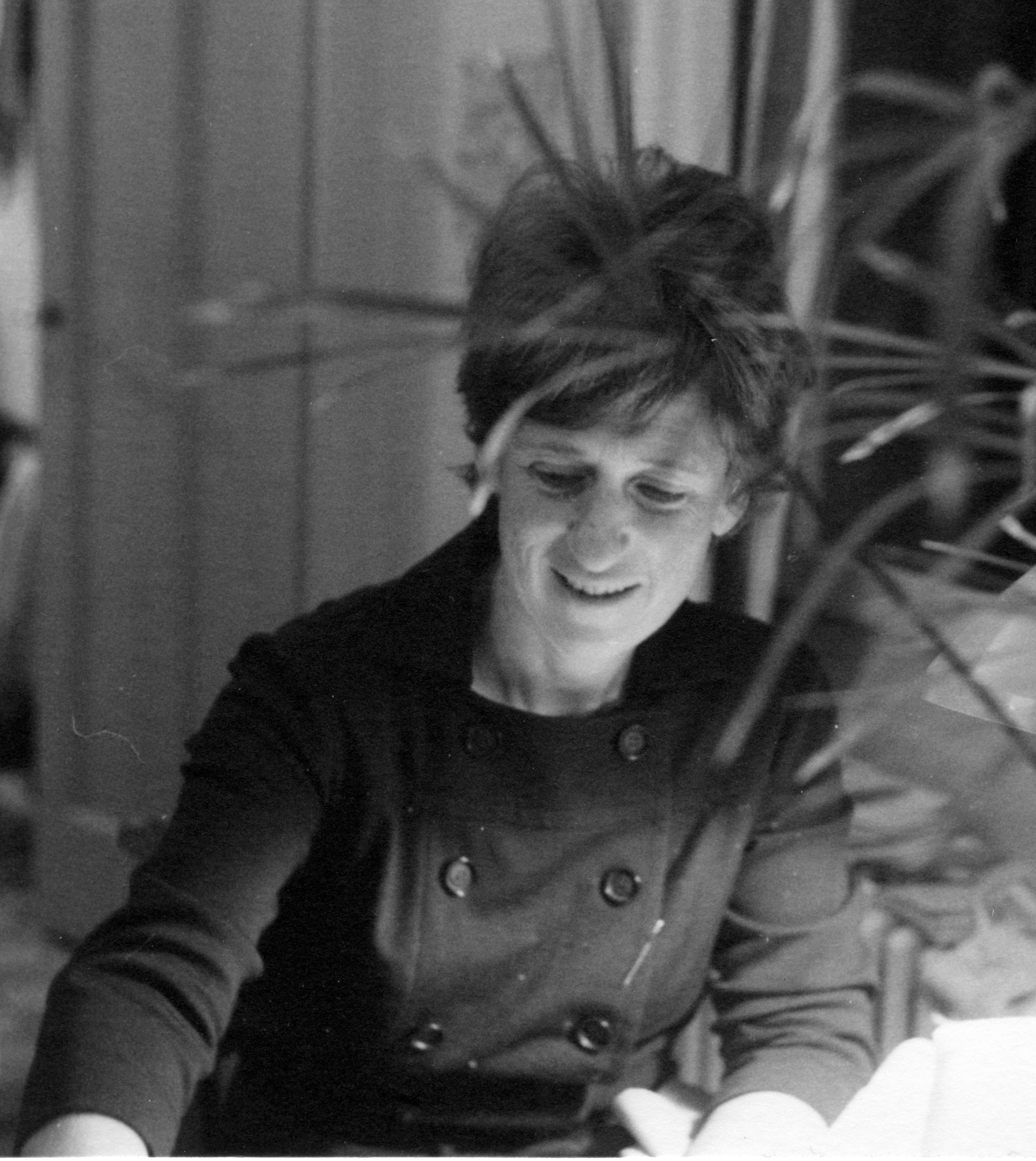
Luisella Goldschmidt-Clermont (1925 – 2013)
Authors/Creators
Description
Many people make a great impact through their work, but in most cases this effect fades over time. For Luisella Goldschmidt-Clermont, this is certainly not the case.
She played an essential role in two areas which remain very important for many of us at CERN: easy access to information about particle physics and the education of our children. But beyond her professional qualities, she was a warm, well-rounded and intelligent person who was blessed with a sense of humour that helped her in many negotiations.
After completing a degree in social sciences at the Université Libre de Bruxelles (ULB), she started work in the Scientific Information Service at CERN in 1954. She was behind the initiative to organise the exchange of article preprints between research centres and to set up a document information infrastructure, which was subsequently adopted on both sides of the Atlantic. In the 1960s, she played a pivotal role in developing the management of CERN’s preprints and those of the SLAC library in the United States. Later this became the Stanford Physics Information Retrieval System (SPIRES), and subsequently what we now call INSPIRE.
Many of the people who work at CERN stay only for a few years and then return to their home country. The question of how best to educate their children is therefore one which arises in many families. In the mid-1960s, Luisella set herself the task of finding a solution to this problem, with the support of the Staff Association. Setting up a school to serve the needs of the children of CERN personnel was a challenge. Initially, the response from the CERN Management was lukewarm. CERN's Member State delegates were extremely cautious about such a project, as they were more aware than the CERN personnel of the administrative complexities.
So it was Luisella, practically single-handedly, who succeeded in creating a public establishment model for the Lycée International in Ferney-Voltaire that would meet the needs of the local French population and include sections for the teaching of other national curricula. This allowed the children of CERN personnel of other nationalities to reintegrate relatively smoothly into their national education systems.
Anybody who has had to deal with a national bureaucracy can appreciate the challenges that Luisella managed to overcome thanks to her creativity. Thousands of children have benefitted from her efforts and continue to do so, and even though Luisella is no longer with us, her work lives on… And in addition to her campaigning work, she completed a doctorate in sociology at ULB on a subject related to this project.
Luisella subsequently left CERN to pursue a career in social sciences at the ILO and other institutions – an activity which was in keeping with her generous nature and humanist ideals, and where she continued to make a real difference. With Luisella's passing, we have lost a person who always made a difference.
Her friends and colleagues at CERN
To read Luisella Goldschmidt-Clermont's 1971 doctoral thesis ("Contribution à l'étude des problèmes posés par l'intégration européenne - La scolarisation des enfants de fonctionnaires du CERN"), click here.
Other (French)
Beaucoup de gens peuvent avoir un grand impact dans le cadre de leur activité, mais avec le temps, cet effet s’estompe dans la plupart des cas. Cela a toutefois été différent en ce qui concerne Luisella Goldschmidt-Clermont.
Elle a joué un rôle essentiel dans deux domaines qui restent encore très importants pour beaucoup d’entre nous au CERN : l’accès aisé à l’information sur la physique des particules, et l’éducation de nos enfants. Mais au-delà de ses qualités professionnelles, elle avait une personnalité riche, elle était chaleureuse, intelligente, non sans un certain humour, qui a pu l’aider pour certaines négociations.
Après une licence en Sciences sociales à l’Université Libre de Bruxelles (ULB), elle est arrivée, en 1954, dans le Service d’information scientifique du CERN. C’est elle qui a eu l’initiative d’organiser l’échange des pré-tirages d’articles entre les centres de recherche et de mettre sur pied une infrastructure d’information documentaire - adoptée ensuite des deux côtés de l’Atlantique. Dans les années 1960, elle a eu un rôle pivot dans le développement de la gestion des pré-tirages du CERN et dans celui de la bibliothèque du SLAC, aux États-Unis. Ceci est devenu plus tard le système de recherche de données en physique SPIRES de Stanford, et finalement, ce qu’on appelle aujourd’hui INSPIRE.
Une grande partie des personnes qui travaillent au CERN ne sont de passage que pour quelques années et ont vocation à retourner ensuite dans leur pays d'origine. Comment assurer l'éducation des enfants était donc une question qui se posait dans beaucoup de familles. C’est à la solution de ce problème qu’elle s’est attaquée à partir du milieu des années 1960, avec l’appui de l’Association du personnel. La création d'une école adaptée aux besoins des enfants du CERN était une gageure. Au début de l'entreprise, la Direction du CERN était assez tiède. Les délégués des États membres du CERN étaient plus que réservés vis à vis d’un projet dont ils connaissaient mieux que les Cernois la complexité administrative.
C'est Luisella, pratiquement seule, qui réussit à élaborer un modèle d'établissement public pour le Lycée international de Ferney-Voltaire, assurant ainsi la mixité sociale qui répondrait aux besoins de la population française locale, tout en intégrant des sections nationales étrangères. Cela permit aux enfants de Cernois d'autres nationalités de retourner sans trop de heurts dans leur pays d'origine.
Il faut s'être confronté aux rigidités bureaucratiques des États pour apprécier l'ampleur des obstacles que Luisella a réussi à surmonter grâce à sa capacité créative. Des milliers d'enfants ont pu et continuent d’en bénéficier, et si Luisella n'est plus parmi nous, son œuvre, elle, se poursuit...
En parallèle, elle avait soutenu une thèse de doctorat en sociologie à l’ULB sur un thème lié à ce projet. Luisella a ensuite quitté le CERN pour poursuivre une carrière dans le domaine des sciences sociales au BIT et auprès d’autres institutions - une activité qui était en harmonie avec sa nature généreuse et son idéal humaniste. Avec la disparition de Luisella, nous perdons une personne qui a toujours fait la différence.
Ses amis et collègues du CERN
Pour consulter la thèse de doctorat soutenue par Luisella Goldschmidt-Clermont en 1971 (« Contribution à l'étude des problèmes posés par l'intégration européenne - La scolarisation des enfants de fonctionnaires du CERN »), cliquez ici.
Files
Luisella Goldschmidt-Clermont_image.jpg
Files
(4.1 MB)
| Name | Size | Download all |
|---|---|---|
|
md5:2562b447299eff6b4f2371a703497e97
|
4.1 MB | Preview Download |
Additional details
Identifiers
- CDS
- 1527102
- CDS Report Number
- BUL-NA-2013-057
Related works
- Is published in
- Periodical issue: 0fzr5-1c621 (CDS)
- Periodical issue: 8wdrh-9h011 (CDS)
- Periodical issue: 8196c-9xw23 (CDS)