TOTEM Construction Complete
Authors/Creators
Description
The winter technical stop saw the final steps of the installation of the TOTEM experiment. After 8 years of development, the inelastic telescope T1 was successfully installed inside CMS at both sides of the interaction point. This detector joins the previously installed inelastic telescope T2 and the Roman Pots (147m and 220m from the CMS interaction point) to study both elastic and inelastic proton scattering.
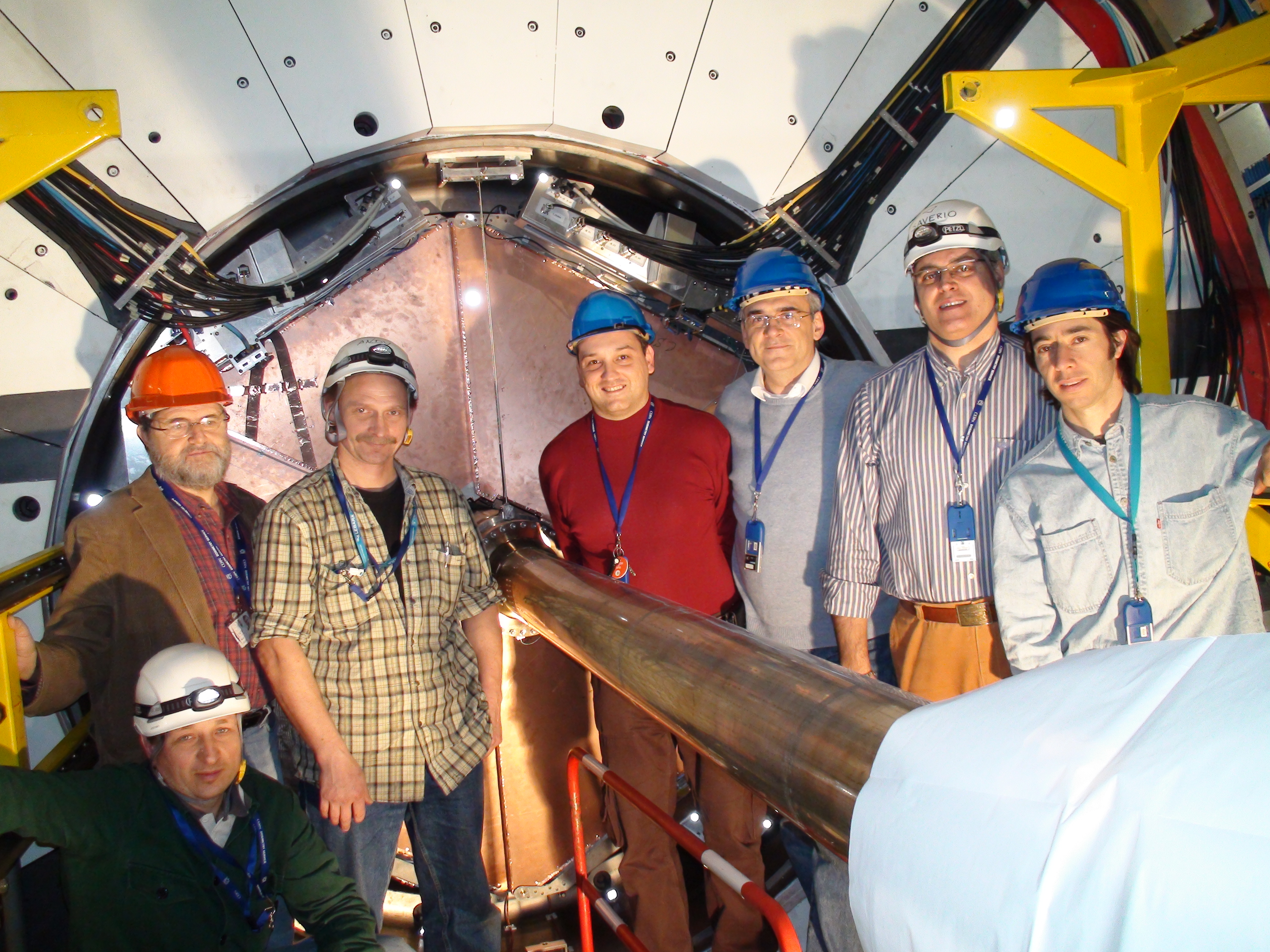
The Genova team who designed and built the detector in front of the '+' arm of the T1 telescope after final insertion. All the detector chambers were assembled at the Petersburg Nuclear Physics Institute, Gatchina, Russia. Major contributions to the construction of the support structure and the installation process came from CERN.
“Installing the T1 detector was an important milestone for TOTEM,” says Joachim Baechler, Technical Coordinator for TOTEM. Enrico Robutti from Genova, responsible for the T1 project, added: "The T1 detector was carefully installed into the end-caps of the CMS experiment over the technical stop – a delicate operation that required the CMS detector to be opened. After the successful installation, we have now begun taking calibration data in preparation for the special runs during 2011/12."
Also the Roman Pot project has now been completed with the installation of 12 additional detector packages at a distance of 147m from the interaction point. "This was an extremely delicate operation as, during data taking, the sensors in these installations will approach the LHC beam centre within a few millimeters, and therefore their alignment has to be precise on the level of better than 100 microns. All services have been installed and tested and the detectors are now running to our satisfaction," says Gennaro Ruggiero, the Roman Pot project leader.
Installation of one of the T1 support trusses inside the CMS endcap ('–' side).
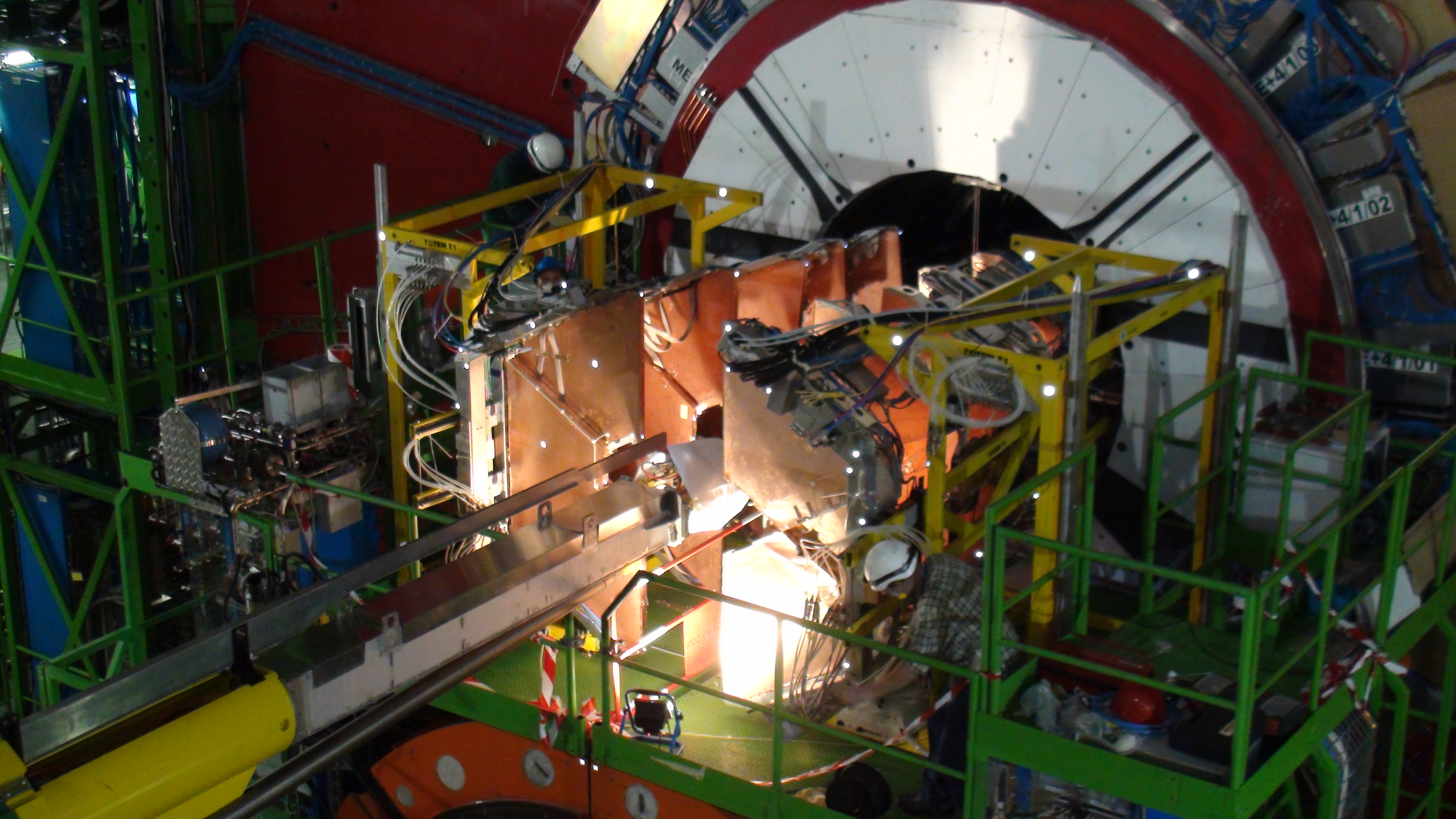
The two half-arms under test on the installation platform, before insertion ('+' side).
The particle detectors T1 together with the previously installed T2 surround the LHC pipe, providing a 360 view of the charged particles emerging from pp collisions with a greatly enhanced coverage in the forward directions. While the team had been able to measure proton scattering with the previous installation, the addition of T1 completes the TOTEM experiment. The completion will allow TOTEM to take precise measurements of the proton-proton interaction cross-sections, as well as detailed studies of elastic and diffractive pp scattering. For this, TOTEM has to use dedicated runs at low luminosities with a reduced pile-up of events, but also to allow the Roman Pot detectors to approach the beam to the smallest possible distances.
The TOTEM collaboration expects an exciting year in 2011.
Other (French)
C’est pendant l’arrêt technique hivernal que l’installation de l’expérience TOTEM s’est achevée. Après huit ans de mise au point, le détecteur T1 a été installé avec succès à l’intérieur de CMS, de chaque côté du point d’interaction. Ce nouveau détecteur vient s’ajouter au téléscope inélastique T2 et aux pots romains (placés à 147 et 220 m de ce même point), dans le but d’étudier la diffusion élastique et inélastique des protons.
L'équipe Genova qui a conçu et construit le détecteur devant le bras « + » du télescope T1 après l'insertion définitive. Toutes les chambres du détecteur ont été assemblées à l'Institut de Physique nucléaire de Saint-Pétersbourg, à Gatchina en Russie. Les principales contributions pour la construction de la structure de support et le processus d'installation viennent du CERN.
« L’installation du détecteur T1 représente une étape importante pour TOTEM », a déclaré Joachim Baechler, coordinateur technique de l’expérience. Enrico Robutti de Genova, responsable du projet T1, ajoute que « Le nouveau détecteur T1 a été installé avec soin à l’intérieur des bouchons de l’expérience CMS pendant l’arrêt technique (opération délicate qui a nécessité l’ouverture du détecteur CMS). L’installation ayant été un succès, nous avons maintenant commencé à recueillir les données d’étalonnage en prévision des périodes d’exploitation spéciales en 2011 et 2012 ».
Par ailleurs, le projet de pots romains s’est également terminé avec l’installation de 12 ensembles de détecteurs, placés à 147 m du point d’interaction. « Cette opération s’est avérée extrêmement délicate car, lors de la phase d’acquisition de données, les capteurs de ces dispositifs devront s’approcher à quelques millimètres du centre du faisceau du LHC. Ces derniers doivent donc être alignés avec une précision de l’ordre de 100 microns. Tous les services ont été installés et testés, et les détecteurs fonctionnent à présent de manière satisfaisante », indique Gennaro Ruggiero, responsable du projet de pots romains.
Installation de l'une des fermes de soutien de T1 à l'intérieur du bouchon de CMS (côté « - »).
Le test des deux demi-bras sur la plate-forme d'installation, avant l'insertion (côté « + »).
Ensemble, les détecteurs T1 et T2 entourent le tube à vide du LHC, offrant ainsi une vue à 360° des particules chargées provenant des collisions proton-proton et une bien meilleure couverture des projections dans la région à petits angles. Nous pouvions déjà mesurer la diffusion des protons avec l’installation précédente, mais l’arrivée de T1 complète l’expérience TOTEM. Maintenant qu'elle est prête, cette dernière va permettre de mesurer avec précision la section efficace des interactions proton-proton, et d’étudier dans le détail la diffusion élastique et diffractive proton-proton. Pour cela, TOTEM doit non seulement recourir à des périodes d’exploitation spéciales à faible luminosité, avec un empilement d’événements réduit, mais aussi faire en sorte que les pots romains se rapprochent le plus possible du faisceau.
L’année 2011 promet d’être passionnante pour la collaboration TOTEM !
Files
DSC00688_1(1)_image.jpg
Files
(23.9 MB)
| Name | Size | Download all |
|---|---|---|
|
md5:9def52fb67600bc3529bf68233f45cb2
|
3.6 MB | Preview Download |
|
md5:9def52fb67600bc3529bf68233f45cb2
|
3.6 MB | Preview Download |
|
md5:53cfbf33c6e3120dfc3e826cfecb9bf7
|
4.4 MB | Preview Download |
|
md5:6ea498c019db81413c086d591341728b
|
2.3 MB | Preview Download |
|
md5:6ea498c019db81413c086d591341728b
|
2.3 MB | Preview Download |
|
md5:32c641fadc24c64ecfb48257437eae7c
|
3.0 MB | Preview Download |
|
md5:040556883399cf8f3edb0b1779e128ed
|
4.7 MB | Preview Download |
_image.jpg?download=1)
_image.jpg?download=1)
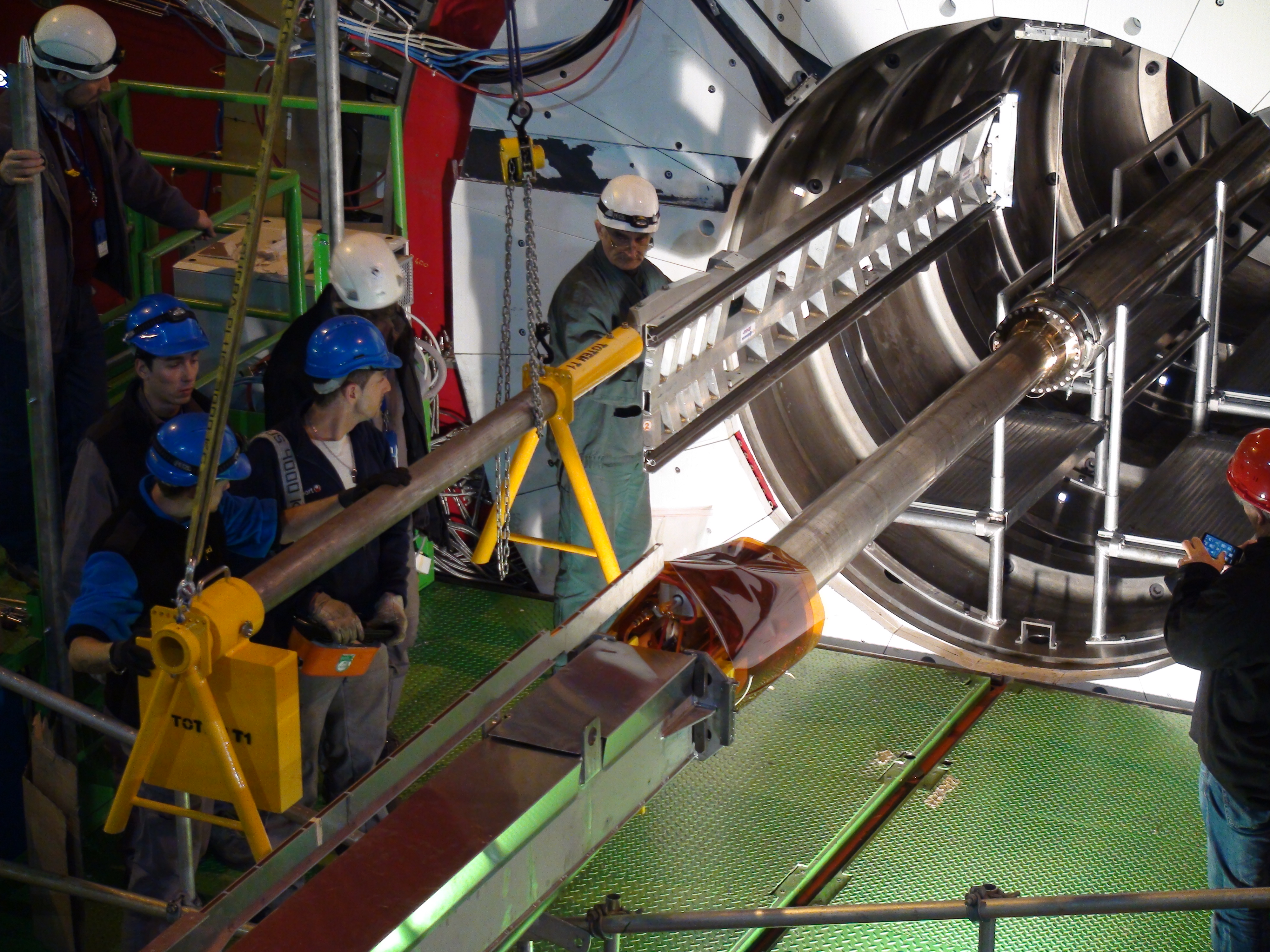
_image.jpg?download=1)
_image.jpg?download=1)
Additional details
Identifiers
- CDS
- 1339904
- CDS Report Number
- BUL-NA-2011-083
Related works
- Is published in
- Periodical issue: z5vy6-3m494 (CDS)
- Periodical issue: 503zj-a3824 (CDS)