ALICE presents its first award to Industry
Authors/Creators
Description
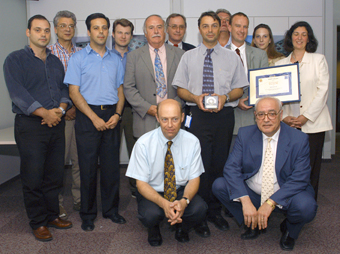
On 19 June, a French company received the first ALICE award to industry. ST Technologies has provided ALICE with a key device for the design of a very sophisticated chip for the readout of the ALICE Time Projection Chamber.
Behind from left to right (Derrière de gauche à droite): Bernardo Mota, member of the ALTRO design team, Jurgen Schukraft, ALICE Spokesperson, Luciano Musa, leader of the ALTRO Design Team and Coordinator of the ALICE TPC FEE, Roberto Camapagnolo, member of the ALICE TPC FEE team, Jean-Pierre Coffin, Deputy of the ALICE Collaboration Board Chairman, Hans de Groot ALICE Resource Coordinator, Laurent Degoujon, ST - Data Converter Design Manager, Claude Engster, member of the ALICE TPC FEE team, Alain Delpi, ST - Data Converter Business Unit Manager, Carmen Gonzalez, member of the ALICE TPC FEE team, Yiota Foka, ALICE Outreach Coordinator; Front: Fabio Formenti , EP-ED Group Leader, Juan Antonio Rubio, ETT Division Leader
The ALICE experiment is setting new demands on readout electronics in terms of resolution, density and power consumption. These requirements are beyond the present capability of commercial-off-the-shelf components and call for Application Specific Integrated Circuits (ASICs) that embed in a single chip the circuits to digitise, process, compress and store the information of a large number of channels. ALTRO (ALICE TPC Read Out), the chip produced by ST Technologies and the ALICE collaboration for the Time Projection Chamber, meets this challenge perfectly. This is why the firm based in Grenoble, France, received the first ALICE award, on 19 June during the ALICE week at CERN.
ST Technologies made available to the ALICE collaboration the design of one of its most advanced circuits (TSA1001). This was integrated into the ALTRO chip designed by the CERN EP-ED group.
The ALICE experiment aims to recreate and study quark gluon plasma - a state of matter that should have existed about 15 billion years ago - by smashing lead ions together at high energies at the LHC. As with the other LHC experiments, to digest the wealth of information produced, ALICE has to push data handling and processing technologies well beyond the current state-of-the art. In particular, ALICE has to operate efficiently in two widely differing running modes: the proton-proton mode with very frequent but quite small events, with few particles produced, and the heavy-ion mode with relatively low rate, but extremely large events, with tens of thousands of particles produced.
The chips are located in the Time Projection Chamber (TPC). This is the main tracking detector in ALICE's central barrel and the TPC readout chambers are specially designed for the high track density that will occur at the LHC. The readout pads closest to the beam interaction region have been minimised (7x4.5 mm2) to the point that a signal is just visible above electronic noise (S/N>20), requiring carefully designed electronics to reduce the noise. The signals from the pads pass to 4356 front-end cards 10 cm away from the pads. In the front-end card a custom-made charge-sensitive amplifier transforms the charge induced in the pads into a signal that is fed to the input of the ALTRO chip.
The development of the ALTRO chip is the result of the joint effort of several ALICE teams from CERN, GSI, the University of Heidelberg (Germany) and the University of Lund (Sweden). The first sample chips for testing were delivered by ST Technologies at the end of February 2002. All the tests showed that the chip meets design specifications and a production yield of 84%. In September 2002 full production started and all 40 000 chips needed were delivered in December 2002 for testing in 2003 by Lund University. Due to its versatility and excellent performance, the ALTRO chip is being considered for two other parts of the ALICE detector, the Forward Multiplicity Detector (FMD) and the PHOton Spectrometer (PHOS), as well as for an upgrade of the TPC in the STAR experiment at Brookhaven.
Other (French)
La collaboration ALICE a décerné son premier Prix des fournisseurs, le 19 juin dernier. L'entreprise française ST Technologies était récompensée pour avoir fourni à ALICE un élément clé pour la conception d'une puce très sophistiquée, destinée à la chambre à projection temporelle d'ALICE
Behind from left to right (Derrière de gauche à droite): Bernardo Mota, member of the ALTRO design team, Jurgen Schukraft, ALICE Spokesperson, Luciano Musa, leader of the ALTRO Design Team and Coordinator of the ALICE TPC FEE, Roberto Camapagnolo, member of the ALICE TPC FEE team, Jean-Pierre Coffin, Deputy of the ALICE Collaboration Board Chairman, Hans de Groot, ALICE Resource Coordinator, Laurent Degoujon, ST - Data Converter Design Manager, Claude Engster, member of the ALICE TPC FEE team, Alain Delpi, ST - Data Converter Business Unit Manager, Carmen Gonzalez, member of the ALICE TPC FEE team, Yiota Foka, ALICE Outreach Coordinator; Front (Devant): Fabio Formenti , EP-ED Group Leader, Juan Antonio Rubio, ETT Division Leader
L'expérience ALICE impose à l'électronique de lecture de nouvelles exigences en termes de résolution, de densité et de consommation d'énergie. Celles-ci dépassent les possibilités actuelles des composants commerciaux. Les «circuits intégrés aux applications spécifiques» (ASIC) doivent être capables de numériser, traiter, comprimer et stocker, dans une seule puce, les informations recueillies dans un grand nombre de voies. ALTRO (ALICE TPC Read Out), la puce produite par ST Technologies et la Collaboration ALICE pour la chambre à projection temporelle (TPC), a parfaitement relevé ce défi. C'est pourquoi, l'entreprise grenobloise (France) a reçu le premier Prix ALICE pour les fournisseurs le 19 juin dernier, lors de la Semaine ALICE. ST Technologies a mis à la disposition de la Collaboration ALICE la conception de l'un de ses circuits les plus avancés (TSA1001) en vue de son intégration dans une puce de haute technologie conçue par le Groupe EP-ED du CERN pour la chambre à projection temporelle.
L'expérience ALICE a pour objet de recréer et d'étudier le plasma quark-gluon - un état de la matière qui a probablement existé il y a une quinzaine de milliards d'années - en projetant dans le LHC des ions de plomb à haute énergie les uns contre les autres. Pour pouvoir assimiler l'énorme quantité d'informations produite, ALICE, comme les autres expériences du LHC, doit repousser les frontières des technologies du traitement des données. ALICE doit en particulier offrir un fonctionnement efficace dans deux modes d'exploitation très différents : le mode proton-proton avec des événements très fréquents mais très petits, produisant un faible nombre de particules, et le mode ions lourds avec des événements d'une fréquence relativement faible, mais très grands, produisant plusieurs dizaines de milliers de particules.
Les puces sont situées dans la chambre à projection temporelle (TPC). Celle-ci constitue le principal trajectographe du «tonneau» central d'ALICE et les chambres de lecture de la TPC sont spécialement conçues pour la densité des traces élevée que produira le LHC. Les dimensions des damiers de lecture les plus proches de la région d'interaction des faisceaux ont été réduites au minimum (7 x 4,5 mm2), jusqu'au niveau o un signal est à peine visible au-dessus du bruit de fond électronique (rapport signal/bruit > 20), ce qui nécessite une électronique soigneusement conçue pour réduire le bruit. Les signaux provenant des damiers traversent 4356 cartes frontales à 10 cm des damiers. Sur la carte frontale, un amplificateur de charge réalisé à la demande transforme la charge induite dans les damiers en un signal qui est introduit à l'entrée de la puce ALTRO.
Le développement de la puce ALTRO est le résultat des efforts des équipes du CERN, de l'Institut GSI, de l'Université d'Heidelberg (Allemagne) et de l'Université de Lund (Suède). Le premier lot de puces pour les tests a été livré par ST Technologies à la fin de février 2002. Tous les tests ont montré que la puce répondait aux spécifications nominales avec un rendement de production de 84%. En septembre 2002, la production à plein régime a commencé et l'ensemble des 40 000 puces requises a été livré en décembre 2002 pour des essais en 2003 à l'université de Lund. En raison de sa souplesse et de ses excellentes performances, la collaboration envisage actuellement d'utiliser la puce ALTRO dans deux autres parties du détecteur ALICE : le détecteur de multiplicité à petit angle (FMD) et le spectromètre à photons (PHOS), ainsi que pour une amélioration de la TPC de l'expérience STAR à Brookhaven.
Files
na-2003-091_0306046web.JPG
Files
(113.9 kB)
| Name | Size | Download all |
|---|---|---|
|
md5:d460727058da8d3cddf2a17cb0e0c3a0
|
113.9 kB | Preview Download |
Additional details
Identifiers
- CDS
- 630020
- CDS Report Number
- BUL-NA-2003-091
- Aleph number
- 000013398MMD
Related works
- References
- Other: 000013175 (Other)