Looking at CERN from a different perspective
Authors/Creators
Description
Although the vast majority of students at CERN study and work on projects in the physics, engineering or IT fields, there are some who come to use CERN as a subject to complement their research in other fields. Larissa Kuchina, a graphic design student, and Jérôme Wohlschlag, an architectural student, completed their degrees and their dissertations on unusual aspects of the Laboratory. Both offer valuable perspectives that are not necessarily the ones we usually encounter.
Top: Aerial vue of the CERN site in 1961 (CERN archive).
Bottom: Photo of the Master's project model.
Recently, Jérôme Wohlschlag featured CERN in his dissertation for his Master’s degree in architecture at the Ecole Polytechnique Fédérale de Lausanne. Developed with the help of Professor Franz Graf’s TSAM Laboratoire des Techniques et de la Sauveguard de L’Architecture Moderne, Jérôme’s project focused on the preservation and extension of CERN’s ‘Main Buildings’, which were designed and built in the late 1950s by major players in modern Swiss architecture. “Using Peter and Rudolf Steiger’s drawings of the first stages of construction, I was able to show that the site has great potential for rehabilitation,” he says. “The project revealed a previously unrecognized architectural heritage, and basing construction on these first stages allowed us to propose expansion that meets current architectural requirements.”
The CERN site, with its multi-flavoured buildings and unorthodox layout, can seem daunting. “At first, the site was a mysterious labyrinth to me,” explains Jérôme. “But as I started studying the history of its urban and architectural planning, it became more familiar and I was able to appreciate the quality of the original construction.” But becoming comfortable with the CERN site is often something that only comes after years of experience.
Larissa Kuchina, however, has provided a possible solution to this problem with a diploma project to complete her Bachelor’s degree at the Geneva University of Art and Design. Using fundamental particles – the smallest entities in the Universe – as a starting point, she has proposed ‘CERN. Signage and Identity’, a new system to both establish identity at CERN and help navigate the confusing maze of workshops, experiments and administrative buildings on the site.
“In graphic design, the smallest entity is the visible point, so I decided to translate the particle into a point to make something invisible into something that is visible and more human,” she says. “It is the fundamental particles studied at CERN that create the structures we see all around us, so I designed a pattern comprising different-sized points as the basis for each graphical feature.” This pattern forms the background for each of the elements of the way-finding system that Larissa has proposed be erected around the Meyrin and Prévessin sites.
Each proposed element refers to a redesigned map that allows visitors and staff to locate buildings with greater ease. “I worked a lot on the CERN map, because it is essential to finding your way around at CERN,” Larissa explains. “I made it more legible and clear by dividing the Meyrin site into 5 different zones and by colour-coding these zones according to function.”
She also proposed an alternative to the ‘Black Line’ that guides visitors from the Reception to the Main Building – a ‘beam’ of small blue particles and arrows painted on the floor that keeps visitors on track between the two points.
Creativity is a common feature of many young students. Whatever their specific field of activity and whatever their professional future, they all have the potential to bring a fresh breeze of novelty to our Lab.
Other (French)
Si la plupart des étudiants présents au CERN se consaerent à des projets dans le domaine de la physique, de l’ingénierie ou des technologies de l’information, pour certains d’entre eux, le CERN est un sujet de recherche dans d’autres domaines. Pour obtenir leur diplôme, Larissa Kuchina, étudiante en graphisme, et Jérôme Wohlschlag, étudiant en architecture, qui ont soutenu leur projet dernièrement, se sont penchés sur des aspects méconnus du laboratoire. Tous deux offrent un point de vue intéressant sur l’Organisation, qui ne correspond pas nécessairement à l’idée que nous nous en faisons habituellement.
En haut : vue aérienne prise en 1961, site du CERN (archive CERN).
En bas : photo de la maquette du projet de Master.
Étudiant à l’École polytechnique fédérale de Lausanne, Jérôme a consacré son mémoire de Master au CERN. Jérôme, dont le projet a été réalisé avec l’aide du laboratoire TSAM (Techniques et Sauvegarde de l’Architecture Moderne) dirigé par le Professeur Franz Graf, s’est intéressé à l’entretien et à l’extension des bâtiments principaux du CERN, qui ont été conçus et construits à la fin des années 1950 par les figures de proue de l’architecture suisse moderne. « À partir des dessins de Rudolf Steiger sur les premières étapes de la construction, je suis parvenu à montrer que le site se prêtait particulièrement bien à la réhabilitation, explique-t-il. Le projet a révélé un héritage architectural jusqu’à présent inconnu. De plus, en fondant notre démarche sur les premières étapes de la construction, nous avons pu mettre au point un projet d’extension conforme aux exigences de l’architecture d’aujourd’hui. »
Le domaine du CERN, avec ses bâtiments hétéroclites et son agencement peu orthodoxe, peut sembler intimidant. « Au départ, le domaine était pour moi un labyrinthe mystérieux, explique Jérôme. Mais en commençant à étudier l’histoire de sa planification urbaine et architecturale, je m’y suis habitué, et j’ai pu apprécier la qualité de la construction d’origine. » Néanmoins, il faut souvent du temps pour se familiariser avec le site du CERN.
Larissa Kuchina a présenté, dans le cadre de son bachelor à la Haute école d’art et de design de Genève, un projet qui apporte une possibilité de réponse au problème. En partant de l’idée que les particules fondamentales sont les plus petites entités de l’Univers, elle a élaboré le projet « CERN. Signalétique et identité du lieu », un nouveau système en parfaite adéquation avec l’identité du CERN, qui permet de se repérer dans le dédale d’ateliers, d’expériences et de bâtiments administratifs.
« En graphisme, la plus petite entité est le point visible, j’ai donc décidé de faire de la particule un point pour rendre visible et plus humain quelque chose d’invisible, explique-t-elle. Ce sont les particules fondamentales étudiées au CERN qui sont à l’origine des structures qui nous entourent ; j’ai donc conçu un motif composé de points de différentes tailles comme élément de base pour chaque élément graphique. » Ce motif sert à former l’arrière-plan de chacun des éléments du système de repérage que Larissa a proposé de faire ériger sur les sites de Meyrin et Prévessin.
Chacun de ces éléments renvoie à une nouvelle carte qui permet aux visiteurs de trouver les bâtiments plus facilement. « J’ai beaucoup travaillé sur le plan du CERN, car il est indispensable pour trouver son chemin, explique Larissa. Je l’ai rendu plus lisible et plus clair en divisant Meyrin en cinq zones et en adoptant un code de couleur pour celles-ci suivant leur fonction. » Elle a également proposé de remplacer la ligne noire qui guide les visiteurs de la réception au bâtiment principal par un « faisceau » de petites particules bleues et de flèches peintes sur le sol permettant aux visiteurs de ne pas se perdre en chemin.
La créativité est une qualité partagée par de nombreux étudiants. Quels que soient leur domaine de spécialité et le métier auquel ils se destinent, tous ont le potentiel de faire souffler un vent de fraîcheur sur notre Laboratoire en y apportant de nouvelles idées.
Files
bluebeam_image.jpg
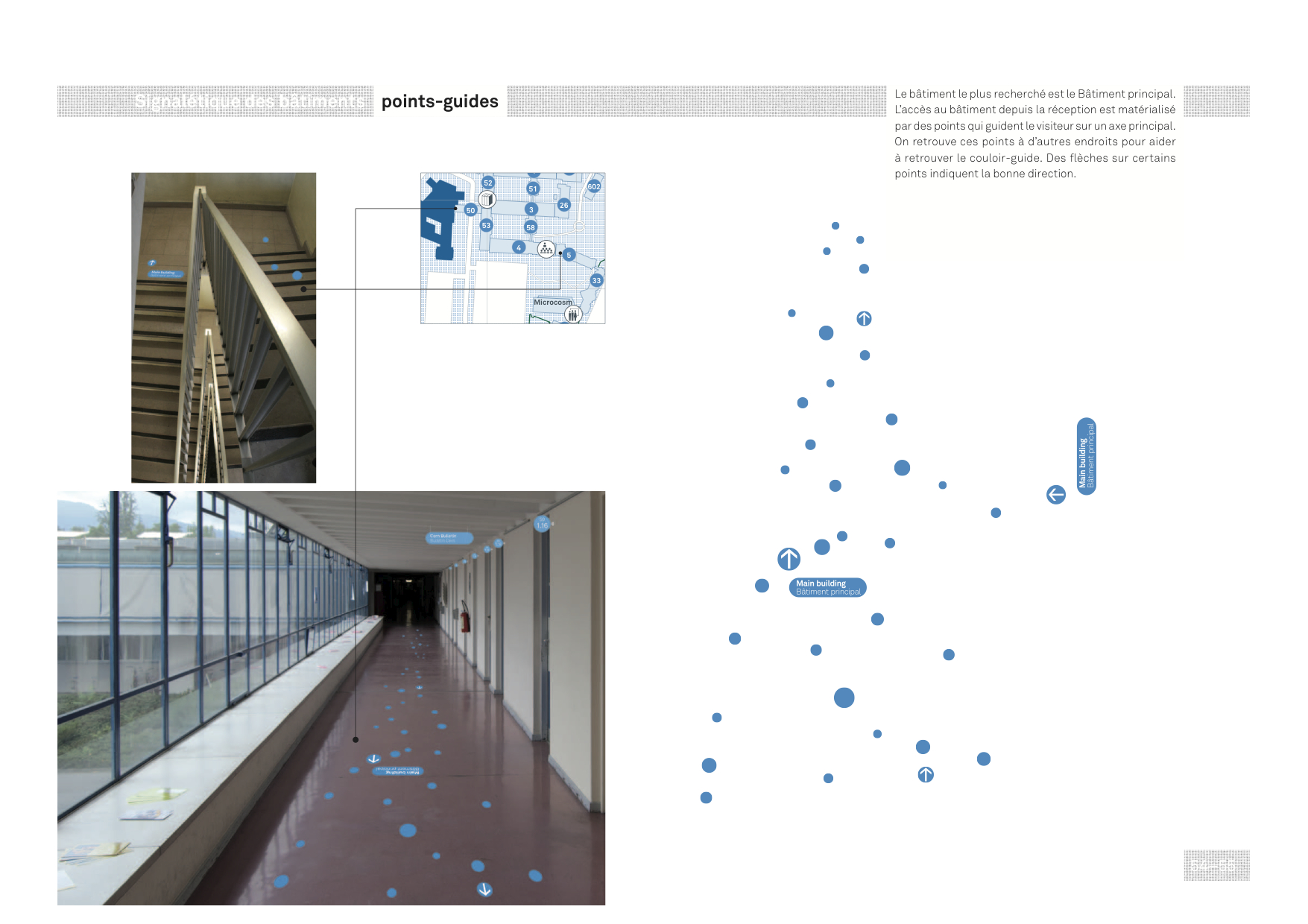
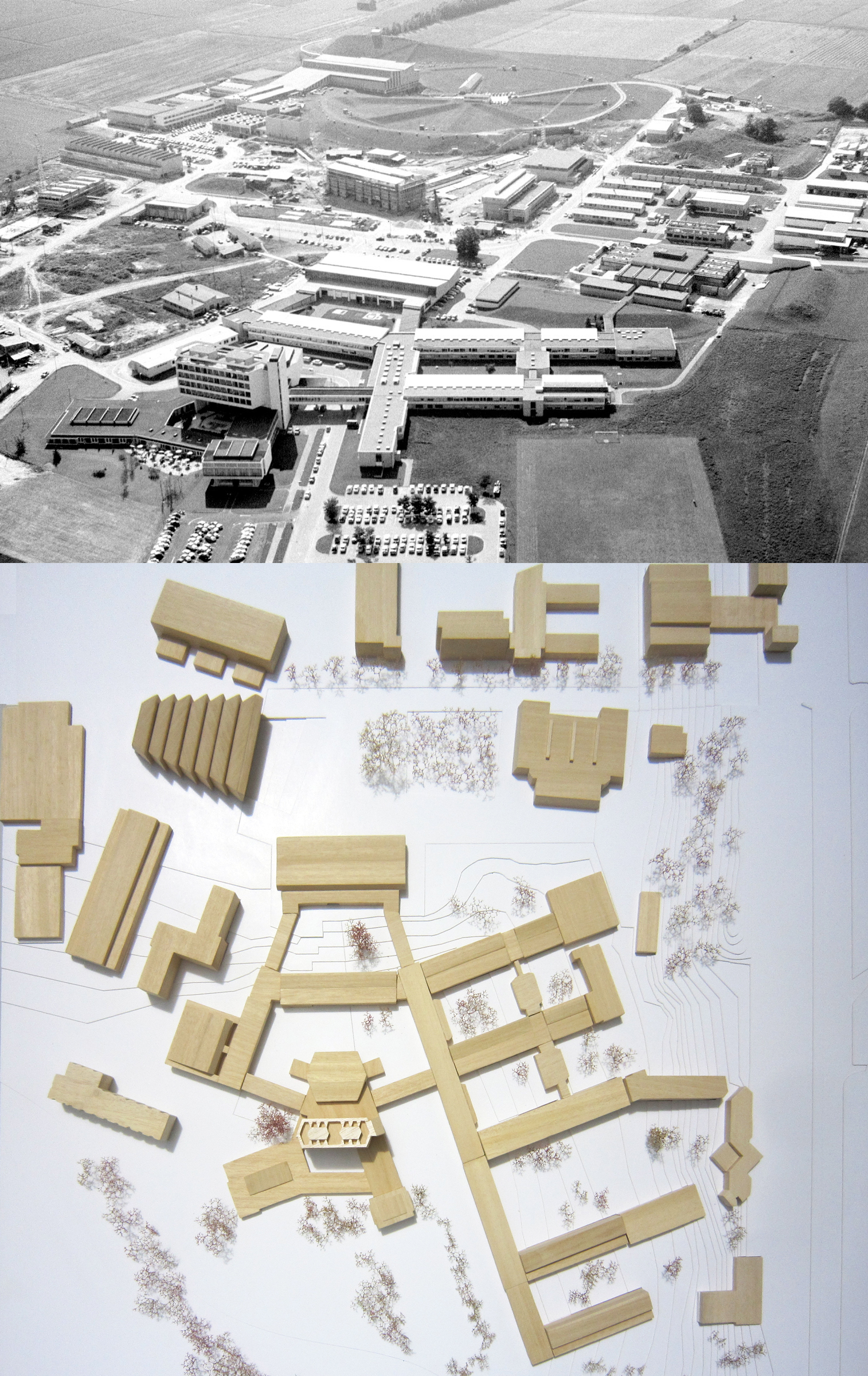
_image.jpg?download=1)
Additional details
Identifiers
- CDS
- 1368920
- CDS Report Number
- BUL-NA-2011-192
Related works
- Is published in
- Periodical issue: dpg0m-te662 (CDS)
- Periodical issue: bbtf8-5qa37 (CDS)