Go on a particle quest at the first CERN webfest
Authors/Creators
Description
From 3 to 5 August, CERN played host to its very first webfest. Organised by the Citizen Cyberscience Centre (CCC) and the Peer 2 Peer University, the 2012 CERN Webfest saw pizza-fuelled summer students hacking their way almost non-stop through an entire weekend to produce a host of weird and wonderful innovations. As each of the teams raced against time in the hope of winning the grand prize of a trip to the Mozilla festival in London, sleep was hard for the students to come by, but fortunately great ideas were not.
Projects dreamt up by the students included a browser-based dashboard for the Large Hadron Collider (LHC), a new CERN open-data initiative, and a virtual world for the LHC@home platform. However, the highlight of the event was the ParticleQuest game, which was selected by a panel of judges as the weekend’s overall winning project. The ParticleQuest team members selected Alejandro Avilés to go to the Mozilla Festival in London in November. Congratulations, Alejandro!
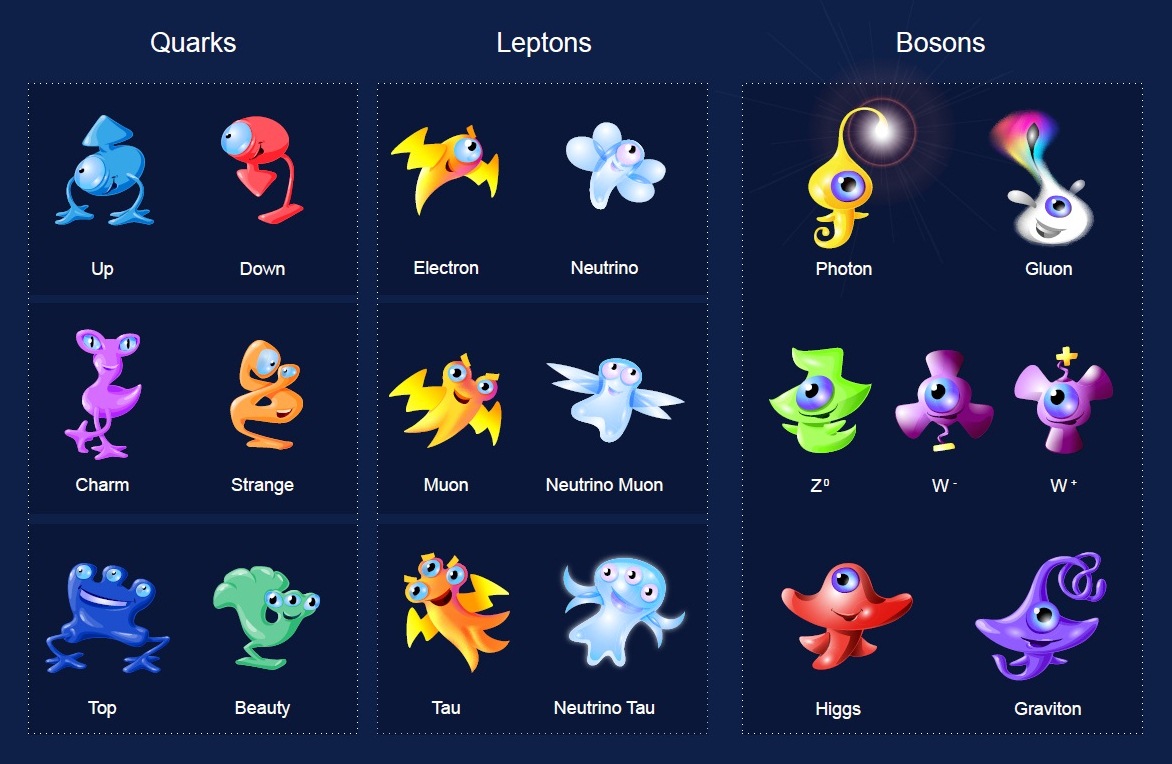
ParticleQuest, which can be played online here, is a hack of Mozilla’s new open-source game BrowserQuest. In the current version of the game, which was modified after the event, players have to help find the Higgs boson among a croweded zoo of particles. The game’s main aim is to educate. Each of the particles have had charming sprites created for them by graphic designer André-Pierre Olivier and when you encounter them in the game they’ll even tell you a little bit about themselves. “These beautiful graphics were the real inspiration behind the project,” explains Alejandro Avilés, who goes by the pseudonym ‘OmeGak’ online. “Each of the designs reflects the actual behaviour of the particle represented – it’s really amazing.”
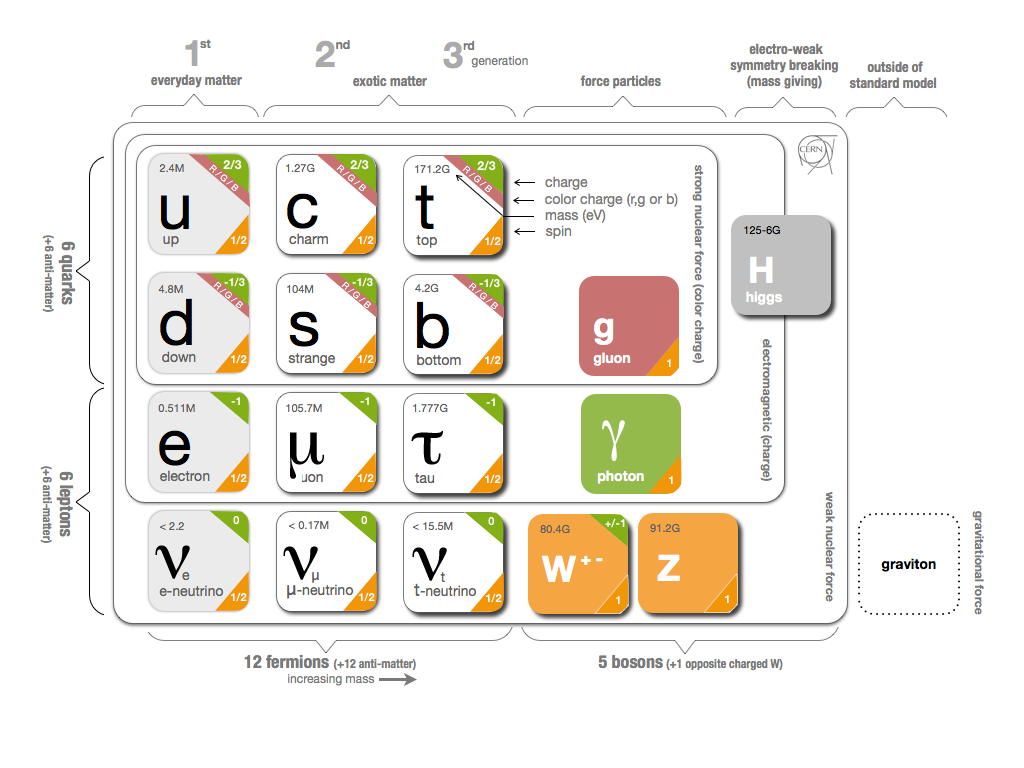
Other highlights from the weekend include an Android-based cosmic ray detector, which you can read about in detail here, and an attempt to create a standard infographic for the Standard Model (pictured right). This project was inspired by the announcement of the discovery of a particle consistent with the Higgs boson on 4 July. However, the project went much further than simply adding a slot for the Higgs boson to the usual representations of the Standard Model. Instead, the group sought to make their infographic as informative as possible, with additional information about each particle contained within each cell – along the lines of the periodic table of elements. Francesca Valery Day, one of the students who worked on this project explained that the team was aiming to “explain the Standard Model from the beginning in an intuitive order for someone who doesn’t know any maths or physics, in a way that’s fun and interactive”.
Of course, this being a webfest, the team weren’t satisfied with merely creating a brand-new infographic to revolutionise the way the most fundamental concepts in modern physics are taught. Rather, they went on to produce a suite of interactive Feynman diagrams, which can be accessed in a web browser and can also be used as a learning tool. “Feynman diagrams are a really great way of understanding the Standard Model without having to know any maths or any quantum mechanics,” explains Day. “You can literally see what’s going on.”
Francois Grey of the CCC, who helped to organise the event, said: “I was really impressed by the students' enthusiasm – many of them stayed up most of the night to get their hack done – and by the creativity they have shown… I mean, we’re talking about some of them doing browser-based Feynman diagrams, I’m sure no one’s even dreamed of doing that kind of thing before.”
The CERN Webfest was sponsored by the Mozilla Foundation and the Shuttleworth Foundation. The source code used for all of the projects has also been made available on GitHub, so work can continue and new contributors can join in the fun.
The original version of this article was published on iSGTW.
Other (French)
Du 3 au 5 août, le CERN a accueilli son tout premier webfest. Organisé par le Citizen Cyberscience Centre (CCC) et la Peer 2 Peer University, la manifestation (CERN Webfest 2012) a réuni l’espace d’un week-end une ribambelle d’étudiants d'été déterminés à relever le défi pour produire à un rythme effréné une foule d'innovations aussi étranges que merveilleuses. Chaque équipe étant engagée dans une course contre la montre dans l’espoir de remporter le premier prix (un voyage gratuit pour participer au festival Mozilla, à Londres), les étudiants n’ont pas beaucoup dormi, ce qui, heureusement, ne les a pas empêchés d’avoir de brillantes idées.
Au rang des projets imaginés, un tableau de bord basé sur un navigateur web pour le Grand collisionneur de hadrons (LHC), un nouveau projet de données ouvertes CERN et un monde virtuel pour la plate-forme LHC@home. Le temps fort du week-end a toutefois été le jeu ParticleQuest, désigné grand vainqueur par le jury. Les membres de l’équipe ParticleQuest ont choisi Alejandro Avilés pour aller au festival Mozilla, en novembre. Félicitations Alejandro !
ParticleQuest (disponible en ligne ici) est un hack du nouveau jeu open source BrowserQuest de Mozilla. Dans la version actuelle du jeu, qui a été modifiée après l’événement, les joueurs doivent trouver le boson de Higgs dans un zoo rempli de particules. Le jeu a un but éducatif. Chaque particule est représentée par un petit lutin, créé par le graphiste André-Pierre Olivier. Chaque fois que vous rencontrez l’un de ces personnages pendant le jeu, il vous parle un peu de lui. « Ces superbes images graphiques ont été la véritable source d’inspiration du projet, explique Alejandro Avilés qui, en ligne, se fait appeler OmeGak. Chaque personnage a été conçu de manière à illustrer le comportement de la particule qu’il représente. C’est vraiment incroyable. »
Parmi les autres trouvailles du week-end, citons un détecteur de rayons cosmiques sur Android (tous les détails ici), et un dispositif expérimental permettant de créer des images graphiques pour le Modèle standard (voir image ci-contre). À l’origine du projet : l’annonce, le 4 juillet, de la découverte d’une particule aux caractéristiques compatibles avec celles du boson de Higgs. Ne se contentant pas de trouver une place au boson de Higgs dans les représentations usuelles du Modèle standard, le groupe s’est efforcé de rendre leurs images aussi instructives que possible en donnant des informations supplémentaires sur chaque particule contenue dans chaque case, comme dans le tableau de classification périodique des éléments. Francesca Valery Day, l’une des étudiantes qui a travaillé sur le projet, souligne que, dès le début, l'objectif de l'équipe était « d’expliquer le Modèle standard de manière intuitive, amusante et interactive à quelqu’un qui n’a pas forcément de connaissances en mathématiques ou en physique. »
Comme il s’agissait d'un webfest, l'équipe ne pouvait biensûr se contenter de créer une infographie nouvelle pour révolutionner la manière dont les notions les plus fondamentales de la physique moderne sont enseignées. Elle est donc allée plus loin en élaborant une suite de diagrammes de Feynman interactifs, accessibles depuis un navigateur web et pouvant servir également d’outils pédagogiques. « Les diagrammes de Feynman sont un outil formidable pour comprendre le Modèle standard sans avoir besoin de compétences particulières en mathématiques ou en mécanique quantique, poursuit Francesca. On voit littéralement ce qui se passe. »
François Grey (du CCC), qui a participé à l'organisation de la manifestation, a déclaré : « J’ai été très impressionné par l’enthousiasme des étudiants - nombre d’entre eux sont restés debout pratiquement toute la nuit pour terminer leur projet – et aussi par leur créativité… Rendez-vous compte, des diagrammes de Feynman basés sur un navigateur web ! Je suis certain que personne avant eux n’avait eu une telle idée. »
Le webfest du CERN a été parrainé par la Mozilla Foundation et la Shuttleworth Foundation. Le code source utilisé pour tous les projets a été mis à disposition sur GitHub. Les travaux peuvent donc se poursuivre et de nouveaux contributeurs se joindre à la fête.
La version originale de cet article a été publiée sur iSGTW.
Files
ParticleQuestSprites_image.jpeg
Files
(362.4 kB)
| Name | Size | Download all |
|---|---|---|
|
md5:222822d6b0656136a1e30766723735a2
|
180.6 kB | Preview Download |
|
md5:0e2da30cce62779b28757742b1d9566f
|
181.8 kB | Preview Download |
Additional details
Identifiers
- CDS
- 1473657
- CDS Report Number
- BUL-NA-2012-269
Related works
- Is published in
- Periodical issue: crp51-fes88 (CDS)
- Periodical issue: xyppc-bgf53 (CDS)