Ten years for the public Web
Authors/Creators
Description
Ten years ago, CERN issued a statement declaring that a little known piece of software called the World Wide Web was in the public domain. Nowadays, the Web is an indispensable part of modern communications.
The idea for the Web goes back to March 1989 when CERN Computer scientist Tim Berners-Lee wrote a proposal for a 'Distributed Information Management System' for the high-energy physics community. The Web was originaly conceived and developed to meet the demand for information sharing between scientists working all over the world. There were many obstacles in the 1980s to the effective exchange of information. There was, for example a great variety of computer and network systems, with hardly any common features. The main purpose of the web was to allow scientists to access information from any source in a consistent and simple way.
By Christmas 1990, Berners-Lee's idea had become the World Wide Web, with its first server and browser running at CERN. Through 1991, the Web spread to other particle physics laboratories around the World.
Computer programmers started to develop ever more sophisticated browsers, but they were mostly confined to the computer systems used by scientists. With CERN's statement in April 1993, it was only a matter of time before browsers that were easy to install and that would work on home computers made an appearance. By November that year, the US National Center for Supercomputing Applications had released Mosaic, the browser that first brought the Web to the public eye.
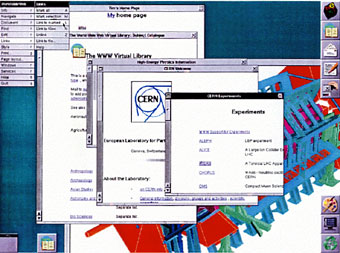
A screenshot using the original browser from CERN.
In the early 1990s, the Web was one of several systems being developed to make the Internet easy to use. That it succeeded where others failed is due to many factors. CERN, with its strong history in computer networking, its global collaborations of computer-literate scientists, and its university-like atmosphere of intellectual openness, provided fertile ground for Tim Berners-Lee's idea to grow. Marrying hypertext to the Internet gave the Web its simple ease of use. The fact that CERN had the foresight to ensure that the Web became part of the public domain, was decisive in the development and success of the Web.
In the words of the inventor himself, «CERN's decision to make the Web foundations and protocols available on a royalty free basis, and without additional impediments, was crucial to the Web's existence. Without this commitment, the enormous individual and corporate investment in Web technology simply would never have happened, and we wouldn't have the Web today.»
For more information go to:
http://info.web.cern.ch/info/Announcements/CERN/2003/04-30TenYearsWWW/
Other (French)
Il y a dix ans, le 30 avril 1993, le CERN publia un communiqué annonçant qu'une petite partie d'un logiciel appelé le World Wide Web entrait dans le domaine public. Aujourd'hui, le Web est devenu un outil de communication moderne indispensable.
L'idée du Web remonte à mars 1989 lorsqu'un informaticien du CERN, Tim Berners-Lee, proposa un "système de gestion décentralisée de l'information" destiné à la communauté des physiciens des hautes énergies. Le Web fut en effet conçu à l'origine pour répondre aux besoins des physiciens éparpillés aux quatre coins du globe d'échanger des informations. Dans les années 80, ces échanges rencontraient de nombreux obstacles tels que l'incompatibilité entre les systèmes informatiques existants. Il fallait trouver un moyen d'accès facile et efficace aux informations, quelque soit l'endroit où elles étaient stockées.
Avant Noël 1990, l'idée de Tim Berners-Lee était devenue le World Wide Web, avec son premier serveur et navigateur, fonctionnant alors uniquement au CERN. Au cours de l'année 1991, la toile du Web s'étendait déjà pour relier plusieurs autres laboratoires dans le monde.
Les programmeurs en informatique commencèrent à développer des navigateurs de plus en plus sophistiqués, mais ils restaient à l'usage des scientifiques. A la suite de la déclaration du CERN d'avril 1993, se développèrent des navigateurs de plus en plus faciles d'installation et fonctionnant sur les ordinateurs personnels. En novembre de cette même année, le National Center for Supercomputing Applications américain lança le navigateur Mosaic, le premier à rendre le Web accessible par le grand public.
Une capture d'écran utilisant le premier navigateur du CERN.
Au début des années 90, le Web faisait partie des nombreux systèmes développés pour faciliter l'utilisation de l'Internet. Son succès par rapport aux autres est dû à de nombreux facteurs. Le CERN, avec sa longue expérience des réseaux informatiques, ses collaborations mondiales de scientifiques utilisant l'informatique, son état d'esprit universitaire et son ouverture intellectuelle, offrit un terrain propice à l'éclosion de l'idée de Tim Berners-Lee. L'association de l'hypertext et de l'Internet fournit au Web son aisance d'utilisation. Et la clairvoyance du CERN qui assura son entrée dans le domaine public, au lieu d'en faire propriété d'une entreprise ou d'une personne, fut décisive. De l'avis même de son inventeur : «La décision du CERN de mettre à disposition les bases et protocoles du Web sans versement de redevances et sans aucune restriction a été déterminante pour l'existence du Web. Sans cet engagement, les efforts considérables consentis dans la technologie du Web par les individus et les entreprises n'auraient jamais été réalisés et nous n'aurions pas le Web aujourd'hui.»
Pour plus d'informations :
http://info.web.cern.ch/info/Announcements/CERN/2003/04-30TenYearsWWW/
Files
na-2003-047_NeXTScreen.jpg
Files
(33.5 kB)
| Name | Size | Download all |
|---|---|---|
|
md5:055f2aba12b0454857e75a2eb89153ab
|
33.5 kB | Preview Download |
Additional details
Identifiers
- CDS
- 46391
- CDS Report Number
- BUL-NA-2003-047
- Aleph number
- 000007873MMD
Related works
- Is referenced by
- Other: ADMBUL_0024684 (Other)