Machine Learning wins the Higgs Challenge
Authors/Creators
Description
The winner of the four-month-long Higgs Machine Learning Challenge, launched on 12 May, is Gábor Melis from Hungary, followed closely by Tim Salimans from the Netherlands and Pierre Courtiol from France. The challenge explored the potential of advanced machine learning methods to improve the significance of the Higgs discovery.
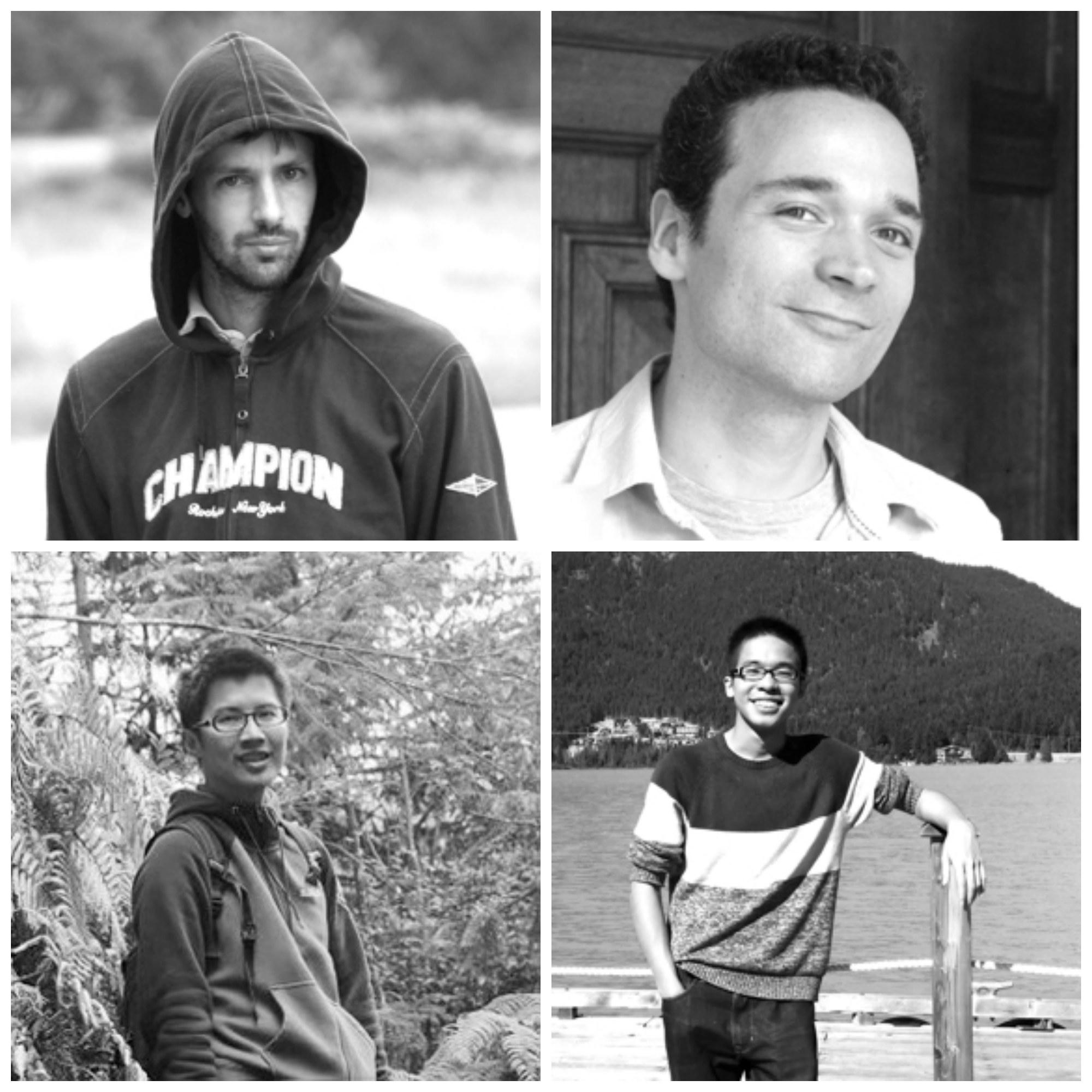
Winners of the Higgs Machine Learning Challenge: Gábor Melis and Tim Salimans (top row), Tianqi Chen and Tong He (bottom row).
Participants in the Higgs Machine Learning Challenge were tasked with developing an algorithm to improve the detection of Higgs boson signal events decaying into two tau particles in a sample of simulated ATLAS data* that contains few signal and a majority of non-Higgs boson “background” events. No knowledge of particle physics was required for the challenge but skills in machine learning - the training of computers to recognise patterns in data – were essential. The Challenge, hosted by Kaggle, had an all-time record of 1,785 teams participating.
“The huge success of the challenge shows the fascination that the discovery of the Higgs boson, including the statistical tools used for it, holds for the public,” says Andreas Hoecker, physics coordinator of the ATLAS experiment. "It also reveals that experimental particle physics, in spite of its sophistication, can learn a lot from machine learning science."
Winner Gábor Melis, a graduate in software engineering and mathematics, developed an algorithm that is an ensemble of deep neural networks trained on random subsets of data provided with very little feature engineering and no physics knowledge. Meanwhile, runner-up Tim Salimans, who has a PhD in Econometrics and works as a data science consultant, developed a solution he describes as a combination of a large number of boosted decision tree ensembles, with some tricks to improve statistical efficiency.
In addition to the main winners, the Special High Energy Physics meets Machine Learning Award has been presented to Tianqi Chen and Tong He of Team Crowwork. Though their score was 3.72 to Melis’ 3.81, a thorough scrutiny showed that Crowwork’s XG Boost algorithm was an excellent compromise between performance and simplicity, which could improve tools currently used in high-energy physics. The team has been invited to CERN next year for a workshop where they will discuss the application of machine learning techniques in high-energy physics.
* The simulated data used for the challenge will be made available on opendata.cern.ch for those who would like to test new ideas.
Other (French)
Le gagnant du défi intitulé Higgs Machine Learning Challenge (Apprentissage automatique et boson de Higgs), lancé le 12 mai pour une durée de quatre mois, est maintenant connu : il s’agit de Gábor Meli, de Hongrie. Tim Salimans, des Pays-Bas, et Pierre Courtiol, de France, complètent le podium. Le défi consistait à étudier les possibilités offertes par des méthodes d'apprentissage automatique évoluées pour améliorer le niveau de signification de la découverte de bosons de Higgs.
Gagnants du défi Higgs Machine Learning Challenge : Gábor Melis et Tim Salimans (en haut) et Tianqi Chen et Tong He (en bas).
Les participants au défi Higgs Machine Learning Challenge avaient pour mission d'élaborer un algorithme destiné à améliorer la détection de signaux correspondant à la désintégration de bosons de Higgs en deux particules tau, au moyen d'un échantillon de données d'ATLAS simulées* contenant peu de signaux et une majorité d'événements de bruit de fond non liés à des bosons de Higgs. Ce défi ne demandait aucune connaissance en physique des particules, mais il était essentiel de posséder des compétences dans le domaine de l’apprentissage automatique, en sachant entraîner des ordinateurs à reconnaître des motifs parmi des données. Le défi, organisé par le site Kaggle, a attiré cette année 1785 équipes, un record.
« L’énorme succès du défi montre que le public est fasciné par la découverte du boson de Higgs, y compris par les outils statistiques qui ont été utilisés à cette fin, fait observer Andreas Hoecker, coordinateur pour la physique de l’expérience ATLAS. Il montre aussi que la physique des particules expérimentale, malgré sa complexité, peut grandement tirer profit de l’apprentissage automatique. »
Gábor Melis, le gagnant, possède un diplôme en génie logiciel et en mathématiques. Il a mis au point un algorithme représentant un ensemble de réseaux neuronaux profonds entraînés sur des sous-ensembles aléatoires de données, faisant appel à un minimum d’ingénierie des caractéristiques (feature engineering) et ne demandant aucune connaissance en physique. Le candidat qui s’est classé deuxième, Tim Salimans, est titulaire d’un doctorat en économétrie et travaille comme consultant en science des données. Il a élaboré une solution qu’il décrit lui-même comme la combinaison de plusieurs ensembles d'arbres de décision boostés, comportant des astuces améliorant l'efficacité statistique.
À côté des récompenses principales, le prix Special High Energy Physics meets Machine Learning a été remis à Tianqi Chen et Tong He, de l’équipe Crowwork. Ces derniers ont obtenu moins de points que Gábor Melis (3,72 contre 3,81), mais un examen attentif a montré que l’algorithme qu’ils ont mis au point, appelé XG Boost, offre un excellent compromis entre performance et simplicité, et pourrait améliorer certains outils utilisés en physique des hautes énergies. L’équipe a été invitée au CERN l’année prochaine pour participer à un atelier consacré aux techniques d'apprentissage automatique utilisées en physique des hautes énergies.
* Celles et ceux qui souhaitent mettre à l'épreuve de nouvelles idées trouveront sur le site opendata.cern.ch les données simulées utilisées pour le défi.
Files
Higgs Machine_image.jpg
Files
(962.4 kB)
| Name | Size | Download all |
|---|---|---|
|
md5:f15bc368cf471fc143283759cbaa7795
|
962.4 kB | Preview Download |
Additional details
Identifiers
- CDS
- 1972036
- CDS Report Number
- BUL-NA-2014-265
Related works
- Is published in
- Periodical issue: ens22-j2j03 (CDS)
- Periodical issue: mx57f-ezm87 (CDS)