The PS Booster hits 40
Authors/Creators
Description
Many accelerators’ "round" birthdays are being celebrated at CERN these days – the PS turned 50 in 2009, the SPS was 35 in 2011, and this year it's the turn of the PS Booster to mark its 40th anniversary. Originally designed to accelerate 1013 protons to 800 MeV, it has far exceeded its initial design performance over the years.
Imagine the scene: a group of accelerator physicists staring expectantly at a monitor, when suddenly a shout of joy goes up as a signal flickers across the screen. Does that sound familiar? Well, turn the clock back 40 years (longer hair, wider trouser legs) and you have the situation at the PS Booster on 26 May 1972. On that day, beam was injected into the Booster for the first time. “It was a real buzz,” says Heribert Koziol, then Chairman of the Running-in Committee. “We were very happy – and also a little relieved – when the beam finally went all the way round.”
The machine, at that time run by the Synchrotron Injection Division under Giorgio Brianti and his deputy Helmut Reich, had the mission to increase the intensity that could be accelerated in the PS by a factor of 10. The Booster is still one of a kind today: four superimposed synchrotron rings, into which the beam from the Linac is successively injected. The four beams are then accelerated and eventually recombined after extraction before entering the PS.
Prior to construction of the Booster, protons were accelerated up to 50 MeV in the Linac and injected directly into the PS to be accelerated up to 26 GeV. Adding the Booster allowed an acceleration of up to 800 MeV before injection into the PS. At this higher energy, the PS accepted an order of magnitude more protons, thus enhancing its potential for experiments and for the machines it was supplying with protons.
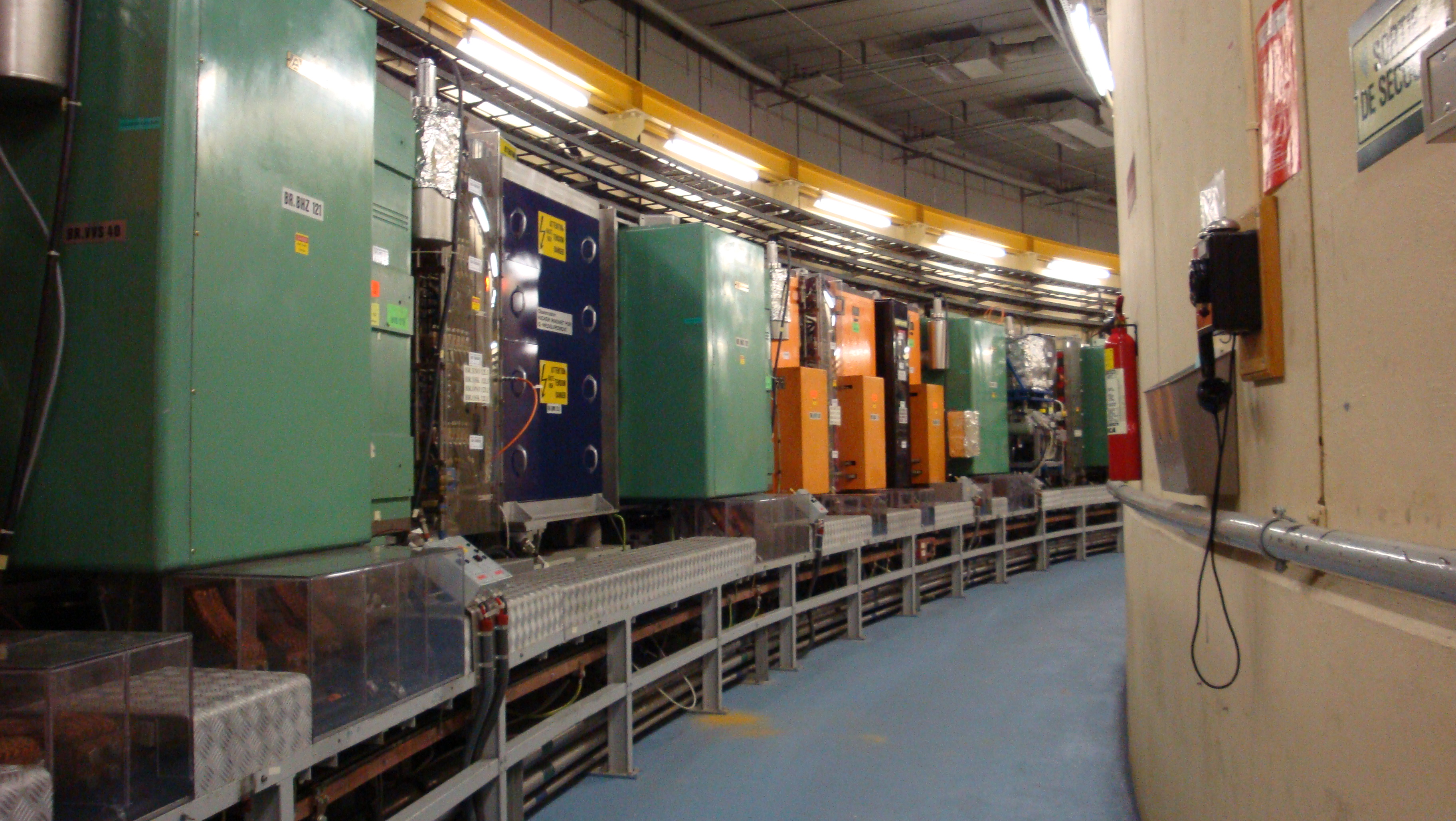
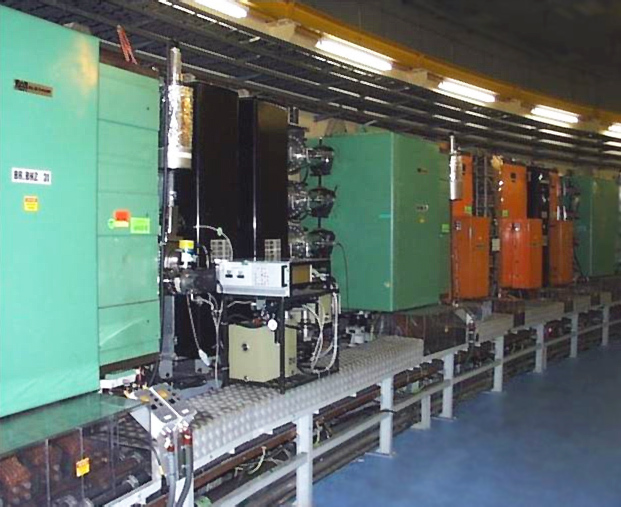
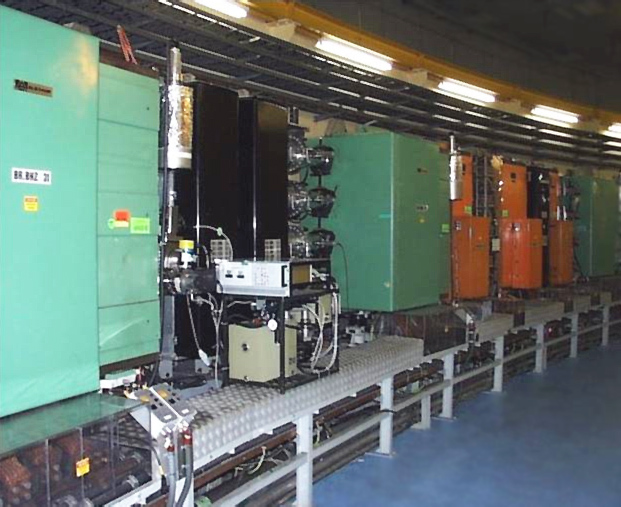
The PS Booster in 2012. The boxes around the 4 PS Booster rings (not visible) contain magnets: the green ones contain dipoles and the orange ones, quadrupoles.
“By 1974, we had reached the full design intensity of 1013 protons per pulse,” explains Karlheinz Schindl, part of the original team and who later went on to become the group leader responsible for the Booster and its preparation for the needs of the LHC.
The Booster has since gone from strength to strength as a result of successive upgrades, and by the 1980s it was operating at four times the original design intensity. It has also developed an incredible versatility, able to adapt the structure and quality of its proton beams to supply both its sole direct user, ISOLDE, and to pass the different beams to the PS for further exploitation by all other proton facilities at CERN, including the LHC. It has also learnt to accelerate all kinds of ions.
“The magnets are pretty much the only original components left,” explains Klaus Hanke, today responsible for Booster operation and upgrade. “And we are currently preparing for the next massive upgrade. Having taken the machine from 800 MeV to 1.0 GeV and then to 1.4 GeV in the past, we are now looking at increasing to 2 GeV. We plan for the Booster to run for the whole lifetime of the LHC.”
To mark the 40th anniversary, the PS Booster team is planning a colloquium in the autumn and an accompanying Courier article. In the meantime, we can all blow out a mental candle for the Booster and wish it every success until its next major anniversary.
Other (French)
Plusieurs accélérateurs du CERN ont fêté un anniversaire important dernièrement : 50 ans de bons et loyaux services pour le Synchrotron à protons (PS) en 2009 et 35 ans pour le SPS en 2011. Cette année, c’est au tour du Booster du PS (PSB) de célébrer son 40e anniversaire. Conçue à l’origine pour accélérer un faisceau de 1013 protons à une énergie de 800 MeV, la machine a largement dépassé sa performance nominale au fil des ans.
Imaginez plutôt : un groupe de physiciens des accélérateurs, les yeux rivés sur un écran de contrôle. Soudain, un signal lumineux traverse l’écran et c’est l’explosion de joie. Cette scène vous rappelle quelque chose ? Nous sommes le 26 mai 1972, les cheveux sont plus longs, les pantalons plus larges, et un faisceau est injecté dans le PSB pour la première fois. « L’effervescence était à son comble, se souvient Heribert Koziol, alors président du groupe chargé de la mise en marche du PSB. Nous étions tellement contents, et aussi un peu soulagés, de voir le faisceau accomplir son premier un tour. »
La machine, qui était alors placée sous la responsabilité de la Division Synchrotron injecteur, représentée par Giorgio Brianti et son adjoint Helmut Reich, avait pour mission de faire augmenter d’un facteur 10 l’intensité du faisceau injecté dans le PS. Aujourd’hui, le PSB est toujours unique en son genre : quatre anneaux synchrotron superposés, dans lesquels le faisceau du Linac est progressivement réparti. Les quatre faisceaux sont ensuite accélérés, puis recombinés après extraction avant d’être redirigés vers le PS.
Avant la construction du PSB, les protons étaient accélérés à une énergie de 50 MeV, puis injectés directement dans le PS où ils étaient accélérés à 26 GeV. La création du PSB a permis d’atteindre une accélération de 800 MeV avant l’injection dans le PS. Grâce à cette énergie plus élevée à l’injection, le PS pourrait dorénavant recevoir dix fois plus de protons et en faire profiter les expériences et les machines dépendantes de ses faisceaux.
« En 1974, nous avions atteint l’intensité nominale de 1013 protons par impulsion », souligne Karlheinz Schindl, membre de l’équipe d’origine, devenu par la suite responsable du groupe chargé de l’exploitation du PSB et de sa préparation pour les besoins du LHC.
Le PS Booster en 2012. Les caissons autour des 4 anneaux du PS Booster (non visibles) contiennent les aimants : les verts contiennent des dipôles, et les oranges, des quadrupôles.
Depuis lors, le PSB n’a fait que gagner en puissance au fil des améliorations successives, jusqu’à atteindre en 1980 une intensité quatre fois supérieure à son intensité nominale. Il est également devenu extrêmement polyvalent, adaptant la structure et la qualité de ses faisceaux de protons pour aussi bien alimenter ISOLDE, son unique utilisateur direct, que le PS, les faisceaux étant ensuite exploités par toutes les autres installations de protons du CERN, y compris le LHC. À présent, il est aussi capable d’accélérer tous les types d'ions.
« Les aimants sont à peu près tout ce qu'il reste de l’installation d’origine, indique Klaus Hanke, aujourd’hui responsable de l’exploitation et de l’amélioration du PSB. En ce moment, nous préparons la prochaine grande amélioration. Après avoir fait passer l’énergie de la machine de 800 MeV à 1 GeV, puis à 1,4 GeV, il s’agit d’atteindre un niveau de 2 GeV. Nous avons l’intention d’exploiter le PSB pendant toute la durée de vie du LHC. »
Pour marquer ce quarantième anniversaire, l’équipe du PSB prévoit d’organiser un colloque à l’automne et de publier un article dans le CERN Courier. En attendant, nous pouvons tous souffler une bougie imaginaire en l’honneur du PSB et lui souhaiter encore de belles réussites pour la décennie à venir.
Files
7602020_image.jpeg
Additional details
Identifiers
- CDS
- 1442604
- CDS Report Number
- BUL-NA-2012-138
Related works
- Is published in
- Periodical issue: 06pbh-gk208 (CDS)
- Periodical issue: kbctc-f7n21 (CDS)