LHC current leads go into production
Authors/Creators
Description
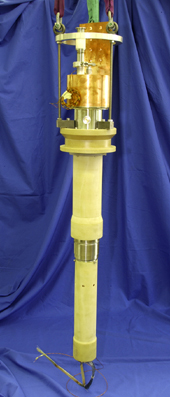
A 13 kA current lead, measuring 1.5 m in length. The lower part consists of a high-temperature superconductor (Bi-2223), operating at between 50 K and 4.5 K, while the heat-exchanger upper part allows the current to be brought from room temperature to 50 K.
The last tests on the pre-series current leads for the LHC magnets have been successfully completed and series production has just begun.
The series production of the superconducting current leads for the LHC magnets has just got under way. The research and development phase begun in 1996 was completed in mid-March 2004, when the last pre-series were successfully tested in Building SM18. These were the 600 amps current leads, which incorporate a high-temperature superconductor (HTS) in the form of Bi-2223 tape with a silver alloy sheath.
There are three types of current leads incorporating this material, with ratings of 13 000 A, 6 000 A and 600 A respectively. All in all, the LHC magnets will be supplied with 1.7 million amps of current, which will be conducted by 64 leads of the first type (13 000 A), 258 of the second (6000 A) and 708 of the third (600 A). This will require 30 km of HTS tape, whose production is already well in hand.
About 10 000 stacks, consisting of seven to nine tapes - 4 mm wide and 0.2 mm thick - will be soldered together at CERN, where they will undergo electrical tests at 77 kelvin before being sent to the manufacturers of the leads. The bulk of the production of the leads has been entrusted to an Italian company and to Russia's BINP (Budker Institute for Nuclear Physics). The remaining production will be done in the TS workshops at CERN, where the first two pre-series 13 kA leads and one 4 x 600 A lead assembly were made. 'The Technical Support Department developed reliable techniques to assemble these leads, including vacuum brazing, welding and surface treatment. This work is an excellent example of fruitful collaboration between the AT and the TS Departments,' says Dr. Amalia Ballarino (AT-MEL), project leader, in charge of the development, design and specification of all the LHC current leads.
'The use of high-temperature superconductor technology reduces the heat conducted into the cryogenic environment by a factor of ten and makes the current leads three times more efficient than classical leads,' she continues.
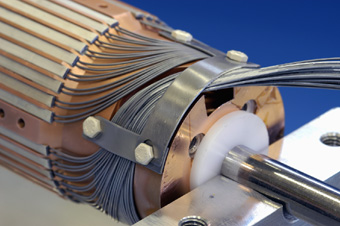
The high-temperature superconductor operates between 50 and 4.5 K. It is integrated in the lower section of the leads (see photo), the last few centimetres of which rest in the liquid helium. Bus-bars bring the current from there to the magnets operating at 1.9 K.
The upper part of the leads brings the current from room temperature to 50 K, by means of a heat exchanger cooled by helium gas at 5 to 20 K (widely available in the LHC cryogenic system).
The current passes from room temperature to 50 K via the heat exchanger, then to the 4.5 K helium-bath via the high-temperature superconductor, before reaching the low-temperature superconducting cable.
All the design work on the leads was done at CERN, taking account of the electrical and thermodynamic requirements and the size constraints imposed by the restricted space within the LHC tunnel. 'This approach has allowed us to achieve a considerable reduction in cost,' says Amalia Ballarino. 'Thanks to the experience we have acquired in the CERN workshops, I am confident about the series production now starting at BINP'.
A close-up of the lower part of a 13 kA current lead. The high-temperature superconductor (on the left in the photo) with the low-temperature superconductor (on the right). Resting in liquid helium, the low-temperature superconductor is connected to the bus-bars conveying the current to the LHC magnets.
Technical info
Cover articleOther (French)
Les pré-séries des amenées de courant, qui alimenteront les aimants du LHC, ont passé avec succès leur dernier test, permettant d'amorcer la production en série.
Other (French)
Une amenée de courant à 13 kA. La pièce mesure 1,5 m de longueur. Sa partie inférieure est composée d'un supraconducteur haute température (Bi-2223) qui fonctionne entre 50 K à 4,5 K. Sa partie supérieure, constituée d'un échangeur de chaleur, permet le passage de la température ambiante à 50 K.
Les pré-séries des amenées de courant, qui alimenteront les aimants du LHC, ont passé avec succès leur dernier test, permettant d'amorcer la production en série.
C'est parti ! La production en série des amenées de courant supraconductrices des aimants du LHC a commencé depuis peu. La phase de recherche et développement, commencée en 1996, s'est achevée mi-mars, lorsque les dernières pré-séries ont été testées, avec succès, dans le bâtiment SM18. Il s'agissait de la pré-série des amenées à 600 ampères, comprenant un supraconducteur à haute température (HTS), en ruban de Bi-2223 avec une matrice en alliage d'argent.
Trois types d'amenées de courant, incorporant ce matériau, existent, à trois niveaux d'intensité différents : 13 000 A, 6 000 A, et 600 A. Au total, les aimants du LHC seront alimentés par 1,7 millions d'ampères, conduits par 64 amenées du premier type (13 000 A), 258 du second type (6 000 A) et 708 du troisième (600 A). Cela nécessite 30 km de ruban de HTS, dont la production est déjà en bonne voie.
Environ 10 000 faisceaux, de 7 à 9 rubans - 4 mm de largeur et 0,2 mm d'épaisseur - seront soudés au CERN, où ils passeront des tests électriques à 77 kelvins, avant d'être livrés aux fabricants des amenées. Le gros de la production des amenées a été confiée à une entreprise italienne et au BINP (Budker Institute for Nuclear Physics) en Russie. Le reste de la production sera fabriquée dans les ateliers de TS, au CERN.
Les deux premières pré-séries d'amenées à 13 kA ainsi que quatre à 600 A ont été assemblées dans ces ateliers. « Des techniques fiables ont été déployées par le Support Technique pour assembler ces amenées : brasage sous vide, soudage, traitement de surface. Ce travail est un excellent exemple de collaboration fructueuse entre AT et TS », se félicite Amalia Ballarino (AT-MEL), chef du projet, chargée de la conception, du développement, et de la spécification de toutes les amenées de courant du LHC.
« La technologie de la supraconductivité à haute température réduit la dissipation de chaleur dans l'environnement cryogénique d'un facteur dix. Et rend les amenées de courant trois fois plus efficaces que des classiques », poursuit-elle.
Le supraconducteur à haute température fonctionne entre 50 et 4,5 K. Il est intégré dans la partie inférieure des amenées (voir la photo), dont les derniers centimètres plongent dans l'hélium liquide. De là, les barres omnibus (bus-bars) amènent le courant jusqu'aux aimants fonctionnant à 1,9 K.
La partie supérieure des amenées assure, pour sa part, le passage du courant, de la température ambiante à 50 K. Cela, grâce à un échangeur de chaleur, refroidi par de l'hélium gazeux entre 5 et 20 K - disponible en grande quantité dans le système cryogénique du LHC.
Ainsi, le courant passe de la température ambiante à 50 K, via l'échangeur de chaleur, puis à 4,5 K dans le bain d'hélium, via le supraconducteur à haute température, pour arriver enfin au câble supraconducteur à basse température.
La conception des amenées a été entièrement réalisée au CERN, prenant en compte les caractéristiques électriques et thermo-dynamiques requises ainsi que les contraintes de taille dans le tunnel du LHC. « Cette approche a permis de réduire considérablement les coû ts », précise Amalia Ballarino, qui commente, par ailleurs : « grâce à l'expérience acquise dans les ateliers du CERN, je suis confiante quant à la production en série qui s'amorce au BINP ».
Zoom sur la partie inférieure d'une amenée de courant à 13 kA. Le supraconducteur à haute température (sur la photo à gauche) rejoint le supraconducteur à basse température (à droite). Plongé dans l'hélium liquide, celui-ci est relié aux barres-omnibus transportant le courant jusqu'aux aimants du LHC.
Files
na-2004-096_2523.jpg
Files
(109.9 kB)
| Name | Size | Download all |
|---|---|---|
|
md5:977bb5e9128e3f7440ba4c7b544c106c
|
43.9 kB | Preview Download |
|
md5:d04da2dc3a96dd489eebb51ab65bf653
|
66.0 kB | Preview Download |
Additional details
Identifiers
- CDS
- 734637
- CDS Report Number
- BUL-NA-2004-096
- Aleph number
- 000015504MMD