Published August 17, 2010
| Version v1
Periodical article
Open
A CERN fireman is an instructor for French-speaking Switzerland
Authors/Creators
Description
Davide Pagnani, a team leader in the CERN Fire Brigade, is a Swiss Federal expert and instructor in the field of interventions involving radioactivity. Firemen from throughout the French-speaking part of Switzerland come to CERN for training exercises supervised by Davide.
Training on the radiation protection techniques.
The training of qualified firemen in radiation protection is organised in collaboration with the Radiation Protection Group of CERN's Occupational Health and Safety and Environmental Protection Unit (HSE). "I have been collaborating with the radiation protection section ever since I joined the CERN Fire Brigade", says Davide. "Close collaboration is essential both in terms of the training we provide and in the event of an incident requiring our intervention."
Davide Pagnani is an instructor not only for the CERN Fire Brigade but also at the Swiss Federal level, for French-speaking Switzerland: "Among other things, I run the training courses for the Suisse Romande fire service at the Applied Radiophysics Institute (IRA) in Lausanne, where the theoretical part of the training takes place", says Davide. "For the last three years, the practical part of the training has been done at CERN: all the firemen from French-speaking Switzerland come here. We do drills in specially determined areas that allow the use of radioactive sources under optimum safety conditions".
Through these exchanges with other fire brigades of French-speaking Switzerland, CERN can export and share its knowledge and expertise in interventions involving radioactive sources. The benefits of this joint training are extremely important for CERN as it enables the various fire brigades to standardise their methods, equipment and manoeuvres, thus improving operations and making them even more efficient in the event of a serious incident requiring the assistance of the fire brigades stationed at the airport or in Geneva, Lausanne or Neuchatel.
BOX: Davide's curriculum vitae
After obtaining a diploma as a radiation protection technician in Italy, Davide intended to work in the control room of a nuclear reactor, but fate decided otherwise: following a reform by the Italian government, the construction of new nuclear power stations was prohibited and Davide's plans changed.
Shortly afterwards, in 1986, Davide began his military service with the Italian firefighting service. He was sent to the north of Italy, near Genoa, to measure the fall-out from the Chernobyl explosion.
He enjoyed the work as a fireman and decided to sit the entrance exam. He was then transferred to Rome, where he spent eight years, including four in the service dealing with technological hazards. He then applied to join the CERN Fire Brigade and was recruited in 1998.
Other (French)
Davide Pagnani, chef d’équipe au sein de la brigade des pompiers du CERN, est expert et aussi instructeur au niveau fédéral suisse dans le domaine des interventions liées spécifiquement à des situations dans lesquelles est impliquée la radioactivité. Les pompiers de Suisse romande viennent au CERN pour se former en faisant des exercices pratiques encadrés par Davide.
Formation sur les techniques de radioprotection.
La formation continue des pompiers en matière de radioprotection est organisée en collaboration avec le groupe de radioprotection au sein de l’unité Santé et sécurité au travail et protection de l'environnement (HSE). « Je collabore avec la section de Radioprotection depuis que j’ai intégré la brigade des pompiers du CERN, explique-t-il. Cette collaboration étroite est un aspect indispensable aussi bien au niveau de la formation dispensée aux collègues qu’en cas d’intervention pratique. »
Davide Pagnani est formateur au CERN, pour la brigade, mais aussi au niveau fédéral suisse et notamment pour la fédération romande : « J’encadre entre autres les cours de la formation romande à l’Institut de radio-physique appliquée (IRA) de Lausanne, où a lieu la partie théorique, poursuivit Davide. Depuis trois ans, la partie pratique se déroule au CERN : tous les pompiers de la Suisse romande viennent ici. Nous faisons les exercices pratiques dans des zones spécifiquement définies permettant l’utilisation de sources radioactives dans des conditions optimales de sécurité.»
À travers ces échanges avec les autres corps de pompiers de la Suisse romande, les compétences et le savoir-faire du CERN en matière d’interventions pour des accidents impliquant une présence de radioactivité peuvent être exportées et partagées. Le retour pour le CERN est extrêmement important car, grâce à cette formation commune, les différentes brigades peuvent uniformiser leurs méthodes d’intervention, leur matériel et leurs manœuvres. En cas de problème majeur qui nécessiterait le renfort des pompiers de l’aéroport, Genève, Lausanne ou Neuchâtel, l’efficacité de l’intervention en profiterait et serait sans doute encore meilleure.
BOX : Le parcours de Davide
Titulaire d’un diplôme italien de technicien en radioprotection, Davide aurait dû travailler dans la salle de contrôle d’un réacteur nucléaire. Mais le sort en a décidé autrement : suite à une réforme du gouvernement italien, la construction de centrales nucléaires a été interdite et les plans de Davide ont changé.
Peu de temps après ces événements, en 1986, Davide commence son service militaire chez les sapeurs pompiers. Il est envoyé dans la partie nord de l’Italie, près de Gènes, pour mesurer les retombées du nuage de Tchernobyl.
Le métier de pompier lui plait et il décide de passer le concours. Il est alors affecté à Rome. Il y passe 8 ans, dont 4 dans le service d’intervention pour le risque technologique. Il postule ensuite au CERN, et l’intègre en 1998.
Files
IMG_4861(1)_image.jpg
_image.jpg?download=1)
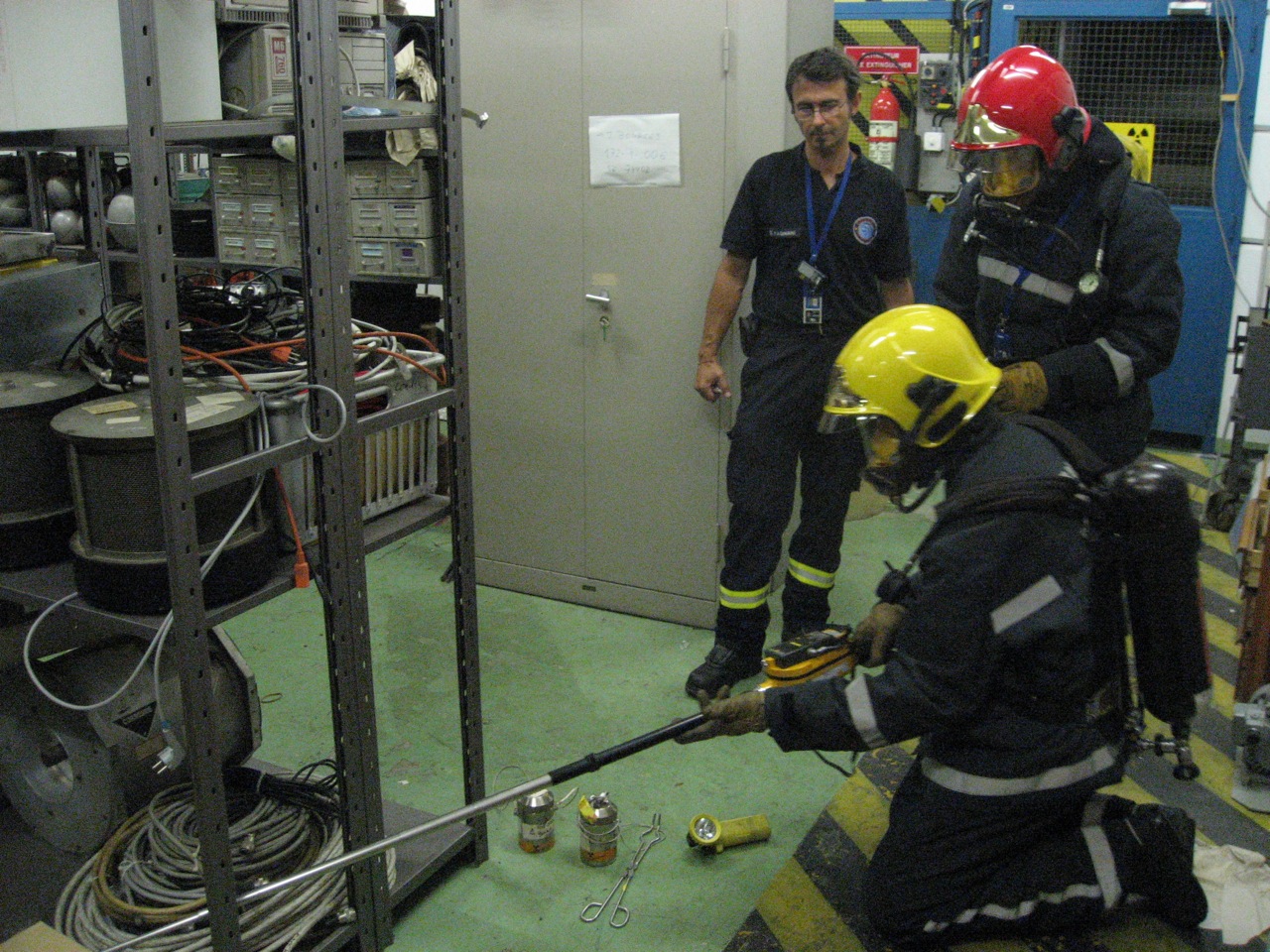
_image.jpg?download=1)
Additional details
Identifiers
- CDS
- 1285141
- CDS Report Number
- BUL-NA-2010-205
Related works
- Is published in
- Periodical issue: 69kjy-pf467 (CDS)
- Periodical issue: b8x0c-2cr10 (CDS)