Full intensity for the LHC
Authors/Creators
Description
The power supply to one eighth of the LHC was successfully tested over a period of 24 hours.
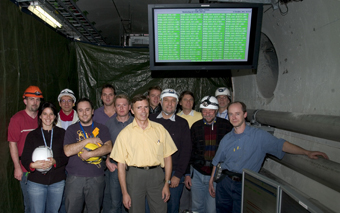
Members of the various Groups who participated in the commissioning of the power converters for one section of the LHC on 12 and 13 October.
The LHC is gradually taking shape. While the major operation of lowering the magnets into the tunnel continues, many of the machine's other components are gradually being installed and commissioned. On 13 October, the power supply to one sector of the accelerator was successfully tested over a period of 24 hours. This was the first time that all the power converters for the supply of electricity to one eighth of the machine had been operated together in situ.
Once installed the accelerator will have a power rating of around 200 megawatts (MW), which is equivalent to that of LEP. By way of comparison, the peak consumption for the Canton of Geneva is 400 MW. However, what makes LHC different is its use of superconducting technology. As a result of this, the LHC magnets will not lose energy by heating up when strong currents pass through them. However, in order to produce the magnetic fields of up to 9 tesla that they will need to control the trajectories of the protons they will have to be supplied with high-intensity current.
Thus, although their power consumption is relatively low (with peak rates of 50 MW during the acceleration phase and 25 MW during standard operations for physics runs, compared to the 200 MW rating for the whole of the machine), the magnets' special characteristics have called for a design and installation procedure that is completely different to that of LEP.
'The need for very strong currents with moderate voltages required the power converters to be placed as close to the machine as possible and new topologies had to be developed to reduce their size and increase their performance', explains Frédérick Bordry, Leader of the AB Department's Power Converter Group. Given that space underground is limited, the power converters selected are as compact as possible.
The LHC is equipped with more than 1600 power converters, which is more than 200 for each sector. They are mainly located in secondary tunnels, either side of the even points of the machine. However, a number are also located at the odd points, while smaller power converters are installed directly below the dipole magnets.
Their job is to convert the alternating mains current (18 kilovolts or 400 volts) into a high-intensity direct current, of up to 13000 amperes, that is as stable as possible.
'We are able to achieve a precision of several millionths for the intensity of the current delivered to the magnets', explains Frédérick Bordry. Large numbers of sensors and safety systems will be used to monitor that the machine is operating properly, triggering energy dumping if necessary. If any quenches occur on a magnet, enormous resistors will absorb the energy. The energy stored in the LHC's 1232 dipoles will be in excess of 10 Gigajoules, which is equivalent to that of an Airbus A380 travelling at 700 km/h.
Obviously, these high-intensity currents induce a lot of heating in non-superconducting cables, since, in contrast to the accelerator, this part of the electrical circuits is resistant. A substantial water and ventilation cooling system provides the cooling for the power converters and the enormous electric cables. 'As part of this first commissioning phase, we are particularly interested in checking the proper functioning of the power converters' peripheral infrastructures', underlines Roberto Saban who is responsible for co-ordinating LHC commissioning.
In addition to the Power Converter Group (AB/PO), which is responsible for designing and operating the power converters, a number of Groups from the AB, AT and TS Departments have also participated in the operation. The Cooling and Ventilation Group (TS/CV) checked the performance levels of the ventilation and cooling installations. The Electrical Engineering Group (TS/EL) monitored the heating of the cables, the electricity consumption and any disruptions to the power supply. The Magnets and Electrical Systems Group (AT/MEL) monitored the thermal performance of the energy extraction system. The Controls Group (AB/CO) provided the computing infrastructures as well as the control software and monitored the operation together with the Operation Group (AB/OP).
After this first period of operation at full power, the next stage will be the commissioning of the power converters next year, this time after they have been connected to the magnets. At that stage, the operation of other key elements, such as the electrical distribution box which provides the interface between the power-supply system and the accelerator, will be tested. In transferring the power to the magnets, the box has to ensure the transition from room temperature to that of the machine at close to absolute zero (around -270°C).
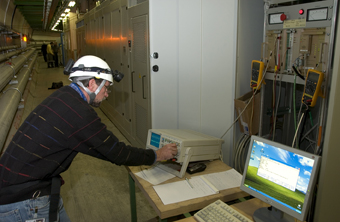
Checking the operating parameters for the power converters during their commissioning for one sector of the accelerator.
Technical info
Cover articleOther (French)
L'alimentation électrique d'un huitième du LHC a été testée avec succès sur une période de 24 heures.
Other (French)
L'alimentation électrique d'un huitième du LHC a été testée avec succès sur une période de 24 heures.
Des membres des différents groupes ayant participé à la mise en service des convertisseurs de puissance sur un secteur du LHC, les 12 et 13 octobre derniers.
Le LHC prend peu à peu forme. Tandis que les aimants poursuivent leur grande descente souterraine, les multiples équipements de la machine sont tour à tour installés et mis en service. Le 13 octobre dernier, l'alimentation électrique pour un secteur de l'accélérateur était testée avec succès sur une période de 24 heures. C'était la première fois que tous les convertisseurs de puissance fournissant le courant électrique pour un huitième de la machine fonctionnaient ensemble et in situ.
L'accélérateur disposera d'une puissance électrique installée d'environ 200 mégawatts (MW), soit l'équivalent de celle du LEP. A titre de comparaison, la consommation de pointe du canton de Genève est de 400 MW. Toutefois, la grande particularité du LHC tient à l'utilisation de la supraconductivité. Les aimants du LHC ne perdront ainsi pas d'énergie par échauffements lorsqu'ils seront traversés par de forts courants. Mais pour produire les champs magnétiques jusqu'à 9 teslas, permettant de contrôler la trajectoire des protons, ils doivent être alimentés par d'intenses courants.
Ainsi, si la consommation des aimants est relativement modérée (50 MW en pointe durant l'accélération et 25 MW en régime permanent durant la physique comparés aux 200 MW de l'ensemble de la machine), leur spécificité a nécessité une installation et une conception totalement différente de celle du LEP. « Le besoin de très forts courants avec des tensions modérées a obligé à placer les convertisseurs au plus proche de la machine, à développer de nouvelles topologies pour réduire leur volume et à augmenter leurs performances », explique Frédérick Bordry, chef du groupe Convertisseur de puissance du département AB. Comme la place est limitée en souterrain, les convertisseurs choisis sont les plus compacts possibles.
Plus de 1600 convertisseurs équipent le LHC, soit environ 200 par secteur. Ils sont placés principalement dans des tunnels secondaires, de part et d'autre des points pairs de la machine. Mais un certain nombre équipe également les points impairs et de petits convertisseurs sont installés directement sous les aimants dipôles.
Leur rôle est de convertir le courant alternatif du réseau (18 kilovolts ou 400 volts) en courant continu de forte intensité, jusqu'à 13000 ampères, le plus stable possible. « Nous sommes capables de parvenir à une précision de quelques millionièmes sur l'intensité délivrée aux aimants», explique Frédérick Bordry. De nombreux capteurs et systèmes de sécurité permettent de contrôler le bon fonctionnement et d'assurer l'évacuation de l'énergie. D'énormes résistances absorberont l'énergie en cas de transition résistive (ou « quench ») d'un aimant. L'énergie stockée dans les 1232 dipôles du LHC sera supérieure à 10 gigajoules, soit l'énergie d'un airbus A380 à 700 km/h.
Evidemment, ces courants intenses induisent beaucoup d'échauffements dans les câbles non supraconducteurs. Car contrairement à l'accélérateur, cette partie des circuits électriques est résistive. Un important dispositif de refroidissement par eau et de ventilation assure donc le refroidissement des convertisseurs et des énormes câbles électriques. « Au cours de cette première mise en service, nous nous intéressons particulièrement à la vérification du bon fonctionnement des infrastructures autour des convertisseurs », souligne Roberto Saban, qui dirige la coordination de la mise en service du LHC.
De nombreux groupes des départements AB, AT et TS ont participé à l'opération, en plus du groupe Convertisseur de puissance (AB/PO) chargé de la conception et du fonctionnement des convertisseurs de puissance. Le groupe Refroidissement et ventilation (TS/CV) a vérifié les performances des installations de ventilation et refroidissement. Le groupe Ingénierie électrique (TS/EL) a suivi l'échauffement des câbles, la consommation électrique et les perturbations du réseau. Le groupe Aimants et systèmes électriques (AT/MEL) a suivi le comportement thermique du système d'extraction énergie. Le groupe Contrôle (AB/CO) a fourni les infrastructures informatiques ainsi que les logiciels de contrôle-commande et a suivi l'opération conjointement avec le groupe Opération (AB/OP).
Après cette première période de fonctionnement à plein régime, l'étape suivante sera la mise en service l'année prochaine des convertisseurs de puissance connectés cette fois-ci aux aimants. Le fonctionnement d'un autre élément critique, la boîte de distribution électrique qui réalise l'interface entre le système d'alimentation et l'accélérateur, sera par exemple testé. Cette boîte doit assurer la transition, dans le transport du courant vers les aimants, de la température ambiante à celle de la machine, proche du zéro absolu (environ -270°C).
Contrôle des paramètres de fonctionnement des convertisseurs de puissance, lors de leur mise en service sur un secteur de l'accélérateur.
Files
na-2005-120_0510015_04-web.jpg
Files
(204.5 kB)
| Name | Size | Download all |
|---|---|---|
|
md5:2b6a2c7bf3a46e6f0cd305e6dc35035c
|
103.7 kB | Preview Download |
|
md5:6169acc35a1921daf9b5a85f72d67d63
|
100.8 kB | Preview Download |
Additional details
Identifiers
- CDS
- 905564
- CDS Report Number
- BUL-NA-2005-120
- Aleph number
- 000038800MMD