CERN to start producing medical isotopes
Authors/Creators
Description
A promising project that was hailed at the ICTR-PHE 2012 medical conference (see Bulletin issues 10-11/2012 and 12-13/2012) has seen the light of day at CERN. The project, known by the name of MEDICIS, will make it possible to produce a large variety of radioactive isotopes for medical research.
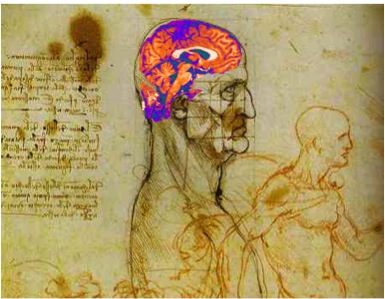
This image of a brain, superimposed on a drawing by Leonardo da Vinci, was taken by a PET scanner after injecting a molecule containing a positron-emitting isotope. CERN-MEDICIS will produce new isotopes for imaging which will be able to show up cancerous tissues and destroy them by emitting local radiation as the isotopes decay.
In the United States, a new radium-based drug which targets bone metastases is about to go on the market. Radium, which can be brought to bear at the cell level, is a potent weapon in the fight against certain types of cancer, and is opening the way to a new form of medicine. This is the direction that CERN has decided to follow through the CERN-MEDICIS* (Medical Isotopes Collected from ISOLDE) project.
Thierry Stora, leader of the CERN-MEDICIS project and of the Targets and Ion Sources Development Team at ISOLDE, explains: "At ISOLDE we have the capability to produce a thousand different radioactive isotopes. The objective of MEDICIS is to make use of the expertise and infrastructure of ISOLDE to produce radioactive isotopes that could be useful in medicine."
In ISOLDE, targets are bombarded with proton beams. Of the incident beams, only 10% are actually stopped in the targets and achieve their objective, while the remaining 90% are not used. By putting up a second target for MEDICIS behind the first one, a portion of the lost beams could be re-used. “This will allow us to produce isotopes specially for medicine, without interfering with ISOLDE’s work,” underlines Thierry Stora. Once the second target has been bombarded and the “medical" isotopes created, the sample will be transferred to a shielded cell in the ISOLDE laboratory, by means of a pneumatic transport system. “The transport system and the shielded cell will be funded from the Knowledge Transfer Fund” (see the article in Bulletin 04-05/2012), says a contented Thierry Stora.
When the sample reaches the shielded cell, an operator will start the process of extracting the radioactive isotopes. The highly purified isotopes will be formed into batches that can be sent to external laboratories that will use them for medical research. “CERN-MEDICIS is supported by the Hôpitaux Universitaires de Genève, the Centre Hospitalier Universitaire Vaudois (CHUV) in Lausanne and the cancer research institute ISREC of the École Polytechnique Fédérale de Lausanne. It will bring together cancer specialists, surgeons, experts in nuclear medicine, scientists and experts from ISOLDE: a real tiger team!” says an enthusiastic Stora.
In the future, MEDICIS is expected to join other European institutes specialising in the production of radioactive isotopes for medical research.
* Note that the name “MEDICIS” has not yet been approved and may change.
| Producing isotopes By bombarding a specific material with a proton beam, the experts from ISOLDE can modify its structure. When the nuclei of the atoms in the target material are broken apart, new elements are created—including radioactive isotopes. There are three possibilities for breaking apart a nucleus. Fragmentation involves a small piece being broken off the nucleus, leaving a lighter nucleus. In fission, a heavy nucleus is split into two nuclei of intermediate mass. In spallation, finally, protons or neutrons are ejected, leaving behind a nucleus that is closely related to the original. The target material can be of many different substances: titanium, lead, ceramic, etc. By choosing just the right target and method, ISOLDE can produce a wide range of different radioactive isotopes. |
Other (French)
Salué lors de la conférence médicale ICTR-PHE 2012 (voir les n°10-11/2012 et 12-13/2012 du Bulletin), un projet prometteur vient de voir le jour au CERN. Baptisé MEDICIS, il permettra de produire une large variété d’isotopes radioactifs pour la recherche médicale.
Superposée sur un dessin de Leonard de Vinci, cette image du cerveau a été obtenue par PET-scan après injection d’une molécule incorporant un émetteur de positron. CERN-MEDICIS produira de nouveaux isotopes pour l’imagerie, qui permettront notamment des tissus cancéreux et de les détruire en émettant une radiation localisée lors de leur décroissance radioactive.
Aux États-Unis, un nouveau médicament à base de radium agissant sur les métastases osseuses est sur le point d’être commercialisé. Capable d’agir à l’échelle d’une cellule, le radium constitue en effet une arme de pointe pour combattre certains cancers, et ouvre la voie à une nouvelle forme de médecine. Une voie que le CERN a décidé d’emprunter à travers le projet CERN-MEDICIS* (pour Medical Isotopes Collected from ISOLDE).
« À ISOLDE, nous pouvons produire 1000 isotopes radioactifs, rappelle Thierry Stora, chef du projet CERN-MEDICIS et de l’équipe Développement des cibles et sources d’ions à ISOLDE. L’objectif du projet MEDICIS serait d’utiliser cette expertise et l’infrastructure d’ISOLDE pour produire des isotopes radioactifs intéressants sur le plan médical. »
Les cibles d’ISOLDE sont bombardées par des faisceaux de protons. Or, seul 10% des faisceaux sont stoppés dans les cibles et remplissent leur objectif, les 90% restants étant inutilisés. En plaçant une seconde cible, pour MEDICIS, derrière la première, une partie des faisceaux perdus peut être réutilisée. « Nous pouvons ainsi produire des isotopes spécialement pour la médecine, sans interférer avec les activités d’ISOLDE », souligne Thierry Stora. Une fois la seconde cible bombardée et les isotopes « médicaux » créés, l’échantillon sera envoyé dans une cellule blindée, dans le laboratoire d’ISOLDE, grâce à un système de transport pneumatique. « Le système de transport et la cellule blindée seront financés par le Fonds dédié au transfert de connaissances (voir l’article paru dans le Bulletin 04-05/2012), se réjouit Thierry Stora.
Une fois l’échantillon réceptionné dans la cellule blindée, un opérateur procèdera à l’extraction des isotopes radioactifs. De petits lots d’isotopes très purs seront alors constitués, puis envoyés dans des laboratoires externes, où ils serviront à la recherche médicale. « Le projet CERN-MEDICIS est soutenu par les Hôpitaux Universitaires de Genève, le Centre Hospitalier Universitaire Vaudois (CHUV) à Lausanne et l’Institut Suisse de Recherche Expérimentale sur le Cancer (ISREC) de l’École Polytechnique Fédérale de Lausanne (EPFL). Il réunit des oncologues, des chirurgiens, des médecins nucléaire, des chercheurs et des experts d’ISOLDE : une vraie équipe de choc ! », s’enthousiasme Thierry Stora.
Dans le futur, MEDICIS devrait s’associer à d’autres instituts européens spécialisés dans la production d’isotopes radioactifs dédiés à la recherche médicale.
*Notez que le nom « MEDICIS » n’a pas encore été approuvé et pourrait être modifié.
| Comment produire des isotopes ? En bombardant un matériau donné avec un faisceau de protons, les experts d’ISOLDE parviennent à en modifier la structure. En effet, en cassant les noyaux des atomes constituant la cible, il est possible de créer de nouveaux éléments, et notamment, des isotopes radioactifs. Pour casser les noyaux, trois solutions : la fragmentation - un petit morceau est arraché du noyau, aboutissant à la formation d’un noyau plus léger ; la fission - un gros noyau est cassé en deux noyaux moyens ; et la spallation - des protons et des neutrons sont éjectés du noyau, engendrant un noyau proche de celui d’origine. La cible bombardée peut être dans des matériaux très variés : titane, plomb, céramique, etc. Ainsi, c’est en jouant sur le type de cible et la méthode utilisée qu’ISOLDE est capable de produire autant d’isotopes radioactifs différents. |
Files
medicis_image.png
Files
(936.4 kB)
| Name | Size | Download all |
|---|---|---|
|
md5:70838778225897a5631cd75efcf7c7ef
|
886.5 kB | Preview Download |
|
md5:356255e5f85d92ffbae742e728f5a53f
|
49.8 kB | Preview Download |
Additional details
Identifiers
- CDS
- 1434420
- CDS Report Number
- BUL-NA-2012-113
Related works
- Is published in
- Periodical issue: 5pscr-t8543 (CDS)
- Periodical issue: 1sgkx-xdf66 (CDS)