Colin Ramm (1921 - 2014)
Authors/Creators
Description
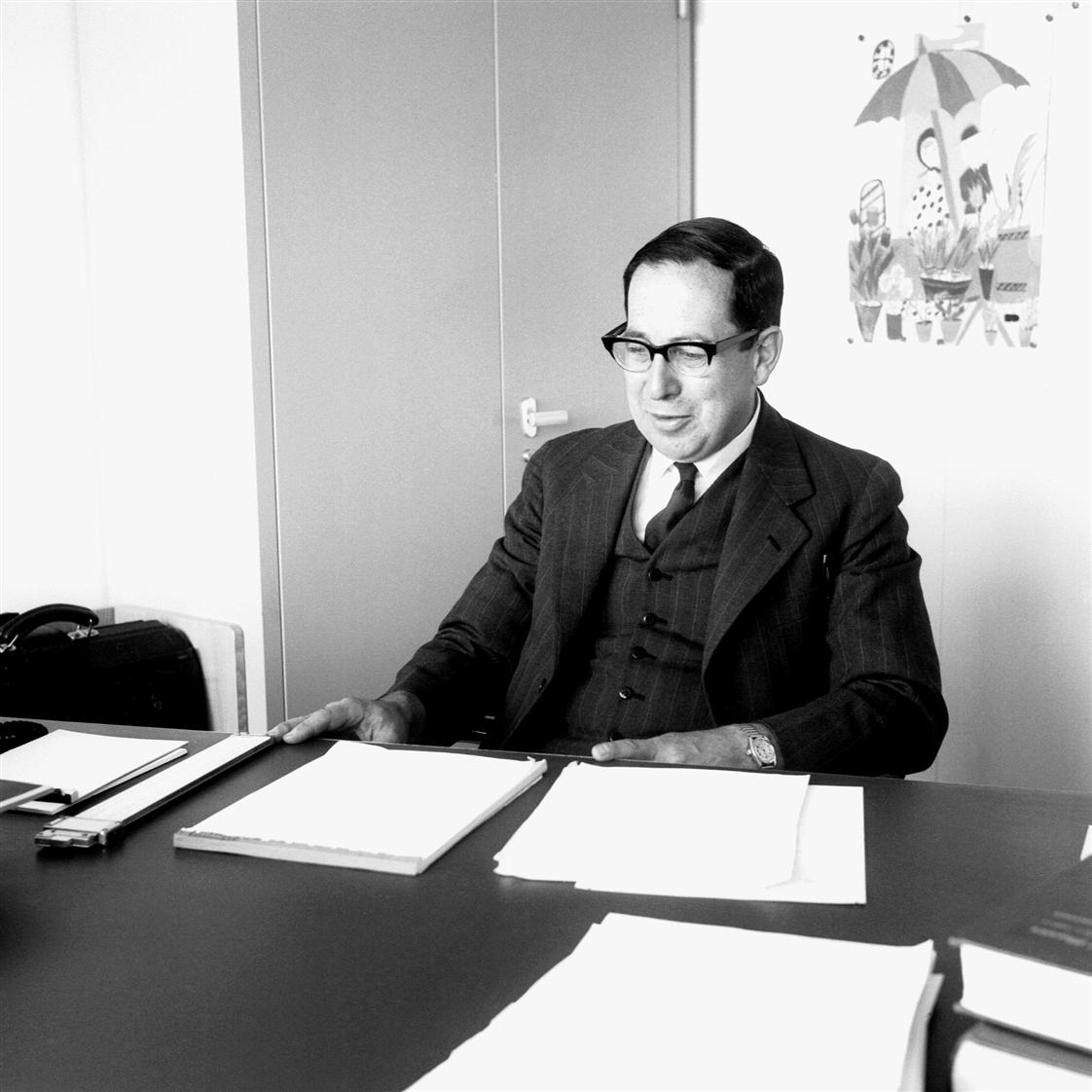
One of the CERN's pioneering figures , Colin Ramm, passed away on 23 June.
Colin was born in Perth, Western Australia, and gained a first-class honours degree in physics at the University of Western Australia in 1942. In 1947 he went to Birmingham University, where Europe’s first proton synchrotron was being built to produce an energy of 1 GeV and where he obtained his doctorate in 1951.
In 1954, Colin joined CERN’s Proton Synchrotron Division as leader of the magnet group, which became responsible for the whole of the synchrotron’s magnet system. The magnet group – which became the Nuclear Physics Apparatus Division in 1961 – then turned towards helping to make the PS usable for experiments, and a number of projects took shape under Colin’s leadership: a heavy-liquid bubble chamber, magnets and lenses for guiding secondary beams, electrostatic separators, a high-energy antiproton beam, scanning apparatus for bubble-chamber photographs, a fast beam-ejection system, and finally an enhanced neutrino beam.
The Ramm chamber – with a volume of 500 litres – was at the time the largest heavy-liquid chamber in the world operating in a magnetic field. Completed in 1960, it was used in CERN’s first neutrino experiments. The electrostatic separators built by Colin’s division gave CERN some of the world’s highest-energy beams of separated particles, as well as leading to research into the basic principles of high-voltage breakdown. However, the enhanced neutrino beam quickly became the Division’s main preoccupation. A group under Berend Kuiper and Günther Plass was already working on a proposal for extracting protons from the synchrotron, when it became obvious that with the ejected beam a greater pion flux could be obtained in the experimental areas. Simon van der Meer came up with the idea of a magnetic horn, to concentrate the pions so that an even larger number of neutrinos from their decays would be directed towards the detectors.
Colin returned to Australia in 1972 when invited to become the first full-time Dean of the Faculty of Science at the University of Melbourne. After retiring as Dean in 1983, he joined the School of Physics, and after a gap of almost 30 years, he returned to teaching, one of his first loves. He retired in 1988.
He leaves behind a daughter and a son, who went on to practise one of Colin’s great interests – marine science.
His friends from Melbourne and CERN
Extracted from the obituary in CERN Courier, November 2014 (p.41).
Other (French)
Colin Ramm, une figure marquante des débuts du CERN, nous a quittés le 23 juin.
Colin Ramm était né à Perth (Australie) et avait obtenu une licence de physique (mention first-class honours) à l’Université d’Australie occidentale en 1942. En 1947, il intègre l'Université de Birmingham (Royaume-Uni), où l'on est en train de construire le premier synchrotron à protons d'Europe, capable de produire une énergie de 1 GeV, et où il obtient son doctorat en 1951.
En 1954, Colin rejoint la division Synchrotron à protons du CERN, en tant que chef du groupe Aimants, chargé par la suite de l'ensemble du système d'aimants du synchrotron. Le groupe Aimants, qui devait devenir en 1961 la division Appareillage de physique nucléaire, s’est alors attelé à rendre le PS utilisable pour les expériences, et différents projets ont vu le jour sous la direction de Colin Ramm : une chambre à bulles à liquide dense, des aimants et des lentilles pour le guidage des faisceaux secondaires, des séparateurs électrostatiques, un faisceau d’antiprotons de haute énergie, un appareil de scannage pour les photographies de chambre à bulles, un système d’éjection rapide du faisceau, et enfin un faisceau de neutrinos amélioré.
La chambre de Ramm – d’un volume de 500 litres – était à l’époque la plus grande chambre à liquide dense opérant dans un champ magnétique. Terminée en 1960, elle était utilisée dans les premières expériences de neutrinos du CERN. Les séparateurs électrostatiques construits par la division de Colin Ramm ont donné au CERN des faisceaux de particules séparées parmi les plus énergétiques du monde et ont conduit à la recherche sur les principes fondamentaux du claquage haute tension. Toutefois, la division s’est rapidement consacrée essentiellement à l’amélioration des faisceaux de neutrinos. Un groupe travaillait déjà, sous la direction de Berend Kuiper et de Günther Plass, à une proposition d’extraction de protons à partir du synchrotron, quand il est apparu clairement que, au moyen du faisceau éjecté, on pouvait obtenir un plus grand flux de pions dans les zones d'expérimentation. Simon van der Meer proposa alors l'idée d'une corne magnétique, pour concentrer les pions afin qu’un encore plus grand nombre de neutrinos issus de leur désintégration soient dirigés vers les détecteurs.
En 1972, Colin Ramm retourna en Australie pour devenir doyen de la Faculté des sciences de l’Université de Melbourne. Ayant cessé d’exercer cette fonction en 1983, il rejoignit alors l’École de physique pour, au bout de trente ans, revenir à ses premières amours : l'enseignement. Il prit sa retraite en 1988.
Il laisse une fille et un fils, qui se consacre aux sciences de la mer, un domaine cher au cœur de Colin.
Extrait de la nécrologie parue dans CERN Courier, nov. 2014, p. 41
Files
ramm_image.jpg
Files
(108.1 kB)
| Name | Size | Download all |
|---|---|---|
|
md5:56e6552d861521f842de50437094caf8
|
108.1 kB | Preview Download |
Additional details
Identifiers
- CDS
- 1958262
- CDS Report Number
- BUL-NA-2014-227
Related works
- Is published in
- Periodical issue: 7y6p1-hz538 (CDS)
- Periodical issue: y02wx-zgy73 (CDS)