Sir William Mitchell (1925-2002)
Authors/Creators
Description
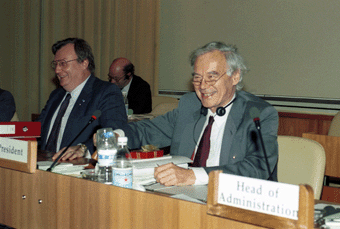
Sir William (Bill) Mitchell, former President of the CERN Council, died on 30th October 2002 at the age of 77. Mitchell was professor of Physics at Oxford University from 1978 to 1989, having previously been Professor of Physics, Dean of Science and Deputy Vice-Chancellor at Reading University. From 1985 to 1990 he was Chairman of the UK's Science and Engineering Research Council (SERC), which at the time was the funding agency for the UK's participation in the CERN programme. As Chairman, Mitchell was one of the UK representatives on the CERN Council, and in 1991 he was elected President, a position he held for three years.
This was a difficult period for CERN. Financial problems were being faced in many member states, notably in Germany as a result of unification. This led to calls for reductions in the CERN budget and, more significantly, to requests for delays in consderation of future programmes. On the other hand for the future of CERN and the progress of elementary particle physics, it was necessary to achieve adoption of the LHC as the next European project. In view of the financial climate at the time, and competition from the Superconducting Supercollider (SSC) then under construction in the USA, this was far from obvious. It was with evident satisfaction that Mitchell was able to declare, after the December 1991 session of the CERN Council had adopted the LHC programme that «This is an historic occasion - the LHC Project now exists!».
Mitchell was a powerful advocate of European cooperation, not only at CERN, but in other areas. He took the lead in negotiating an equal partnership for the UK, with France and Germany, in the Institut Laue Langevin in Grenoble.
Mitchell's own scientific investigations were in the field of condensed matter physics. He was one of the first to realise the potential of thermal neutron scattering for the study of solids, and initiated the use of research reactors at Harwell and Aldermaston for this purpose. It was under his Chairmanship that the SERC funded the Spallation Neutron Source (ISIS) which was built at Rutherford Appleton Laboratory, and remains one of the world's outstanding pulsed neutron sources.
With Mitchell's passing CERN, and European science in general have lost a staunch supporter.
Gerald Myatt
Oxford University
Other (French)
Sir William (Bill) Mitchell, ancien président du conseil du CERN, est décédé le 30 octobre 2002 à l'âge de 77 ans. William Mitchell fut Professeur de physique à l'Université d'Oxford de 1978 à 1989. Il avait été précédemment Professeur en physique, Doyen des Sciences et Vice-chancelier adjoint à l'Université de Reading. De 1985 à 1990, il présida le Conseil de la recherche scientifique et technologique de Grande-Bretagne (SERC), qui à l'époque était l'agence chargée de la contribution britannique au programme du CERN. En tant que président du SERC, William Mitchell fut l'un des représentants britanniques au conseil du CERN et en 1991 y fut élu Président du Conseil, position qu'il occupa trois ans durant.
Le CERN traversait alors une période difficile. Plusieurs états membres devaient faire face à des problèmes budgétaires, notamment l'Allemagne aux prises avec la réunification. Ceci eut pour conséquence des demandes de réduction du budget du CERN et, plus encore, des demandes de délais dans l'étude des futurs programmes. D'autre part, il était nécessaire d'obtenir l'adoption du LHC comme prochain projet européen pour assurer l'avenir du CERN et faire progresser la physique des particules. Mais vu les problèmes financiers à cette époque et la compétition avec le Super Collisionneur Supraconducteur (SSC) alors en construction aux Etats-Unis, faire accepter le LHC était loin d'être évident. C'est donc avec une grande satisfaction que William Mitchell pu déclarer, après que le conseil du CERN eut adopté le programme LHC lors de la session de décembre 1991: « C'est un moment historique, le projet LHC existe enfin ! »
William Mitchell fut un excellent avocat de la coopération européenne, aussi bien au CERN que dans d'autres domaines. Il prit en main les négociations pour que la Grande-Bretagne obtienne un participation égale à celle de la France et de l'Allemagne dans l'Institut Laue Langevin de Grenoble.
William Mitchell était également un chercheur, qui effectua ses travaux dans le domaine la physique de la matière condensée. Il fut l'un des premiers à mettre en évidence le potentiel de la diffusion thermique des neutrons dans l'étude des solides. Dans cette optique, il amorça l'utilisation des réacteurs de recherche de Harwell et Aldermaston. Ce fut également pendant sa présidence que le SERC finança la source de neutrons à spallation (ISIS) qui fut construite au laboratoire Rutherford Appleton. Elle reste l'une des sources à neutrons pulsés les plus remarquables au monde.
Avec sa disparition, le CERN et la communauté scientifique européenne en général ont perdu un de leurs dévoués partisans.
Gerald Myatt
Université d'Oxford
Files
na-2002-159_9312049_11.gif
Files
(49.5 kB)
| Name | Size | Download all |
|---|---|---|
|
md5:09b3fea5a3d704d9d26318991cb69f73
|
49.5 kB | Preview Download |
Additional details
Identifiers
- CDS
- 46151
- CDS Report Number
- BUL-NA-2002-159
- Aleph number
- 000007633MMD
Related works
- Is referenced by
- Other: ADMBUL_0024059 (Other)