Best value for money
Authors/Creators
Description
Last week, the Industrial Services and General Infrastructure section of the Procurement and Industrial Services group received dozens of bids in a single day! The bids were submitted in response to four invitations to tender to be adjudicated on a ‘best value for money’ basis. This adjudication method, introduced at CERN in 2008, ensures that quality is given as much priority as cost containment in the process of awarding industrial services contracts.
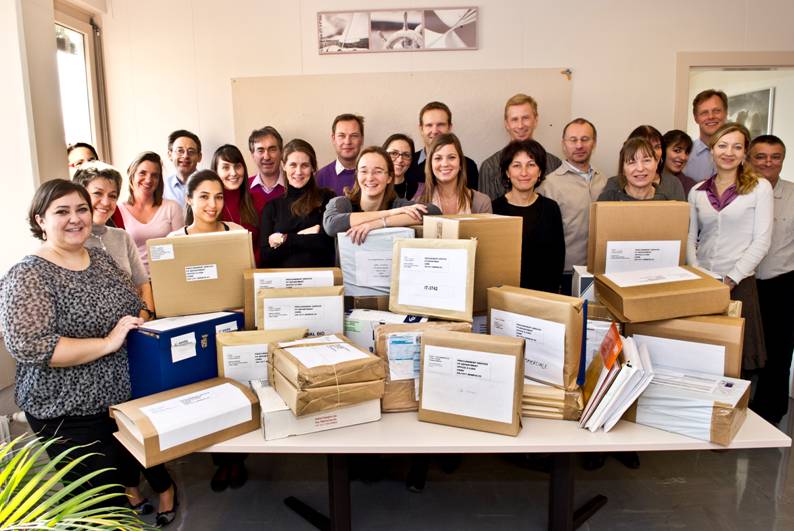
Members of the Industrial Services and General Infrastructure section with the dozens of bids received in a single day.
According to the new adjudication method, service contracts, which include the provision of contractors' personnel working on the CERN site, are awarded to the firm offering the given service with the best quality-price ratio. The procedure is designed to guarantee a better quality of the services offered to CERN. “In the adjudication process, the price usually accounts for 70%,” says Cristina Lara, Head of the Industrial Services and General Infrastructure section. “The more complex the technical requirement, the greater the weighting of the quality score can be.” In general, the criteria and the score they are given in assessing the quality are defined by the Department requesting the service, in collaboration with the Procurement and Industrial Services group, before the invitation to tender is sent out.
The ‘best value for money’ adjudication method enables bidders to offer added value and this improves the quality of the service purchased by CERN. On the CERN side, the adjudication process represents an increased challenge for both the Procurement and Industrial Services group and the Department concerned, which remains in charge of all the technical aspects of the invitation to tender. “The number of documents we prepare for the invitation to tender has significantly increased and the content has become more complex,” explains Cristina Lara. “In addition, the bids we receive contain such an important amount of information and documents that their analysis needs to be spread over several days. With the old criteria, we used to evaluate only the lowest bids among those that were technically compliant, while now all technical bids have to be evaluated.”
The volume and complexity of the daily work has increased, but the results are definitively encouraging for the members of the Industrial Services team: “The quality of services performed by contractors on the CERN site is demonstrably higher than before 2008,” confirms Cristina Lara. “Firms are encouraged to consider the technical aspects of the future contract as much as the price in their bid. In CERN’s interests, firms have been enabled to change their approach, which used to be purely financial, and to integrate qualitative aspects.”
The next step for the Procurement and Industrial Services group will be to develop “e-tendering”, an improved, modern and safe method for firms to submit their bids electronically. The photograph illustrating this article is striking but it might happily be the last one picturing heavy boxes full of documents to be sorted through!
Other (French)
La semaine dernière, la section Services industriels et infrastructure générale du groupe Achats et services industriels a reçu des dizaines d’offres en un seul jour. Ces offres faisaient suite à quatre appels d'offres dans le cadre de la procédure d'adjudication dite au mieux-disant. Cette méthode d’adjudication, introduite au CERN en 2008, a pour but de donner la même importance à la qualité qu’au prix dans le processus d'attribution des contrats de service.
Les membres de la section Services industriels et infrastructure générale avec les dizaines d'offres qu'ils ont reçu en une seule journée.
Selon la nouvelle méthode d’adjudication, les contrats de service, qui prévoient la mise à la disposition de personnel travaillant sur le site du CERN, sont attribués à l’entreprise proposant le service en question avec le meilleur rapport qualité-prix. La procédure vise à garantir une meilleure qualité des services assurés au CERN. « Dans le processus d’adjudication, le prix compte généralement pour 70 %, explique Cristina Lara, chef de la section Services industriels et infrastructure générale. Plus les spécifications techniques sont complexes, plus la note de qualité aura un coefficient élevé. » En général, les critères et la note qui leur est attribuée sont définis par le département demandant le service, en collaboration avec le groupe Achats et services industriels, avant l’envoi de l’appel d’offres.
L’adjudication au mieux-disant permet aux soumissionnaire de proposer une valeur ajoutée, ce qui améliore la qualité du service acheté par le CERN. Du point de vue du CERN, le processus d’adjudication est plus ardu, tant pour le groupe Achats et services industriels que pour le département demandeur, qui reste chargé de définir tous les aspects techniques de l'appel d'offres. « Le nombre de documents que nous préparons pour l’appel d’offres a nettement augmenté, et le contenu est devenu plus complexe, explique Cristina Lara. De plus, les offres que nous recevons contiennent une telle masse d'informations et de documents que leur analyse prend nécessairement plusieurs jours. Avec les anciens critères, nous devions simplement évaluer l’offre la plus basse parmi celles qui étaient techniquement conformes, alors que mainatenant, toutes les offres technique doivent être évaluées. »
Le volume et la complexité du travail au quotidien ont augmenté, mais les résultats sont encourageants pour les membres de l’équipe des services industriels. « La qualité des services assurés par les entreprises sur le site du CERN est sans aucun doute meilleure qu'avant 2008, assure Cristina Lara. Les entreprises sont encouragées à prendre en compte les aspects techniques des futurs contrats autant que le prix de leur offre. Pour mieux servir les intérêts du CERN, les entreprises ont été en mesure de modifier leur perspective, jusqu'alors purement financière, pour intégrer les aspects qualitatifs. »
La prochaine étape pour le groupe sera de développer l'appel d'offres électronique, un système moderne et sûr qui permettra aux entreprises de présenter leur offre par voie électronique. L’image que vous avez sous les yeux est impressionnante, mais fort heureusement, ce devrait être la dernière photo montrant des cartons de documents à examiner !
Files
BestValue_image.jpg
Files
(68.7 kB)
| Name | Size | Download all |
|---|---|---|
|
md5:9c303aeaeed179c4c7a7121759218645
|
68.7 kB | Preview Download |
Additional details
Identifiers
- CDS
- 1324542
- CDS Report Number
- BUL-NA-2011-017
Related works
- Is published in
- Periodical issue: jg05y-bd615 (CDS)
- Periodical issue: q6y0x-hnv68 (CDS)