Hawking Colloquium Packed CERN Auditoriums
Authors/Creators
Description
Stephen Hawking's week long visit to CERN included an 'exceptional CERN colloquium' which filled six auditoriums.
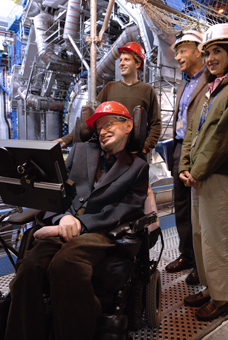
Stephen Hawking during his visit to the ATLAS experiment.
Stephen Hawking, Lucasian Professor of Cambridge University, visited the Theory Unit of the Physics Department from 24 September to 1 October 2006. As part of his visit, he gave two lectures in the main auditorium - a theoretical seminar on 'The Semi-Classical Birth of The Universe', attended by about 120 specialists; and a colloquium titled 'The Origin of The Universe'. As a key public figure in theoretical physics, his presence was eagerly awaited on both occasions.
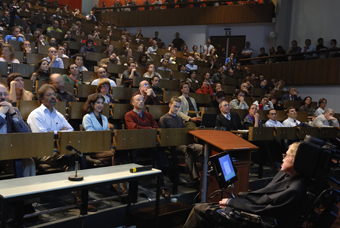
Those who wanted to attend the colloquium had to arrive early and be equipped with plenty of patience. An hour before it was due to begin, the 400 capacity of the main auditorium was already full. The lecture, simultaneously broadcast to five other fully packed CERN auditoriums, was attended by an estimated total of 850.
Stephen Hawking attracted a large CERN crowd, filling the main auditorium one hour before the start of his talk.
After much anticipation, Prof. Hawking finally entered the room. A flood of camera flashes were interrupted by Hawking's familiar computer voice - 'no flash'. He does not allow flash photography because it affects the process of communication with his computer. A switch attached to his glasses projects an infra-red beam onto his right cheek. Movements of his cheek muscles activate the switch, allowing him to select words from a computer database and create sentences. When a message is completed, it is sent to a speech synthesizer.
In the colloquium, Prof. Hawking took us through attempts by ancient philosophers to answer the fundamental questions: Why are we here? Where did we come from? He went on to describe the Steady State Theory proposed in 1948, and its replacement by the current Big Bang model, after the discovery of cosmic microwave background radiation in 1965. He explained that in order to understand the origin of the Universe, we need to combine Einstein's general theory of relativity with quantum theory. When both are considered together, time can behave as another direction in space under extreme conditions. The combined theory predicts that small fluctuations would develop, leading to the formation of galaxies, stars and other structures in the Universe. This hypothesis is supported by the observation of small irregularities in cosmic microwaves.
Despite a profound change in our understanding of cosmology, there is still much to be discovered. We lack a good explanation of why the Universe's rate of expansion is accelerating again, after a long period of slowing down. Will it continue to expand forever, or will it eventually collapse again?
The LHC experiments may help us to answer some of these questions. In a meeting with the Director General Robert Aymar, Prof. Hawking congratulated him and the CERN community on the LHC. 'You have an exciting two years ahead of you', said Hawking, after touring the various facilities of the LHC earlier in the week. When asked what he considered to be the most important discoveries that the new experiments can make, Prof. Hawking commented, 'There are three candidates: superpartners, black holes and the Higgs'. He considers superpartners and black holes to be the most important findings.
Prof. Hawking's lectures are available here:
- 'Exceptional CERN Colloquium - The Origin of the Universe' (for a general audience)
- 'The Semi-Classical Birth of the Universe' (for a specialist audience)
Other (French)
Pendant la semaine qu'il a passée au CERN, Stephen Hawking a donné une conférence exceptionnelle qui a rempli six amphithéâtres.
Stephen Hawking lors de sa visite de l'expérience ATLAS.
Stephen Hawking, titulaire de la chaire lucasienne à l'Université de Cambridge, a rendu visite à l'unité Théorie du Département de physique du 24 septembre au 1er octobre 2006. Cette visite a été l'occasion de deux conférences dans l'amphithéâtre principal, d'abord pour un séminaire théorique, auquel ont participé quelque 120 spécialistes, puis pour une conférence publique intitulée «La naissance de l'Univers». Dans les deux cas, cette grande figure de la physique théorique était attendue par des auditeurs enthousiastes.
Ceux qui voulaient assister à la conférence publique ont dû arriver bien à l'avance et s'armer de patience. Une heure avant le début de la conférence, l'amphithéâtre de 400 places était déjà plein. La conférence, diffusée en direct dans cinq autres amphithéâtres a été suivie par environ 850 personnes.
Stephen Hawking a attiré les foules du CERN, remplissant six amphithéâtres.
Quand, enfin, le professeur Hawking est entré dans la salle, il a interrompu le déchaînement des flashs de sa célèbre voix synthétique: «Pas de flashs!» En effet, les flashs des photographes interfèrent avec le système de communication par ordinateur qu'utilise Stephen Hawking: un dispositif fixé à ses lunettes projette un rayon infrarouge sur sa joue droite, et les mouvements des muscles de sa joue lui permettent de choisir des mots dans une base de données informatique et de constituer ainsi des phrases. Le message ainsi élaboré est transmis au synthétiseur vocal.
Au cours de la conférence, Stephen Hawking a d'abord effectué un retour dans le passé évoquant les réponses que les philosophes de l'Antiquité cherchaient à donner aux questions fondamentales: pourquoi sommes-nous là? D'où venons-nous? Il a ensuite exposé la théorie de l'Univers stationnaire, proposée en 1948, et le modèle actuel du Big Bang qui l'a remplacée après la découverte en 1965 du fond cosmologique diffus. Il a expliqué que, pour comprendre l'origine de l'Univers, il faut associer la théorie de la relativité générale d'Einstein avec la théorie quantique, et considérer que le temps peut constituer une autre dimension de l'espace dans des conditions extrêmes. Cette théorie suppose que de petites fluctuations se sont produites, conduisant à la formation de galaxies, d'étoiles et d'autres structures de l'Univers. Cette hypothèse est appuyée par l'observation de petites irrégularités dans les micro-ondes cosmiques.
Si notre compréhension de la cosmologie a connu une évolution spectaculaire, il reste beaucoup à découvrir. Nous ne pouvons expliquer de manière satisfaisante pourquoi l'expansion de l'Univers s'accélère à nouveau, après un ralentissement. L'Univers va-t-il continuer à se dilater éternellement, ou va-t-il s'effondrer sur lui-même?
Les expériences du LHC pourront peut-être aider à répondre à ces questions. Lors d'un entretien avec Robert Aymar, Directeur général du CERN, Stephen Hawking l'a félicité, ainsi que l'ensemble du CERN, pour la réalisation du LHC. «Les deux prochaines années vont être passionnantes pour vous», a déclaré Stephen Hawking, qui avait visité les différents sites du LHC. À la question de savoir quelles sont les découvertes les plus importantes que pourrait réaliser le LHC, il a répondu: «Il y a trois possibilités: les superpartenaires, les trous noirs et le boson de Higgs». Selon lui, les superpartenaires et les trous noirs seraient les découvertes les plus intéressantes.
Les conférences sont disponibles sur le Web:
- Exceptional CERN Colloquium - The Origin of the Universe (pour le grand public)
- The Semi-Classical Birth of the Universe (pour les spécialistes)
Files
na-2006-134_Hawkins-1-web.jpg
Files
(259.1 kB)
| Name | Size | Download all |
|---|---|---|
|
md5:e811dac60fb950cd64bf0fe77fad7835
|
134.3 kB | Preview Download |
|
md5:19f3e7bb8cbb18c0e4765400c4c8e7d8
|
124.7 kB | Preview Download |
Additional details
Identifiers
- CDS
- 987584
- CDS Report Number
- BUL-NA-2006-134
- Aleph number
- 000043629MMD
Related works
- References
- Other: 000043618 (Other)