CMS: Aerospace goes underground
Authors/Creators
Description
Gleaming aluminium on the outside and carbon black on the inside, as long as a sedan and taller than a man, a strange hollow cylinder arrived at CERN by truck August 26.
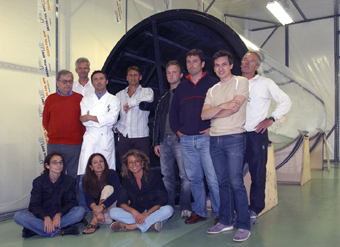
The CMS team celebrates the arrival of the "Tube". From left to right, sitting: Blanca Perea Solano, Jeannine Muffat-Joly, Ariella Cattai (Tracker Technical Coordinator). Standing: Georges Roiron, Hans Postema, Eric Albert, Paolo Petagna, Arvid Larsson, Nuno Bernardino Rodrigues, Enzo Carrone, Jack Hill.
Over several hours, crews carefully unloaded the structure, known to its builders as "the Tube", and delivered it into a huge, white clean tent inside Building 186. Though this structure is reminiscent of a satellite, rather than soaring into space, it will journey deep underground.
This tube will house the heart of the CMS detector, the CMS Tracker, where its payload of roughly 16 000 silicon sensors will track the paths of particles spraying from collisions between protons accelerated by the LHC. Although the CMS Tracker is for particle physics rather than astrophysics, the Tube has a lot in common with satellites: it must be very light, stiff, and keep its shape over its lifetime.
The CMS detector will be in a spacious cavern underground, but the Tracker will be buried under other detectors that form the rest of the experiment. On top of that, the streams of particles passing through the detector will leave it highly radioactive. For repairs or maintenance, it's nearly as difficult to access as the Hubble Space Telescope. Thus the Tracker has to be very reliable and, if it does sustain damage, to keep working regardless.
The engineers responsible for the CMS Tracker all have solid backgrounds in aerospace, so they were able to draw on their experience to design this equipment to be much like a satellite. Hans Postema previously collaborated on the AMS project, a particle physics experiment that went into orbit on board a NASA space shuttle and will be part of the International Space Station. Postema also flies his acrobatic plane in his spare time. Marco Oriunno and Paolo Petagna both did years of aerospace engineering and aeronautics research before arriving at CERN.
These engineers designed "the Tube" to be very light for its size and strength. After particles race through the Tracker, they reach other layers of the detector, preferably with little interference. "For a particle Tracker, you want it as transparent as possible. Any material there is just noise for the experiment," Petagna says. "Physicists would like to have a magical way of keeping their detectors in place without any mass." Short of such a wondrous device, they've designed a strong but light and thin honeycomb of carbon fibres that wraps around the Tracker for support and insulation.
Like a satellite buffeted by radiation and pummelled with small rocks, the CMS Tracker will take a pounding - but in this case, from the very particles it is looking for. "But in designing a device to withstand this punishment," Petagna says, "it's always a trade-off between the expected life of the experiment and what you can physically do." For this reason, the atmosphere inside the Tube will stay at a chilly -20° C to minimize radiation damage to the sensors. Eventually they may wear out, but everything has been designed to last at least 10 years at the LHC's expected luminosity.
How do they ensure reliability? Their philosophy, Petagna says, is test, test, test. "You accept the minimal amount of risk you can." In moving from the drawing board to the production floor, it made a big difference to have a company they trusted with the manufacturing: Plyform, of Varallo Pombia, a village outside Milan, specializes in making highly technical composite structures. In addition to the main support structure, the company is also making several other parts of the Tracker. The engineers hope that all these measures will give the CMS Tracker a long, productive life underground.
Technical info
Cover articleOther (French)
Un étrange cylindre creux, en aluminium brillant à l'extérieur et noir à l'intérieur, aussi long qu'une limousine et plus haut qu'un homme, est arrivé au CERN par camion le 26 août dernier.
Other (French)
Un étrange cylindre creux, en aluminium brillant à l'extérieur et noir à l'intérieur, aussi long qu'une limousine et plus haut qu'un homme, est arrivé au CERN par camion le 26 août dernier.
L'équipe CMS fête l'arrivée du « Tube ». De gauche à droite, assis: Blanca Perea Solano, Jeannine Muffat-Joly, Ariella Cattai (Coordinateur technique pour le détecteur). Debouts : Georges Roiron, Hans Postema, Eric Albert, Paolo Petagna, Arvid Larsson, Nuno Bernardino Rodrigues, Enzo Carrone, Jack Hill.
Pendant plusieurs heures, des équipes ont déchargé avec pré??caution la structure, appelée « Tube » par ses constructeurs, et l'ont apportée jusqu'à une gigantesque tente de couleur blanche immaculée à l'intérieur du bâtiment 186. Bien que cette structure rappelle un satellite, au lieu de filer dans l'espace, elle effectuera son voyage à grande profondeur sous terre.
Ce tube abritera le coeur du détecteur CMS, l'équipement appelé trajectographe, dont la « charge utile » d'environ 16 000 capteurs en silicium détectera les traces des particules issues des collisions entre les protons accélérés par le LHC. Bien que le trajectographe de CMS soit destin Tube » très léger eu égard à ses dimensions et sa résistance. Lorsque les particules auront traversé le trajectographe, elles atteindront d'autres couches du détecteur, de préférence avec peu d'interférences seulement. « Un trajectographe pour particules doit être aussi transparent que possible. Tous ses matériaux ne sont rien d'autre que du bruit pour l'expérience, » explique Paolo Petagna. « Ce que les physiciens souhaiteraient, c'est une méthode magique pour maintenir leurs détecteurs en place, sans aucune masse. » Faute d'un équipement aussi merveilleux, ils ont conçu une structure de fibres de carbone en nid d'abeilles, à la fois solide, légère et mince, qui entoure le trajectographe pour le soutenir et l'isoler.
Comme un satellite secoué par les rayonnements et martelé par de petits fragments de roches, le trajectographe de CMS subira un pilonnage, mais celui-ci sera le fait des particules mêmes qu'il recherche. « Mais lorsque l'on conçoit un dispositif capable de résister à ces mauvais traitements, on doit toujours trouver un équilibre entre la durée de vie attendue de l'expérience et ce qu'il est concrètement possible de faire, » précise Paolo Petagna. Pour cette raison, l'atmosphère à l'intérieur du tube sera maintenue à -20° C afin de réduire au minimum l'endommagement des capteurs par les radiations. Il est possible qu'ils montrent de l'usure à terme, mais tout a été conçu pour durer au moins dix ans à la luminosité attendue pour le LHC.
Que font les ingénieurs pour assurer la fiabilité ? Leur philosophie, selon Paolo Petagna, consiste à faire des tests sans relâche. « On accepte le minimum de risques qu'il est possible de prendre. » Lorsque l'on passe de la planche à dessin à la production, il est très important d'avoir une entreprise sur qui compter pour la fabrication. La société Plyform, implantée à Varallo Pombia, un village près de Milan, est spécialisée dans la réalisation de structures composites de haute technicité. En plus de la structure de support principale, l'entreprise fabrique aussi plusieurs autres éléments du trajectographe. Les ingénieurs espèrent que toutes ces mesures permettront d'assurer au trajectographe de CMS une vie longue et productive sous terre.
Files
na-2004-179_0408020_01.jpg
Files
(105.1 kB)
| Name | Size | Download all |
|---|---|---|
|
md5:0514d0ff9e5466f92b5bbd6425de2f35
|
105.1 kB | Preview Download |
Additional details
Identifiers
- CDS
- 793163
- CDS Report Number
- BUL-NA-2004-179
- Aleph number
- 000034163MMD
Related works
- References
- Other: 000034128 (Other)