CNGS: Opening the way to Gran Sasso
Authors/Creators
Description
The excavation and concreting of the underground structures of the CNGS (CERN Neutrinos to Gran Sasso) project has just been completed. The way to Gran Sasso is now open and, to mark the occasion, we are publishing a special two-part Bulletin report on the CNGS project.
The first part, which appears this week, covers the facility which will allow a beam of neutrinos to be sent from CERN to INFN's underground laboratory at Gran Sasso in Italy in 2006. The second part, to appear in next week's issue, will feature the two CNGS experiments, OPERA and ICARUS.
"3.3 km of galleries, tunnels and caverns located at between 55 and 122 metres below the earth's surface have been excavated and concreted in 33 months, by a team of around a hundred people." Natacha Lopez, who is in charge of civil engineering for CNGS, has good reason to be satisfied with the work that has been accomplished. "The deadlines set by CERN have been met to within a week and there have been no particular incidents." The end of June marked the completion of the first phase of underground civil engineering work on the CNGS project.
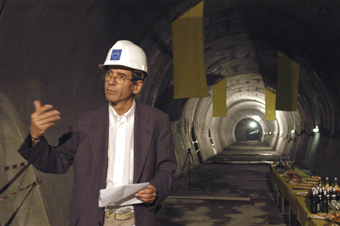
Jean-Luc Baldy, head of civil engineering at CERN, congratulates Natacha Lopez and her team on their excellent work on the excavation of the 3300 metres of tunnels for the CNGS project. Behind him, the 150-metre-long target chamber.
There's no stopping these particles!
The aim of the CNGS project is to produce a high-energy neutrino beam at CERN in 2006 and send it towards the Gran Sasso underground laboratory, where it will be analysed. For this purpose, protons from the SPS will be transported along an approximately 800 metre transfer line before entering a "target chamber" measuring 150 metres long and 6.5 metres in diameter. Here, the protons will bombard a graphite target to produce pions and kaons.
The particles produced will then enter a system of two magnetic horns which will focus the pions and kaons into a parallel beam pointing towards Gran Sasso (see separate article entitled "Assembly of the magnetic horns under way"). Pions and kaons will then decay into muons and muon-neutrinos along the 1000-metre tunnel, at the end of which a "hadron stop" will absorb the hadrons (remaining protons, pions and kaons). Two muon detectors will then measure the flow of muons produced and thus, indirectly, that of the muon-neutrinos.
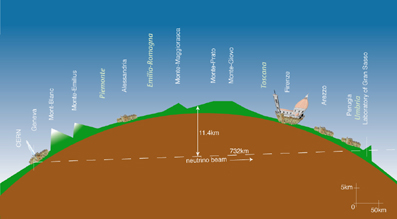
The muon-neutrino beam will finally leave the CERN tunnels, and there will be no stopping the neutrinos, which will begin their journey of some 730 km through the earth's crust towards the Gran Sasso underground laboratory, where the two huge detectors of the ICARUS and OPERA experiments will be waiting for them.
The trajectory of the neutrino beam from CERN to the Gran Sasso Laboratory located underneath 1400 metres of rock, 120 km from Rome.
Underground structures
All of the project's underground structures have already been completed. 45,000 cubic metres of rock have been excavated since September 2000. In March 2002, the tunnelling machine finished excavating a stretch of Leman Basin molasse from the target chamber, through the decay tunnel, to the point where the hadron stop will be positioned. The use of a special cutting machine programmed from a small built-in computer in addition to more traditional cutting machines made it possible to accelerate the excavation work in the most difficult sections.
Concreting was done as excavation progressed. "For the first time at CERN, the access galleries have been lined with shotcrete, which makes their walls less smooth than those of the tunnels. This means that we save both money and time as we won't need to paint them either", explains Natacha Lopez.
The work has been done by the SCS consortium - Spie Batignolles (France), Condotte d'Acqua (Italy) and Sotrabas (France) - and supervised by the GIBB - Hellas consortium (United Kingdom and Greece). The French company Norisko was responsible for safety coordination. The first part of the work has cost 26 million Swiss francs out of a total cost of 77.6 million Swiss francs for the whole CNGS project.
The civil engineering for the project is now entering a second phase. In less than a week, the graphite and steel blocks that will be used to absorb the hadrons will start to be installed in their 26-metre-long chamber, a job that will take seven weeks to complete. The decay tube will then be installed between the target chamber and the hadron stop in the same cavern as the first muon detector. This is to be completed by April 2004. The first components of this vacuum tube measuring 2.5 metres in diameter and 1000 metres long are currently being manufactured in Italy by the SCJV consortium.
The last stage of the civil engineering will be done between May and July 2004 and will consist of the finishing work and the closure of the shaft. The equipment will then be installed inside the 3.3 km of tunnels, so that everything will be ready for the first neutrino beam to be sent to Gran Sasso in spring 2006.
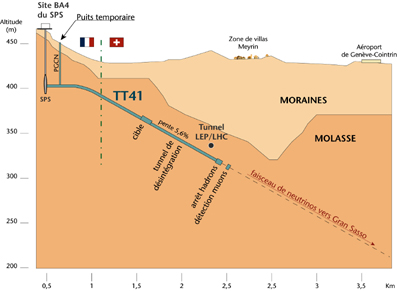
Sectional elevation of the CNGS civil engineering structure.
For more information about the CNGS project, see:
http://proj-cngs.web.cern.ch/proj-cngs/
And for details of the CNGS experiments, see:
ICARUS (Imaging Cosmic And Rare Underground Signals): http://pcnometh4.cern.ch/
OPERA (Oscillation Project with Emulsion-tRacking Apparatus): http://opera.cern.ch
Next week, the Bulletin will publish two articles on
the OPERA and ICARUS experiments:
don't miss them!
Technical info
Cover articleOther (French)
L'excavation et le bétonnage des structures souterraines du projet CNGS (CERN Neutrinos to Gran Sasso) viennent de s'achever. La voie vers le Gran Sasso s'ouvre donc et par la même occasion, un dossier spécial du Bulletin consacré au projet CNGS. Deux volets sont au programme.
Un premier volet, sera consacré, cette semaine, au dispositif permettant d'envoyer en 2006 un faisceau de neutrinos du CERN jusqu'au laboratoire souterrain de l'INFN à Gran Sasso en Italie. Et un second volet, la semaine prochaine, donnera une vue d'ensemble des expériences du projet : OPERA et ICARUS.
Other (French)
L'excavation et le bétonnage des structures souterraines du projet CNGS (CERN Neutrinos to Gran Sasso) viennent de s'achever. La voie vers le Gran Sasso s'ouvre donc et par la même occasion, un dossier spécial du Bulletin consacré au projet CNGS. Deux volets sont au programme.
Un premier volet, sera consacré, cette semaine, au dispositif permettant d'envoyer en 2006 un faisceau de neutrinos du CERN jusqu'au laboratoire souterrain de l'INFN à Gran Sasso en Italie. Et un second volet, la semaine prochaine, donnera une vue d'ensemble des expériences du projet : OPERA et ICARUS.
« 3,3 km de galeries, tunnels et cavernes, situés entre 55 et 122 de mètres de profondeur, ont été excavés et bétonnés en 33 mois, par une équipe d'une centaine de personnes. » Natacha Lopez, responsable du génie civil de CNGS, peut se féliciter du travail réalisé sur le chantier. « Les délais prévus par le CERN ont été tenus à une semaine près et aucun incident particulier n'est survenu. » Fin juin, le génie civil fêtait ainsi la fin de la première phase des travaux souterrains du projet CNGS.
Jean-Luc Baldy, chef du génie civil au CERN, félicite Natacha Lopez et son équipe pour la «très belle réalisation» que constituent les 3300 mètres des galeries du projet CNGS. Derrière lui : la chambre cible de 150 mètres de long.
Particules «passe-murailles»
Le projet CNGS consiste à produire au CERN en 2006 un faisceau de neutrinos de haute énergie et à l'envoyer dans la direction du laboratoire souterrain de Gran Sasso, où il sera analysé. Pour cela, des protons issus du SPS seront transportés le long d'une ligne de transfert d'environ 800 mètres avant d'entrer dans une «chambre cible» de 150 mètres de long et 6,5 mètres de diamètre. A cet endroit, les protons bombarderont une cible de graphite pour donner naissance à des pions et des kaons.
Les particules produites entreront alors dans un système de deux cornes magnétiques qui focaliseront les pions et les kaons en un faisceau parallèle dirigé vers le Gran Sasso (voir l'encadré «Les cornes magnétiques en cours d'assemblage»). Puis, le long d'un tunnel de 1000 mètres, pions et kaons se désintègreront en muons et neutrinos du muon. A la sortie du tunnel, un «hadron stop» absorbera les hadrons (protons, pions et kaons restants). A sa suite, deux détecteurs à muons mesureront le flux de muons produits, et donc indirectement celui de neutrinos du muon.
Le faisceau de neutrinos du muon quittera finalement les galeries du CERN. Et les neutrinos, tels des passe-murailles, entameront leur course de quelque 730 km à travers l'écorce terrestre pour rejoindre le laboratoire souterrain de Gran Sasso, où deux immenses détecteurs les attendront : ceux des expériences ICARUS et OPERA.
La trajectoire du faisceau de neutrinos du CERN jusqu'au laboratoire de Gran Sasso situé sous 1400 mètres de roches, à 120 km de Rome.
Structures souterraines
Toutes les structures souterraines du projet sont aujourd'hui réalisées. 45000 mètres cubes de déblais ont été excavés depuis septembre 2000. En mars 2002, le tunnelier finissait de creuser la molasse du bassin lémanique, de la chambre cible en passant par le tunnel de désintégration, et jusqu'à l'emplacement du «hadron stop». En plus des haveuses classiques, une haveuse programmée à l'aide d'un petit ordinateur de bord a permis d'améliorer les cadences d'excavation dans les endroits les plus difficiles.
Le bétonnage s'est déroulé au fur et à mesure de l'avancée des travaux. « Pour la première fois au CERN, les galeries d'accès ont été finies au béton projeté, ce qui rend leurs parois moins lisses que celles des tunnels. Comme il ne sera pas non plus nécessaire de peindre ces galeries, nous gagnons du temps et de l'argent », précise Natacha Lopez.
C'est le consortium SCS - Spie Batignolles (France), Condotte d'Acqua (Italie) et Sotrabas (France) - qui a assuré les travaux, tandis que le consortium GIBB (Royaume-Uni) - Hellas (Grèce) les supervisait. L'entreprise française Norisko a, quant à elle, coordonné la sécurité. Le montant des travaux de cette première phase s'élève à 26 millions de francs suisses sur un coût global de 77.6 millions de francs suisses pour l'ensemble du projet CNGS.
Le génie civil du projet CNGS entre maintenant dans une deuxième phase. Dans moins d'une semaine et durant sept semaines, les blocs de graphite et d'acier servant à arrêter les hadrons seront mis en place dans la chambre de 26 mètres de long qui leur est destinée. Puis le tube de désintégration sera installé pour fin avril 2004, entre la chambre cible et le «hadron stop» situé dans la même caverne que le premier détecteur à muon. Les premiers éléments de ce tube à vide de 2,5 mètres de diamètre et 1000 mètres de long sont façonnés en Italie par le consortium SCJV.
La dernière étape du génie civil consistera à réaliser, de mai à juillet 2004, les travaux de finitions et la fermeture du puits. Suivra alors l'installation des équipements sur les 3,3 km de galeries. Tout sera en place pour qu'au printemps 2006, le premier faisceau de neutrinos plonge vers le Gran Sasso.
Coupe verticale des ouvrages du projet CNGS.
Pour en savoir plus sur CNGS :
http://proj-cngs.web.cern.ch/proj-cngs
Et sur les expériences du projet :
ICARUS (Imaging Cosmic And Rare Underground Signals) : http://pcnometh4.cern.ch
OPERA (Oscillation Project with Emulsion-tRacking Apparatus) : http://opera.cern.ch
La semaine prochaine, le Bulletin consacrera deux
articles aux expériences OPERA et ICARUS :
à ne pas manquer !
Files
na-2003-079_0306050_01.JPG
Additional details
Identifiers
- CDS
- 627593
- CDS Report Number
- BUL-NA-2003-079
- Aleph number
- 000013261MMD
Related works
- References
- Other: 000013157 (Other)