The Colliderscope: a real-time show
Authors/Creators
Description
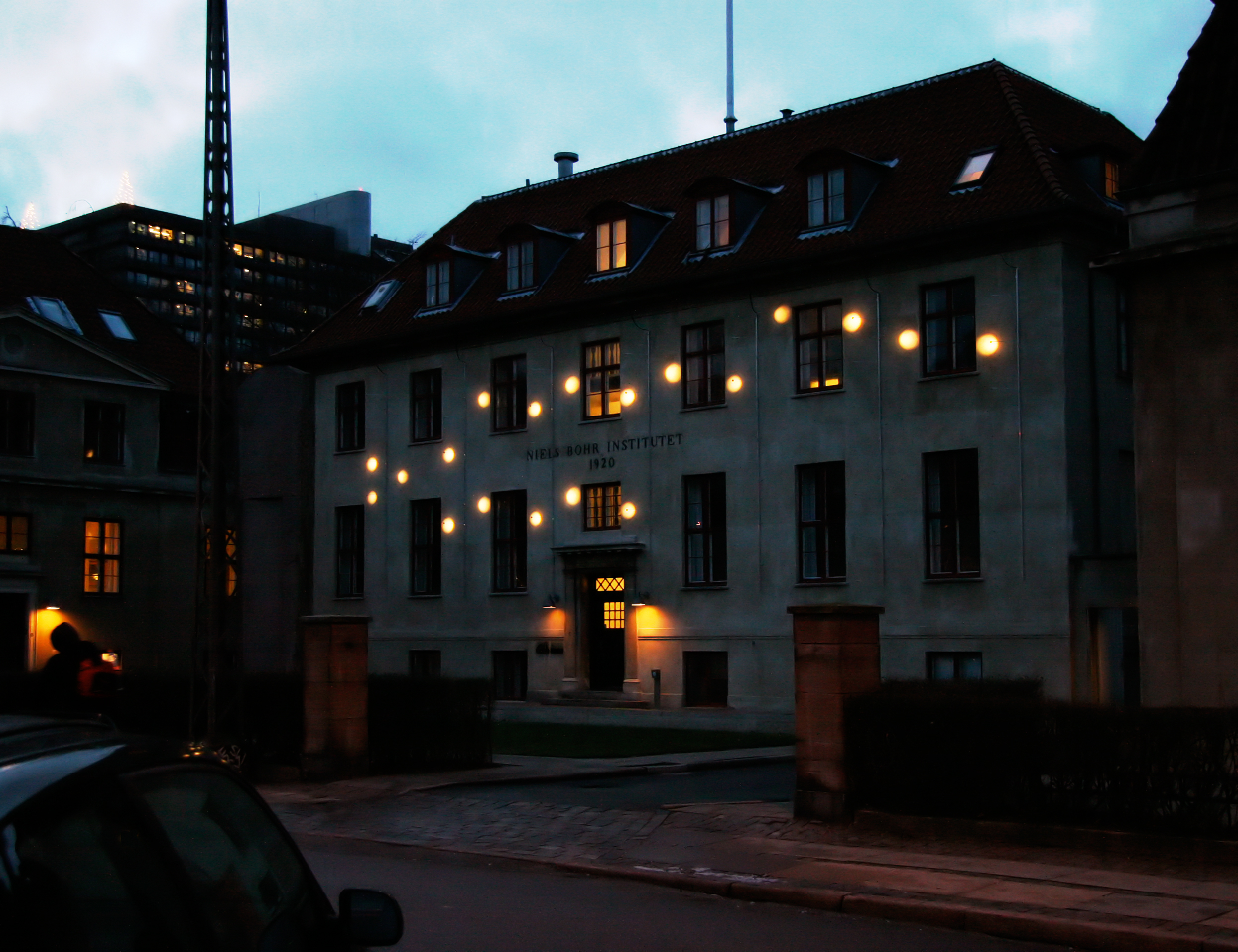
Ninety-six LED lights distributed over the facade of the Niels Bohr Institute (NBI) in Blegdamsvej (Denmark) reproduce the actual signals coming from the Transition Radiation Detector (TRT) in ATLAS. Thanks to the Colliderscope, when a collision occurs below the ground in Geneva, people passing by in Blegdamsvej will be aware of it almost in real-time.
Niels Bohr Institute facade lit up to reflect the latest data from ATLAS-TRT .
The Niels Bohr Institute has participated in the development of the TRT detector, and this is why the NBI physicist Clive Ellegaard had the idea of involving the artists Morten Skriver and Christian Skeel to develop a work of art in which art and science fuse together. “For an artist, the LHC is one of the greatest and most fantastic symbolic constructions of all time, on a par with the Egyptian pyramids”, said Skriver. “At first sight, science and art seem to be two fundamentally different human endeavours. Science tries, with absolute objective precision, to take the world apart in order to understand how the different parts work together. Art tries to assemble the world in totally subjective and ambiguous expressions. However, both science and art pursue the same goal: they try with intelligence and intuition to come as close as possible to an understanding of the mystery of existence.”
When the LHC starts up again in February, the Colliderscope will be able to show what is happening at the TRT with just a few seconds' delay. The Colliderscope is a satellite exhibition of the Esbjerg Art Museum and is currently scheduled to run until 2011. Support for the Colliderscope comes from the Danish Arts Agency, the Velux Foundation and the Niels Bohr Foundation.
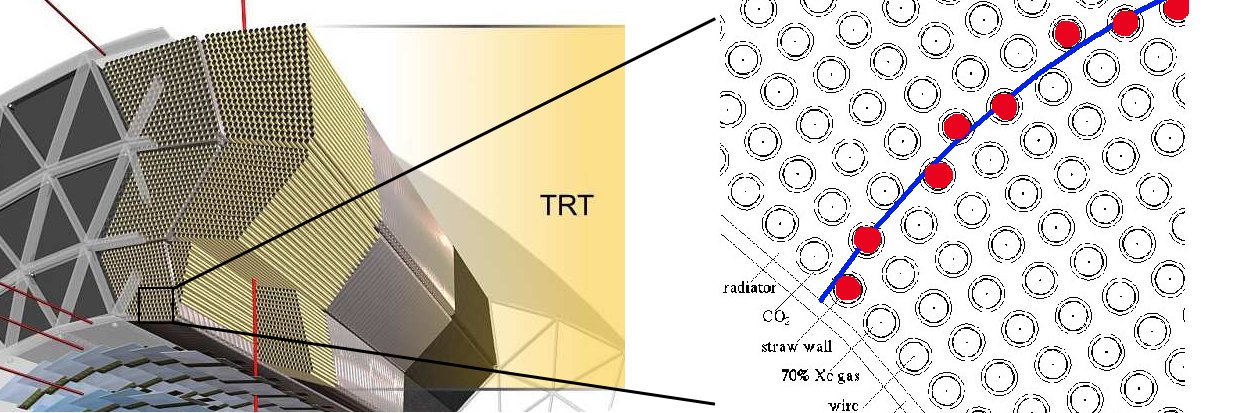
The TRT detector in the ATLAS experiment.
Three parameters measured by the TRT control the way the diode lamps are lit up in the Colliderscope: the momentum and charge of the particle, and the quality of the reconstructed tracks it produces. The momentum of the particles issued from the proton-proton collisions controls the curvature of the light pattern on the building's facade, whereas the charge determines the bending direction. The speed at which lights are lit up follows the momentum log. The quality of the track in the TRT controls the initial intensity of the Colliderscope’s LED lights: higher intensity means best quality of the track reconstruction and slower fading off means best accuracy of the position of the LED with respect to the measured track.
In addition, secondary particles have a specific light time and some LED lights are lit up simultaneously. This is the case for the electrons: since there are no electrons in the colliding protons, the track of an electron in the TRT signifies that "something interesting" happened that warrants extra scrutiny.
More information, pictures are a video are available here.
Other (French)
Quatre-vingt seize lampes à LED réparties sur la façade de l’Institut Niels-Bohr à Blegdamsvej (Danemark) reproduisent les signaux réels en provenance du détecteur à rayonnement de transition (TRT) d’ATLAS. Grâce au Colliderscope, lorsqu’une collision se produit sous terre à Genève, les passants de Blegdamsvey pourront l’observer presque en temps réel.
La facade de l'institut Niels-Bohr où des lumières montrent les dernières données du TRT d'ATLAS.
L’institut Niels-Bohr a participé au développement du détecteur TRT, et c’est pourquoi un physicien du NBI, Clive Ellegaard, a eu l’idée de faire participer les artistes Morten Skriver et Christian Skeel pour développer une œuvre alliant l’art à la science. « Pour un artiste, le LHC est l’une des constructions symboliques les plus fantastiques de tous les temps, c’est comme les pyramides d’Égypte, déclare Skriver. À première vue, l’art et la science semblent être des entreprises humaines fondamentalement différentes. La science essaye, avec une précision objective absolue, de démonter le monde pour comprendre comment les différentes parties s’emboîtent les unes dans les autres. L’art tend à reconstituer le monde sous la forme d’expressions totalement sujectives et ambiguës. Et pourtant, la science et l’art tendent au même but : il s’agit, à force d’intelligence et d’intuition, de se rapprocher autant que possible de la compréhension du mystère de l’existence. »
Lorsque le LHC sera redémarré en février, le Colliderscope permettra de voir ce qui se passe au TRT avec quelques secondes de décalage seulement. Le Colliderscope est une exposition satellite du musée d’art Esjberg et devrait être présenté jusqu’en 2011. L’ œuvre est soutenue par l’Institut danois des arts, la Fondation Velux et la Fondation Niels-Bohr.
Une partie du détecteur TRT dans l'expérience ATLAS.
Trois paramètres mesurés par le TRT déterminent la façon dont les lampes à diodes sont allumées dans le Colliderscope : l’impulsion et la charge de la particule, et aussi la qualité des traces de reconstitution produites. L’impulsion des particules résultant des collisions proton-proton détermine la courbure du tracé lumineux sur la façade du bâtiment, et la charge détermine le sens de cette courbure. La vitesse à laquelle les lumières s’allument est fonction du logarithme de l’impulsion. La qualité des trajectoires dans le TRT détermine l’intensité initiale des lumières du Colliderscope : une forte intensité lumineuse signifie que la reconstitution des trajectoires est excellente et le temps d’affichage est d’autant plus long que la position de la LED correspond plus précisément à la trace mesurée.
De plus, les particules secondaires ont un temps d’illumination spécifique, et certaines lumières LED s’allument simultanément. C’est le cas pour les électrons : comme il n’y a pas d’électrons dans les faisceaux, la trace d’un électron dans le TRT signifie qu’il s’est produit « quelque chose d’intéressant », qu’il faudra étudier de près.
Pour plus d’informations, ainsi que des images, cliquez ici.
Files
ATLAS_TRT_Principle_image.jpg
Files
(1.4 MB)
| Name | Size | Download all |
|---|---|---|
|
md5:2043ee6e417aa583d3caec3d63005572
|
166.1 kB | Preview Download |
|
md5:e43080b7500538f1ef46a2bcde7a8c84
|
1.2 MB | Preview Download |
Additional details
Identifiers
- CDS
- 1234569
- CDS Report Number
- BUL-NA-2010-010
Related works
- Is published in
- Periodical issue: fhra8-vkh41 (CDS)
- Periodical issue: 7y52s-vc840 (CDS)