The Higgs and the inflation of the Universe
Authors/Creators
Description
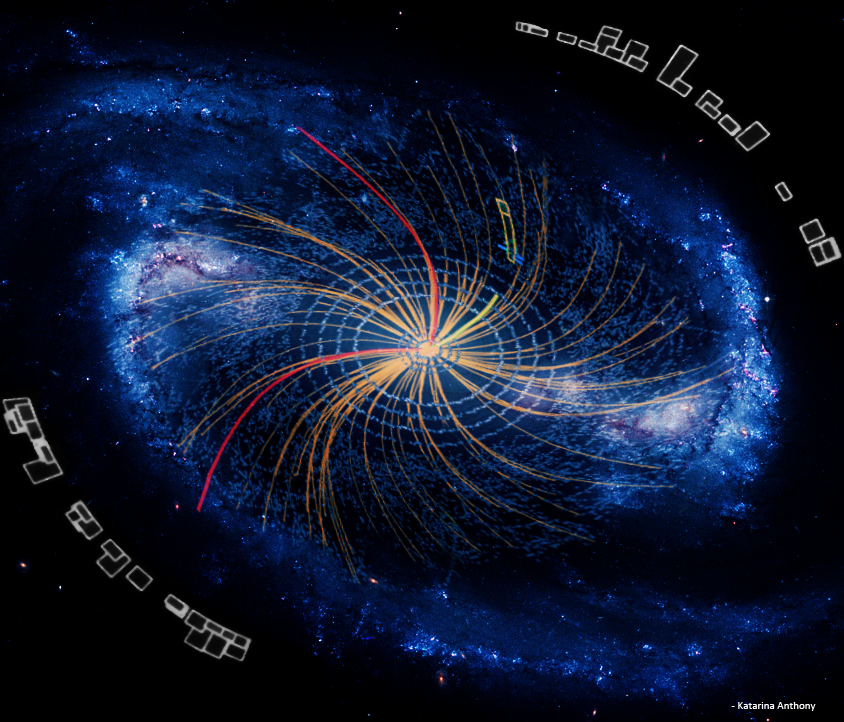
“Inflation” is the theorized very rapid and powerful expansion of the early Universe. This type of evolution could be explained by the presence of a spin-zero elementary particle born with the Big Bang. The Higgs boson is such a particle but this is not sufficient for it to be identified as the “inflaton”, the hypothetical particle thought to be responsible for this inflation.
"The Higgs universe". Image: ATLAS, NASA, ESA and The Hubble Heritage Team (STScI/AURA) - edited by Katarina Anthony.
It is thought that almost immediately (around 10-35 seconds) after the Big Bang, the Universe increased in volume extremely rapidly by undergoing an exponential expansion phase. Following this “inflationary” period, the Universe continued to expand but at a slower rate. A quantum field corresponding to an elementary spin-zero boson could, in principle, have caused such a violent evolution. According to the Standard Model, the Higgs boson is indeed a spin-zero elementary particle. However, all that glitters isn't gold, as CERN’s theorist Gian Giudice points out: “The idea that the Higgs field plays the role of the inflaton is very intriguing. Unfortunately, this cannot be the case in the framework of the plain Standard Model.”
The problem for the theory is that the Higgs boson seems to need a sort of “correction” in order to play the role of the inflaton. “A possible solution could be an anomalously large gravitational interaction between the Higgs field and the curvature of the space-time geometry,” says Gian Giudice. “Such large coupling implies the existence of new heavy particles. In other words, inflation would not be driven by the Higgs field alone but, at best, by a combination of the Higgs field with other, still unknown, fields.”
How will the experiments probe all these theories? “It will be very difficult for the LHC experiments to investigate the properties of the Higgs boson deeply enough to provide an answer,” says Sergio Bertolucci, CERN’s Director for Research and Computing. However, some information could also come from cosmological experiments such as the ESA satellite, Planck. “There is still much to learn from the structure of the Cosmic Microwave Background (CMB) and we are eagerly awaiting the results from the Planck satellite. Discovery of non-gaussianity in the temperature fluctuations of the CMB would open new avenues in our understanding of inflationary dynamics,” says Gian Giudice.
“We need to understand the Higgs boson and its field much more deeply before we can say the last word on its role in the evolution of the Universe,” concludes Sergio Bertolucci. In other words, it may very well be that not all the questions about the Higgs boson will be answered by the LHC.
Other (French)
Le terme « inflation » désigne l’expansion très rapide de l’Univers primordial décrite par la théorie. Ce type d'évolution pourrait s’expliquer par la présence d’une particule élémentaire de spin zéro née avec le Big Bang. Le boson de Higgs correspond bien à ces caractéristiques, mais cela n’est pas suffisant pour qu’on puisse le considérer comme étant l’« inflaton », l’hypothétique particule qui serait responsable de cette inflation.
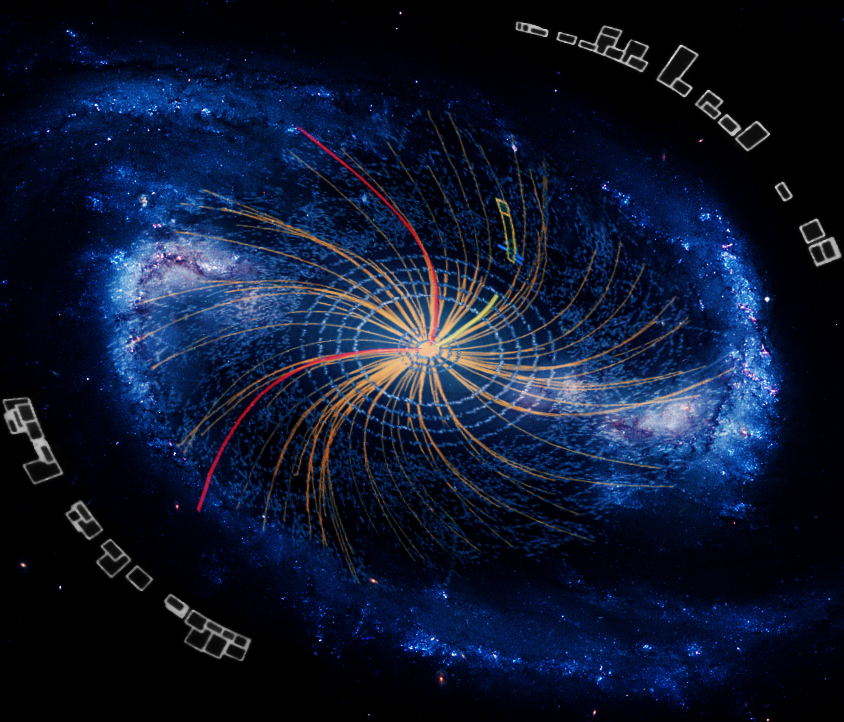
« L'Univers de Higgs ». Image : ATLAS, NASA, ESA et The Hubble Heritage Team (STScI/AURA) - modifiée par Katarina Anthony.
Les physiciens pensent que presque immédiatement (environ 10-35 secondes) après le Big Bang, l’Univers s’est accru en volume de façon très rapide, en traversant une phase d’expansion exponentielle. Après cette période dite d’inflation, l’Univers aurait continué à s’étendre, mais à un rythme plus lent. Un champ quantique correspondant à un boson élémentaire de spin zéro pourrait en principe être la cause de cette évolution très violente. D’après le Modèle standard, le boson de Higgs est bien une particule élémentaire de spin zéro. Malheureusement, tout ce qui brille n’est pas or, comme le souligne Gian Giudice, théoricien au CERN : « L’idée que le champ de Higgs joue le rôle de l’inflaton est très intéressante. Mais cela ne peut pas être le cas dans le Modèle standard ordinaire. »
Le problème pour la théorie est que le boson de Higgs semble devoir bénéficier d’une sorte de « correction » pour pouvoir jouer le rôle d’inflaton. « Une solution possible serait une interaction gravitationnelle anormalement importante entre le champ de Higgs et la courbure de la géométrie de l’espace-temps, explique Gian Giudice. Un couplage aussi fort suppose l’existence de nouvelles particules lourdes. En d’autres termes, l’inflation ne serait pas commandée par le champ de Higgs seul, mais au mieux, par une combinaison du champ de Higgs avec d’autres champs, encore inconnus. »
Comment les expériences pourront-elles mettre à l’épreuve toutes ces théories ? « Il sera très difficile pour les expériences LHC de mesurer les propriétés du boson de Higgs de façon assez approfondie pour pouvoir donner la réponse », déclare Sergio Bertolucci, directeur de la recherche et de l’informatique au CERN. Toutefois, certaines informations pourraient être obtenues d’expériences cosmologiques telles que le télescope spatial Planck de l’ESA. « Il reste beaucoup à apprendre de la structure du fonds cosmologique diffus, et nous attendons avec impatience les résultats du télescope Planck. La découverte du caractère non-gaussien des fluctuations de température dans le fond cosmologique diffus ouvrirait des voies nouvelles pour la compréhension de la dynamique de l’inflation », poursuit Gian Giudice.
« Nous devrons comprendre le boson de Higgs et son champ de façon bien plus approfondie avant d'être en mesure de nous prononcer définitivement sur le rôle de cette particule dans l'évolution de l'Univers », conclut Sergio Bertolucci. En d’autres termes, il est très possible que toutes les questions concernant le boson de Higgs ne puissent pas recevoir de réponse au LHC.
Files
HiggsUniverse_2_image.png
Files
(1.7 MB)
| Name | Size | Download all |
|---|---|---|
|
md5:fca449c878573c8addb9ac3c9575eb7d
|
861.4 kB | Preview Download |
|
md5:97938527ea657711bdb3cb08334c6498
|
860.3 kB | Preview Download |
Additional details
Identifiers
- CDS
- 1525938
- CDS Report Number
- BUL-NA-2013-047
Related works
- Is published in
- Periodical issue: 0fzr5-1c621 (CDS)
- Periodical issue: 8wdrh-9h011 (CDS)
- Periodical issue: 8196c-9xw23 (CDS)