Voices of Romanian scientists
Authors/Creators
Description
As Romania has now become a Member State of CERN, Romanian scientists share their thoughts about this new era of partnership for their community.
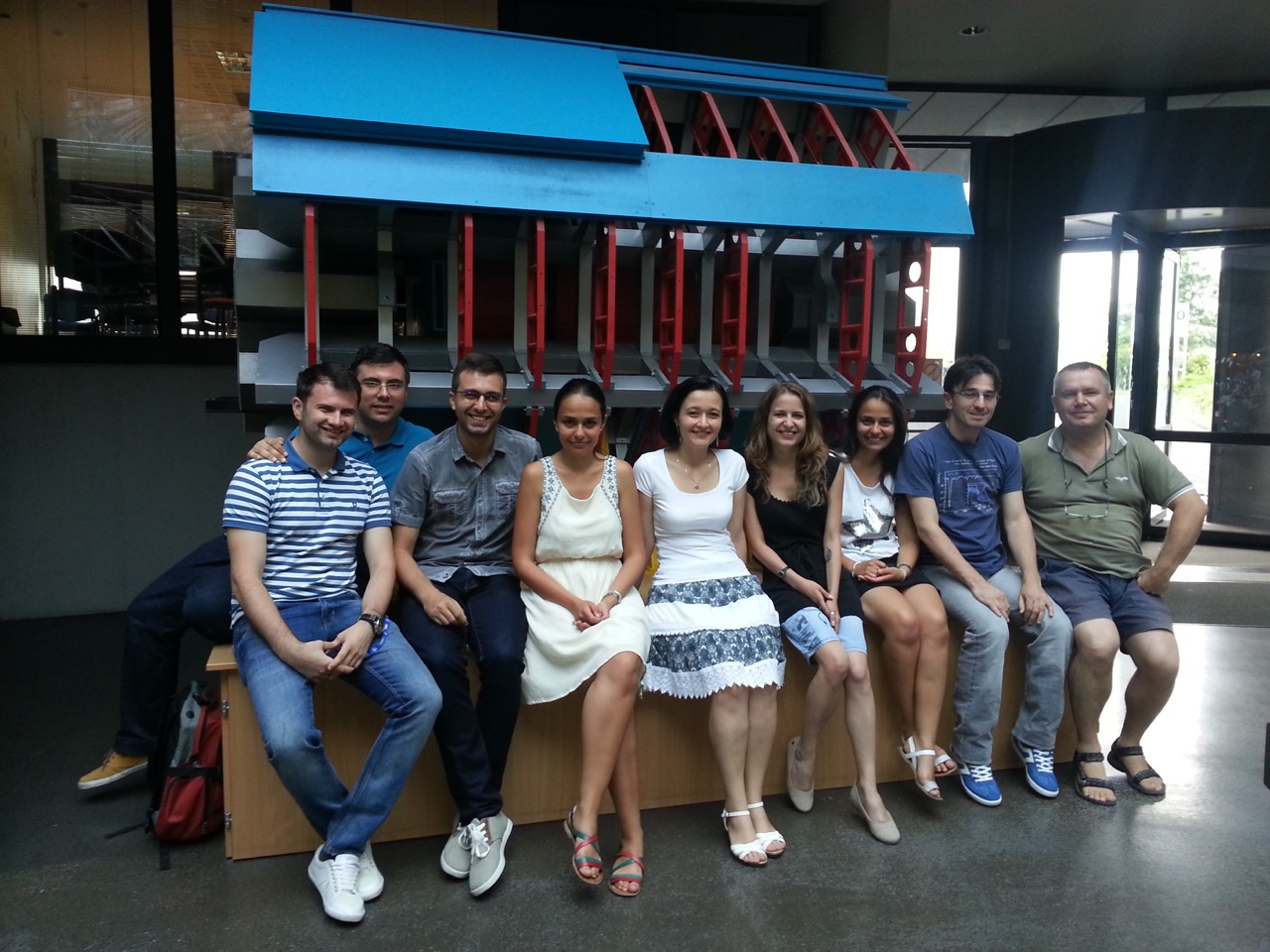
Members of ATLAS from Romanian institutes at CERN (from left to right): Dan Ciubotaru, Michele Renda, Bogdan Blidaru, Alexandra Tudorache, Marina Rotaru, Ana Dumitriu, Valentina Tudorache, Adam Jinaru, Calin Alexa.
On 17 July 2016, Romania became the twenty-second Member State of CERN, 25 years after the first cooperation agreement with the country was signed. “CERN and Romania already have a long history of strong collaboration”, says Emmanuel Tsesmelis, head of Relations with Associate Members and Non-Member States. “We very much look forward to strengthening this collaboration as Romania becomes CERN’s twenty-second Member State, which promises the development of mutual interests in scientific research, related technologies and education,” he affirms.
Romania's scientific community at CERN has grown over the years and currently numbers around a hundred visiting scientists involved in the LHC experiments ALICE, ATLAS and LHCb as well as NA62, n_TOF, ISOLDE and the Worldwide LHC Computing Grid. Some of these physicists share their thoughts about this new stage for their community.
“I am very proud and honored to be a member of the Romanian team in this very exciting moment when we become a Member State,” comments Valentina Tudorache, a member of the ATLAS collaboration from the National Institute for Physics and Nuclear Engineering (IFIN-HH) in Bucharest. “I strongly believe that as a new Member State we will have the opportunity to contribute even more to CERN’s mission particularly at this important time of the year while many analyses are under way so that we can publish LHC Run 2 results,” she concludes.
“With Romania being a CERN Member State, we really hope that this will create the necessary conditions to enhance the synergies, with real benefits on both sides,” declares Mihai Petrovici, head of the Hadron Physics department at IFIN-HH and leader of one of the Romanian teams within ALICE. “The Romanian scientific community has the chance to become more coherent, competitive and visible within the various research activities carried out at CERN. Having access to all CERN facilities on an equal footing with other Member States will have a significant impact on the efficiency and motivation of many researchers and young talented students planning to join this field of research in Romania,” he remarks.
“From the very beginning, we have received a huge amount of support from the CERN administration and we have been greatly encouraged by our colleagues,” says Calin Alexa of IFIN-HH’s Particle Physics department, who is also Romania’s National Contact Physicist in ATLAS and head of his institute’s ATLAS group. What it will change is that the Romanian groups at CERN will benefit from greater stability, increased confidence and a formal support structure. This stability is of a primary importance, especially for the funding agencies.”
“The status of Romania as a Member State of CERN will have a major impact, especially for students, who will now have the opportunity to be much more involved in CERN experiments from a younger age thanks to the fellowship or summer student programmes,” states Ana Elena Dumitriu, a PhD student in the ATLAS collaboration and member of the Department of Elementary Particle Physics at IFIN-HH.
“I don't see this as reaching a final destination, but rather as an important milestone in a long journey that we started many years ago,” affirms Andrei Gheata, a member of CERN’s EP-SFT group. “Romanian researchers, computer scientists, engineers and technicians have been participating in many CERN projects for quite some time, and I have witnessed a constant increase in this participation during the last 15 years,” he continues. “I am confident that this will bring about many opportunities that will benefit both Romanian research and industry, while also contributing to CERN's mission to push the limits of knowledge and technology,” he concludes.
Other (French)
À l’heure où la Roumanie devient État membre du CERN, des scientifiques roumains nous disent comment ils envisagent cette nouvelle ère pour leur communauté.
Des membres roumains des équipes d’ATLAS au CERN. De gauche à droite : Dan Ciubotaru, Michele Renda, Bogdan Blidaru, Alexandra Tudorache, Marina Rotaru, Ana Dumitriu, Valentina Tudorache, Adam Jinaru, Calin Alexa.
Le 17 juillet 2016, la Roumanie est devenue le vingt-deuxième État membre du CERN, 25 ans après la signature du premier accord de coopération. « Le CERN et la Roumanie ont déjà une longue et forte tradition de collaboration, explique Emmanuel Tsesmelis, chargé des relations avec les États membres associés et les États non-membres. Nous sommes très heureux de renforcer cette collaboration avec l’arrivée de la Roumanie comme vingt-deuxième État membre du CERN, ce qui promet un renforcement des échanges en matière de recherche scientifique, de technologie et d’éducation. »
La communauté scientifique roumaine au CERN s’est développée au fil des années, et compte actuellement une centaine de visiteurs scientifiques participant aux expériences LHC ALICE, ATLAS et LHCb, ainsi qu'aux expériences NA62, n_ToF, ISOLDE et à la Grille de calcul mondiale pour le LHC. Certains de ces physiciens nous font part de leurs impressions concernant cette nouvelle étape.
« Je suis très fière et très honorée de faire partie des équipes roumaines à ce moment très important, où mon pays devient État membre, déclare Valentina Tudorache, membre de la collaboration ATLAS, de l’Institut national de physique et de génie nucléaire (IFIN-HH) à Bucarest. Je suis fermement convaincue que nous aurons maintenant la possibilité de contribuer encore plus à la mission du CERN, à ce stade crucial où de nombreuses analyses sont menées en vue de la publication des résultats de la deuxième période d’exploitation du LHC », conclut-elle.
« Maintenant que la Roumanie est État membre du CERN, nous espérons que cela créera les conditions nécessaires pour renforcer les synergies, ce qui sera bénéfique de part et d’autre, déclare Mihai Petrovici, chef du Département de physique hadronique de l’IFIN-HH et chef d’une équipe roumaine d’ALICE. La communauté scientifique roumaine a ainsi la possibilité de devenir plus cohérente, plus compétitive et plus visible dans le cadre des diverses activités de recherche menées au CERN. L’accès à toutes les infrastructures du CERN sur un pied d’égalité avec les autres États membres aura un impact important sur l’efficacité et la motivation de nombreux chercheurs et de jeunes talents qui envisagent de rejoindre ce domaine de recherche en Roumanie », relève-t-il.
« Depuis le tout début, nous avons reçu un très grand soutien de l’administration du CERN et nous avons été grandement encouragés par nos collègues, explique Calin Alexa, du Département de physique des particules de l’IFIN-HH, qui est également le physicien de contact pour la Roumanie à ATLAS et le chef du groupe IFIN-HH d’ATLAS. Ce que cela va changer, c’est que les équipes roumaines au CERN auront une plus grande stabilité, manifesteront plus d’assurance et auront une structure d’appui officielle. Or cette stabilité a une importance capitale, en particulier pour les organismes de financement. »
« Le statut d’État membre de la Roumanie aura un impact majeur, en particulier pour les étudiants qui auront la possibilité de participer bien davantage aux expériences du CERN, à un stade plus précoce de leurs études, par l’intermédiaire des programmes de boursiers ou du programme des étudiants d’été », déclare Ana Elena Dumitriu, doctorante de la collaboration ATLAS et membre du Département de physique des particules élémentaires à l’IFIN-HH.
« Pour moi, ce n’est pas un aboutissement, mais plutôt une étape importante d’un long voyage qui a été entrepris il y a de nombreuses années, affirme Andrei Gheata, membre du groupe EP-SFT du CERN. Chercheurs, informaticiens, ingénieurs et techniciens participent à de nombreux projets du CERN depuis pas mal de temps, et j’ai pu observer un accroissement constant de cette participation au cours des 15 dernières années, poursuit-il. Je suis certain que cela ouvrira de nouvelles perspectives et s’avérera très bénéfique, pour la recherche comme pour l’industrie roumaine ; cela s’inscrit bien dans la mission du CERN, qui est de repousser les limites de la connaissance et de la technologie », conclut-il.
Files
20160718_181111_image.jpeg
Files
(293.6 kB)
| Name | Size | Download all |
|---|---|---|
|
md5:0524ba010a61248ebd0b1bf35ffa536c
|
293.6 kB | Preview Download |
Additional details
Identifiers
- CDS
- 2201023
- CDS Report Number
- BUL-NA-2016-137
Related works
- Is published in
- Periodical issue: 9etm4-nvz15 (CDS)
- Periodical issue: e7bfk-8p094 (CDS)
- Periodical issue: hv3ch-agv28 (CDS)