The Proton Synchrotron, going strong at fifty years
Authors/Creators
Description
It was on the evening of 24 November 1959 that an incredulous Hildred Blewett, on detachment to CERN from the Brookhaven laboratory, exclaimed “Yes! We’re through transition!” The first beam of ten billion protons had not only broken through the 5.2 GeV barrier but gone on all the way to 24 GeV, the machine’s top energy at that time.
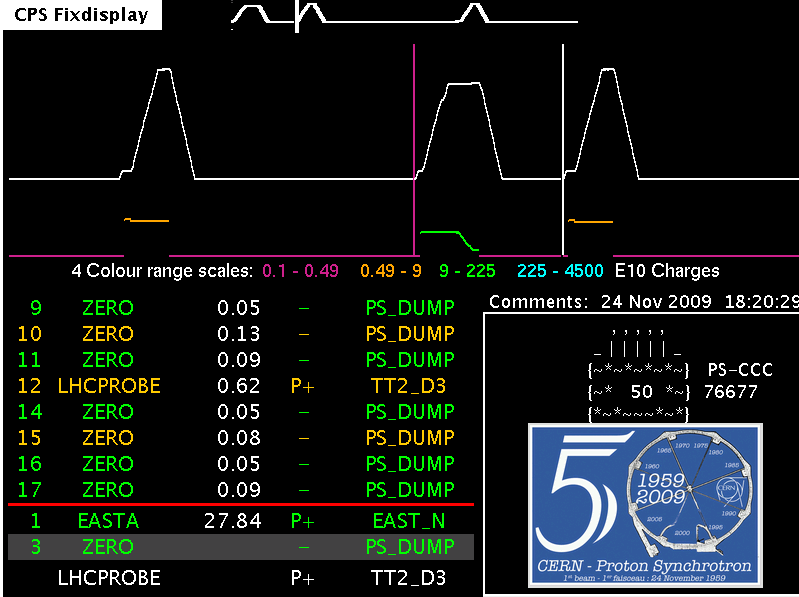
An operational screenshot from the PS, taken on its 50th anniversary. The three white peaks depict different phases (cycles) of the PS’s operation. In the first and third cycle, the PS is producing a very low-intensity beam for LHC commissioning. In the second cycle, protons are being spilled out for use in the East Area.
Over the years, a complex of linear and circular accelerators and storage rings grew up around the PS. In the mid-1990s the complex was at its peak, with eight accelerators: Linac 2 and Linac 3 for protons and heavy ions; the Antiproton Collector and Antiproton Accumulator (AC and AA); the Low-Energy Antiproton Ring (LEAR); the Linear Injector for LEP (LIL); the Electron and Positron Accumulator (EPA); and the PS Booster (PSB). The latter made it possible to increase the PS’s intensity to its current record of 3.15×10¹³ protons per pulse, more than three thousand times as many as at start-up.
In the course of its long career, the Proton Synchrotron has, notwithstanding its name, also been used to accelerate a broad range of other particles, including both light ions (deuterons, alpha particles, oxygen and sulphur) and heavy ions (indium and lead), in addition to antiprotons for the ISR and the SPS and leptons for LEP. From 1983 to 1996, the PS worked as an antiproton decelerator for LEAR, which was later converted into the heavy-ion ring LEIR.
Today, the PS continues to play a vital role in the distribution of proton beams to the SPS and the East Area and in the production of antiprotons for the AD and neutrons for nTOF. It is also an essential part of the LHC injector chain for protons and heavy ions. Among its other duties, the PS is responsible for correctly shaping and spacing the bunches that go to the LHC at the end of the injector chain.
Over the last fifty years the PS has not only provided particles for the physics community but has also given rise to numerous innovations in accelerator technology, including extraction techniques (single-turn extraction by means of kicker magnets, slow extraction by means of sextupole resonance excitation, continuous transfer in five turns and, more recently, the multi-turn extraction scheme being installed in 2009), tomographic reconstruction of the longitudinal phase space, the use of a flying wire to measure emittance, and countless feats of RF gymnastics. The importance of pulse-to-pulse modulation must be emphasised at this point. This technique was used from the end of the 1960s to provide a wide range of different users with a series of beams whose energies and intensities could vary from one cycle to the next.
Despite its long and distinguished career, the PS is nowhere near ready for retirement.
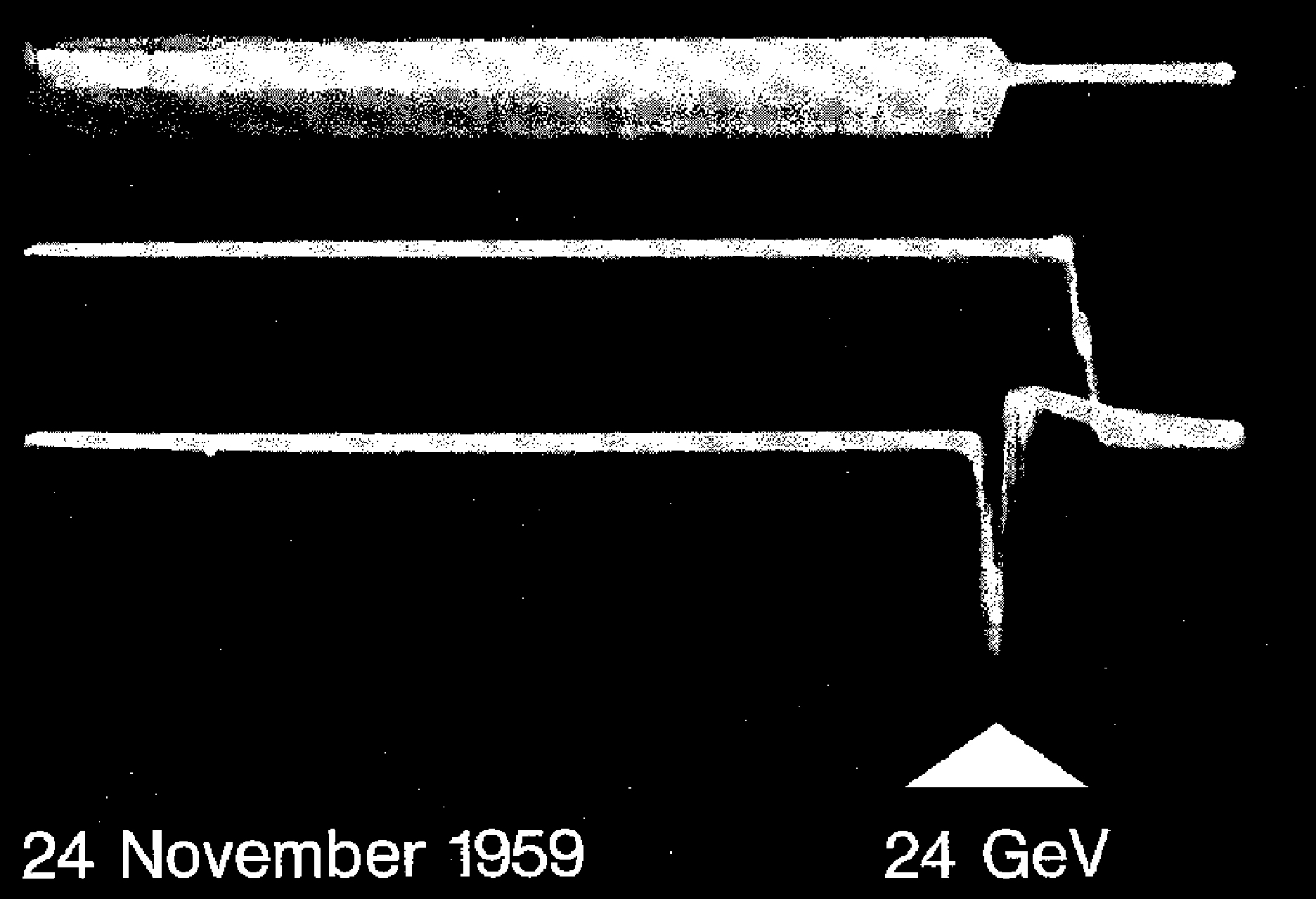
These first oscilloscope tracks (from top to bottom: beam intensity, terminal voltage of main magnet, and timing signal marking the end of acceleration) show how a proton beam was accelerated to 24 GeV, making the PS the most powerful particle accelerator in the world at the time. (Photo CERN Courier, No. 11, vol.9, Nov. 1969).
In 2013 the machine will be equipped with a new proton pre-injector called Linac 4. It is not until the 2020s that the PS is expected to give way to its successor, dubbed PS2. CERN’s Proton Synchrotron is thus in line for at least ten more years of service. Its long life is a tribute to the care with which the original designers built this machine, which has withstood the test of time, and to the care which their successors lavished on the upkeep and modernisation of its components. Happy birthday, PS, and many happy returns!
Further reading: in the October issue of the CERN Courier articles on the PS Anniversary.
A symposium to commemorate many significant events that have marked high-energy physics in the past 50 years was held at CERN on 3-4 December 2009.
Other (French)
C’est dans la soirée du 24 novembre 1959 qu’Hildred Blewett, détachée au CERN par le laboratoire de Brookhaven, s’exclame, incrédule: «Oui, ça y est, on a passé la transition!». Un premier faisceau de 1010 protons avait non seulement passé la barre fatidique des 5,2 GeV, mais il avait même déjà atteint 24 GeV, l’énergie maximale de la machine à l’époque.
Écran montrant le fonctionnement du PS, photographié le jour de son 50e anniversaire. Les trois pics blancs indiquent différentes phases d'opération (cycles) du PS. Durant le premier et le troisième cycle, le PS produit un faisceau de très faible intensité pour la mise en route du LHC. Pendant le second cycle, le PS déverse des protons vers la zone Est.
Au fil des années, le PS s’est entouré d’un complexe d’accélérateurs linéaires et circulaires et d’anneaux de stockage, dont le nombre a culminé jusqu’à huit au milieu des années 90: Linacs 2 et 3 à protons et à ions lourds, collecteur et accumulateur d’antiprotons (AC et AA), anneau à antiprotons de basse énergie (LEAR), injecteur linéaire pour le LEP (LIL), anneau d’accumulation d’électrons et de positons (EPA) et synchrotron injecteur (PSB). C’est ce dernier qui a permis au PS d’augmenter son intensité, jusqu’à atteindre son record actuel de 3,15×10¹³ protons par impulsion, plus de 3000 fois celle du démarrage.
Malgré son nom, le synchrotron «à protons» a, durant sa longue carrière, accéléré une grande gamme d’autres particules: ions légers (deutons, alphas, oxygène et soufre) et lourds (indium et plomb), antiprotons pour les ISR et le SPS, et leptons pour LEP. De 1983 à 1996, le PS a également servi de décélérateur d’antiprotons pour le LEAR, désormais converti en anneau à ions lourds LEIR.
Aujourd’hui, le PS continue de jouer un rôle primordial comme distributeur de faisceaux de protons pour le SPS, pour la zone Est, la production d’antiprotons à l'AD, et de neutrons à nTOF, ainsi que dans la chaîne d’injecteurs de protons et d’ions lourds du LHC. Entre autres tâches, c’est lui qui définit la structure des paquets et leur espacement dans le grand collisionneur au bout de la chaîne.
Durant ces cinquante années, en plus de servir en particules la communauté de physique, le PS a été le moteur de nombreuses innovations en technologie des accélérateurs: méthodes d’extraction (extraction en un tour par aimant de déflexion rapide, extraction lente par excitation de résonnance sextupolaire, «transfert continu» en 5 tours et, plus récemment, extraction multi-tours en cours de mise en route en 2009), reconstitution de l’espace des phases longitudinal par tomographie, mesure d’émittances par fil volant et innombrables gymnastiques radio fréquence. On doit aussi souligner l’importance de la «modulation d’impulsion à impulsion», qui a permis, dès la fin des années 60, de fournir toute une série de faisceaux d’énergies et d’intensités différentes d’un cycle à l’autre, à une grande variété d’utilisateurs.
Malgré une si riche et longue histoire, le PS n’est pas encore prêt pour la retraite: en 2013, la machine sera équipée d’un nouveau pré-injecteur de protons, le Linac 4.
Ces premières traces sur l’oscilloscope (de haut en bas: intensité du faisceau, tension aux bornes de l’aimant principal et signal de séquencement marquant la fin de l’accélération) indiquent qu’un faisceau de protons a été accéléré jusqu’à 24 GeV, faisant du PS l’accélérateur de particules le plus puissant du monde. (Photo Courrier CERN, nº 11 vol.9, nov. 1969).
Visitez également les pages du numéro d'octobre du Courrier CERN consacrées au PS.
Un symposium consacré aux événements majeurs qui ont marqué la physique des hautes énergies ces 50 dernières années s'est tenu au CERN les 3 et 4 décembre 2009.
Files
PS50_image.jpg
Files
(436.1 kB)
| Name | Size | Download all |
|---|---|---|
|
md5:9d77030745ec667ed37bdb6a68717d16
|
381.1 kB | Preview Download |
|
md5:afa1e8a9ce7ec8191fb3b6865a0c6dd6
|
55.0 kB | Preview Download |
Additional details
Identifiers
- CDS
- 1224647
- CDS Report Number
- BUL-NA-2009-392
Related works
- Is published in
- Periodical issue: 3mw9g-yrx81 (CDS)
- Periodical issue: ajm55-q3n10 (CDS)