Hubert Curien, architect of science in Europe
Authors/Creators
Description
Professor Hubert Curien, former French Research Minister and President of the CERN Council from 1994 to 1996, passed away on 6 February 2005 at the age of 80.
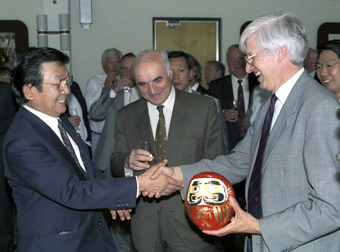
Hubert Curien (in the middle) with the Japanese Minister for Education, Science and Culture, Kaoru Yosano, and CERN's Director-General, Christopher Llewellyn Smith, at the ceremony marking the start of collaboration between CERN and Japan in 1995.
It is impossible to summarise all of Professor Curien's many contributions to the fields of science, politics and management in a few lines. One of the dominating features of his career, however, was undoubtedly his tireless promotion and crafting of a strong and united scientific Europe.
Born in 1924, Professor Curien passed the physics agrégation, a competitive teaching examination, at the Ecole Normale Supérieure in 1949. His speciality was crystallography, a field in which he obtained his doctorate in 1952. A lecturer at the Ecole Normale Supérieure and subsequently the University of Paris VI, he attached great value to the transmission of knowledge and carried on teaching until 1994.
Professor Curien was Director-General of the French National Scientific Research Centre (CNRS) from 1969 until 1973. In 1972 he became President of the French National Space Study Centre (CNES), where he threw all his energy into the development of the Ariane space launcher, which successfully completed its maiden flight on 24 December 1979. Regarded as the father of the European space programme since that time, Professor Curien also headed the European Space Agency from 1981 to 1984, the year in which he was appointed France's Minister of Research. He served in this capacity under four governments between 1984 and 1993, the year of his appointment as President of the CERN Council. From 2001 to 2003 he was President of the French Academy of Science.
Professor Curien's three-year term of office as President of the CERN Council came at a time when difficult decisions on the Large Hadron Collider (LHC) project had to be taken. In December 1994, at the end of his first year in office, the Council reached a consensus in favour of building the LHC in two stages using the available resources. However, at the end of his term of office in December 1996, the CERN Member States reached an agreement providing for the LHC's construction in a single stage with the help of additional contributions from non-Member States. Professor Curien played a leading role in securing the United States' participation in the LHC, which represents an important contribution towards the successful realisation of the project.
He was also closely involved in Japan's entry to the project, as illustrated by this photograph taken in 1995, which shows him with the Japanese Minister for Education, Science and Culture, Kaoru Yosano, and CERN's Director-General, Chris Llewellyn Smith. At this ceremony to mark the start of collaboration between CERN and Japan, Minister Yosano presented Professor Llewellyn Smith with a wooden Daruma doll. In line with Japanese tradition, the doll was painted with one eye to mark the start of the LHC project and the second eye will be added upon the project's completion. It is sad to think that Professor Curien will not be there to see the second eye being painted onto the doll when LHC operation begins in 2007.
Everyone who knew Professor Curien speaks of his unfailing good humour and the courteous smile that never left him. Despite his considerable stature and international reputation, he always remained a disarmingly modest man. The physics community and the CERN personnel owe him a great debt and in him European science has lost one of its most brilliant champions.
Other (French)
Le Professeur Hubert Curien, ancien Ministre français de la Recherche et Président du Conseil du CERN de 1994 à 1996, est décédé le 6 février dernier, à l'âge de 80 ans.
Hubert Curien (au centre) avec le Ministre de l'Education, des Sciences et de la Culture japonais, Kaoru Yosano, et le Directeur général du CERN, Christopher Llewellyn Smith, lors de la cérémonie marquant les débuts de la collaboration entre le CERN et le Japon, en 1995.
Il est impossible de résumer en quelques lignes toutes les contributions de Hubert Curien, que ce soit dans le domaine scientifique, politique ou managérial. S'il fallait trouver un fil conducteur ce serait sans nul doute celui d'une Europe scientifique unie et forte, dont il fut un inlassable promoteur et artisan.
Né en 1924, Hubert Curien obtient l'agrégation de physique à l'Ecole normale supérieure en 1949. Il se spécialise dans la cristallographie, do-maine dans lequel il passe son doctorat en 1952. Professeur à l'Ecole normale supérieure, puis à l'Université de Paris VI, il ne cesse d'enseigner, jusqu'en 1994, très attaché à cette mission de transmission du savoir.
En 1969, Hubert Curien est nommé Directeur général du Centre National de la Recherche Scientifique (CNRS) française, fonction qu'il occupe jusqu'en 1973. Trois ans plus tard, il devient Président du Centre National d'Etudes Spatiales (CNES). A ce poste, il met toute son énergie pour mener à bien le projet de lanceur spatial européen, Ariane, dont le premier vol se déroule le 24 décembre 1979. Considéré depuis comme le père du programme spatial européen, Hubert Curien préside également l'Agence Spatiale Européenne de 1981 à 1984. Il devient Ministre de la Recherche du gouvernement français en 1984. Le portefeuille lui est confié quatre fois jusqu'en 1993, année au cours de laquelle il est nommé Président du Conseil du CERN. De 2001 à 2003, il est le Président de l'Académie des Sciences.
Les trois années de mandat d'Hubert Curien en tant que Président du Conseil du CERN coïncident avec une période de difficiles décisions sur le projet de Grand collisionneur de hadrons (LHC). A la fin de sa première année de présidence, en décembre 1994, le Conseil du CERN parvient à un consensus pour construire le LHC en deux étapes, avec les ressources disponibles. Toutefois, à la fin de son mandat, en décembre 1996, un pas supplémentaire est franchi par un accord entre les Etats membres du CERN pour construire le LHC en une seule étape, grâce aux contributions supplémentaires d'Etats non-membres. Hubert Curien est ainsi l'un des artisans de la participation des Etats-Unis au LHC, une contribution importante pour la réussite du projet.
Il en est de même pour le Japon, comme l'illustre cette photo prise en 1995, où Hubert Curien apparaît encadré par le Ministre de l'Education, des Sciences et de la Culture japonais, Kaoru Yosano, et le Directeur général du CERN, Christopher Llewellyn Smith. Lors de cette cérémonie marquant les débuts de la collaboration entre le CERN et le Japon, le Ministre japonais offre au Directeur général du CERN une poupée Daruma. Selon la tradition japonaise, un oeil est peint sur cette poupée en bois pour marquer le début de la réalisation du projet LHC, le second doit être dessiné lors de son achèvement. Il est triste que Hubert Curien ne puisse être présent lorsque le second oeil sera peint, après le début d'exploitation du LHC en 2007.
Toutes les personnes qui ont côtoyé Hubert Curien témoignent de sa constante bonne humeur, de cette courtoisie souriante dont il ne se départait jamais. Sa haute stature et ses réalisations reconnues internationalement n'avaient pas entamé une modestie désarmante. La communauté de la physique des particules et le personnel du CERN doivent beaucoup à Hubert Curien. Et l'Europe scientifique a perdu l'un de ses plus brillants avocats.
Files
na-2005-020_9506032_06.jpg
Files
(98.3 kB)
| Name | Size | Download all |
|---|---|---|
|
md5:30d5fb679bfc49ce0221cc9d18f8e0d2
|
98.3 kB | Preview Download |
Additional details
Identifiers
- CDS
- 823380
- CDS Report Number
- BUL-NA-2005-020
- Aleph number
- 000034807MMD
Related works
- References
- Other: 000015174 (Other)