By invitation only
Authors/Creators
Description
The Hôtel Métropole in Brussels is a legendary conference venue that will ring a bell to all physicists. 100 years after the first meeting of the Conseil de Physique Solvay, a representative group of the world’s most eminent physicists met again in October this year in the Excelsior Room to discuss “The Theory of the Quantum World”. Three members of CERN's Theory Group were invited to participate. Gian Giudice, one of them, shares with us his thoughts and impressions about this exclusive conference.
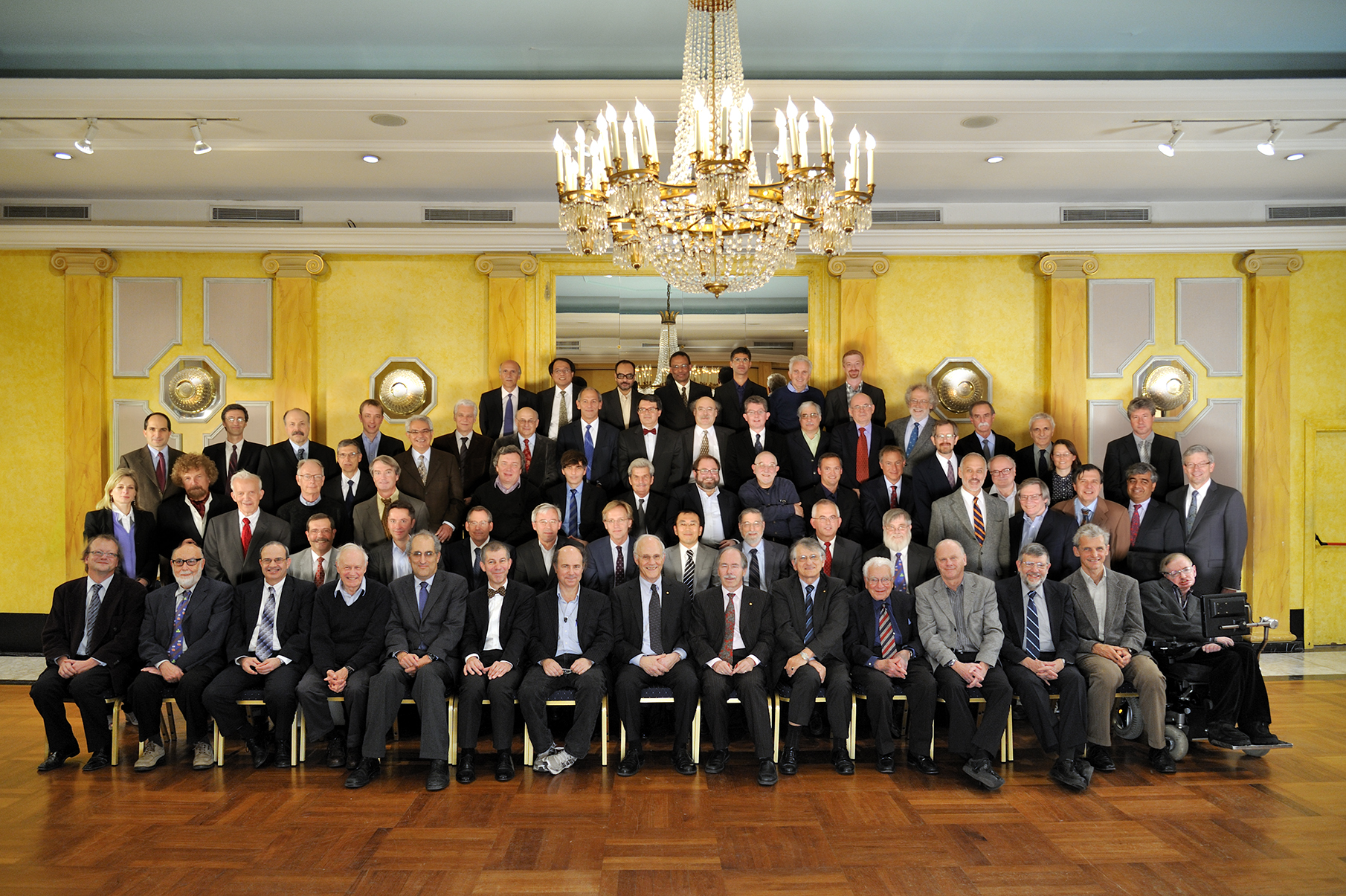
Attendees at the 25th Solvay Conference on Physics, Brussels. Photo provided by "International Solvay Institutes".
“In the tradition of the Solvay Conferences, this is a discussion-oriented meeting with few talks by rapporteurs.” Thus reads the Introduction to the Scientific Programme of the Solvay Conference on Physics. In the Conference programme, the rapporteurs speak for only 30 minutes, with the specific aim of triggering discussion with the audience. And, if you scroll down the list of the rapporteurs, you will find names that have written or are in the process of writing the history of physics. Most of them are Nobel Laureates.
Gian Giudice, Ignatios Antoniadis and Gia Dvali, all members of the CERN Theory Group, and Gabriele Veneziano, a former CERN staff member, were invited to participate. Gian Giudice was also invited to give a five-minute introduction about “What we learned from Higgs searches at the LHC”. “The intense discussions among the participants are the strong point of this unique conference,” says Gian Giudice. “The number of participants is only about three times greater than it was 100 years ago at the first Conseil Solvay. If we think that the number of physicists involved in quantum physics has grown by a factor of at least a hundred, we can appreciate the pains that the organisers take to preserve the quality of the discussions.”
In 1911, the first Conseil Solvay brought together the finest physicists of the era, including: Marie Curie, Albert Einstein, Max Planck, Henri Poincaré and Ernest Rutherford. (Image Source.)
While quantum physics was in its early days 100 years ago, today it has become a sort of “umbrella” term comprising many different fields, from quantum gravity to quantum computation and quantum condensed matter. “The interdisciplinary nature of the conference is another important aspect,” observes Gian Giudice. “The discussions are between colleagues who are not necessarily involved in the same type of research. This always makes the exchanges very enriching. The field of quantum physics has changed dramatically over the last 100 years, but the lively way in which theoretical physicists argue and discuss has remained the same.”
Indeed, one of the enriching discussions this year directly concerned an issue with a CERN stamp: the Bell inequalities. “John Bell was a CERN staff member. His work on the quantum entanglement has significantly contributed to our deep understanding of the quantum world,” says Ignatios Antoniadis, Head of the Theory Group.
The enlargement of the scientific field is not the only difference Gian observes when comparing the first Conseil Solvay with the 25th such event that was held this year. “100 years ago quantum physics was essentially a European affair, but today it is completely international. The largest number of participants this year came from the US, but there were also eminent physicists from India, for example,” he says.
Although the field has widened its borders, not much has changed in the gender ratio. “At the first Conseil Solvay the only woman was Marie Curie. This year, although the total number of participants was about three times higher, there were only two women among us,” confirms Gian Giudice, who then adds: “Theoretical physics is still dominated by men. Hopefully something will change in the future.” The case has been made…
| The Conseils Solvay The Conseils Solvay were set up in 1911 by the Belgian inventor, businessman and philanthropist Ernest Solvay. The first legendary conference was entitled “Conseil Solvay on Radiation and Quanta”. The conference was chaired by Lorentz and saw the participation of Einstein, Planck, Rutherford and many others. It was one of the first international conferences ever organised. Today, the Solvay Institutes are a non-profit organisation led by a Board of Directors, which elects a Director. The International Solvay Scientific Committees assist the Director and are in charge of the organisation of the Conseils Solvay, including the selection of participants. The Chair of the Scientific Committee for Physics is David Gross, winner of the 2004 Nobel Prize. The Solvay conferences are not held regularly. You can find more information about the various conferences as well as other activities of the Solvay Institutes here. |
Other (French)
L’hôtel Métropole à Bruxelles est un lieu de conférence légendaire dont le nom parle certainement à tous les physiciens. Un siècle après la première réunion du Conseil de physique Solvay, un groupe représentant les plus grands physiciens de la planète s’est de nouveau réuni en octobre dernier dans le Salon Excelsior pour évoquer « La théorie du monde quantique ». Trois membres du groupe Théorie du CERN étaient invités. L’un d’entre eux, Gian Giudice, nous fait partager ses impressions et ses réflexions sur cette conférence rassemblant un public choisi.
Les participants de la 25ème conférence Solvay de physique, à Bruxelles. Photo fournie par International Solvay Institutes.
« Dans la tradition des conférences Solvay, il s’agit d’une réunion ouverte à la discussion, ponctuée de quelques présentations de rapporteurs ». C’est ce qu’indique l’introduction du programme scientifique de la Conférence de physique Solvay. Toujours selon ce programme, les rapporteurs ont droit à 30 minutes de parole, l’objectif étant de susciter une discussion avec le public. Et si vous consultez la liste des rapporteurs, vous allez trouver des noms très illustres dans le monde de la physique. Des prix Nobel pour la plupart.
Gian Giudice, Ignatios Antoniadis et Gia Dvali, tous membres du groupe Théorie du CERN, et Gabriele Veneziano, ancien membre du personnel du CERN, figuraient parmi les invités. Gian Giudice avait également été invité à évoquer brièvement les leçons tirées des recherches sur le Higgs au LHC. « Les discussions intenses entre les participants sont le point fort de cette conférence unique en son genre, souligne Gian Giudice. Les participants sont seulement trois fois plus nombreux que lors du premier Conseil de physique Solvay, il y a de cela cent ans. Si l’on songe que le nombre de physiciens en physique quantique a été multiplié au moins par cent, on mesure les efforts déployés par les organisateurs pour préserver la qualité des discussions. »
En 1911, la première conférence Solvay réunit les plus éminents physiciens de l'époque. Parmi eux, Marie Curie, Albert Einstein, Max Planck, Henri Poincaré et Ernest Rutherford. (Source de l'image.)
Si la physique quantique n’en était qu’à ses débuts il y a un siècle, elle est devenue aujourd’hui une sorte de cadre regroupant différentes disciplines : gravité quantique, calcul quantique et matière condensée quantique. « La nature interdisciplinaire de la conférence est une autre caractéristique importante, observe Gian Giudice. Les discussions ont lieu entre des personnes qui ne participent pas nécessairement aux mêmes types de recherche, ce qui rend les échanges toujours très enrichissants. Si la physique quantique a considérablement évolué au cours des cent dernières années, la vivacité des discussions entre physiciens théoriciens est, elle, restée inchangée. »
Cette année, l’une de ces discussions enrichissantes a porté sur une question estampillée CERN : les inégalités de Bell. « John Bell a travaillé au CERN. Ses travaux sur l’intrication quantique ont beaucoup contribué à approfondir notre compréhension du monde quantique », souligne Ignatios Antoniadis, chef du groupe Théorie.
L’élargissement du domaine scientifique n’est pas la seule différence que constate Gian Giudice lorsqu’il compare le premier Conseil de physique Solvay à la 25ème conférence Solvay organisée cette année. « Il y a cent ans, la physique quantique était essentiellement une affaire européenne ; elle est désormais internationale. La majeure partie des participants cette année venait des États-Unis, mais il y avait aussi, par exemple, d'éminents physiciens d'Inde », observe-t-il.
Si la discipline a élargi ses frontières, la parité n’a pas beaucoup progressé. « Le premier Conseil Solvay ne comptait qu’une seule femme : Marie Curie. Cette année, alors que les participants étaient trois fois plus nombreux, seules deux femmes étaient présentes, confirme Gian Giudice. La physique théorique reste un monde d’hommes. Les choses devraient, on l’espère, changer à l’avenir ». À bon entendeur !
| Les Conseils Solvay Les Conseils Solvay ont été créés en 1911 par l’inventeur, homme d’affaires et philanthrope Ernest Solvay. La première conférence, aujourd’hui légendaire, s’intitulait : « Conseil Solvay sur la radiation et les quanta ». La conférence, présidée par Lorentz, accueillit Einstein, Planck, Rutherford et bien d’autres encore. Ce fut l’une des premières conférences internationales jamais organisées. Les Instituts Solvay sont aujourd’hui une organisation sans but lucratif dirigée par un Conseil, qui élit un directeur. Les Comités scientifiques internationaux Solvay assistent le directeur et sont responsables de l’organisation des Conseils Solvay, notamment du choix des participants. Le président du Comité scientifique pour la physique est David Gross, prix Nobel de physique 2004. Les conférences Solvay ont lieu à intervalles irréguliers. Pour en savoir plus sur les différentes conférences ainsi que sur les autres activités des Instituts Solvay, voir ici. |
Files
SolvayGroupPhoto_image.jpg
Files
(1.9 MB)
| Name | Size | Download all |
|---|---|---|
|
md5:fca9fb2ea8cf28613e3e5bd8eef68ddb
|
1.9 MB | Preview Download |
Additional details
Identifiers
- CDS
- 1398634
- CDS Report Number
- BUL-NA-2011-308
Related works
- Is published in
- Periodical issue: baqef-hrs78 (CDS)
- Periodical issue: svcer-qht41 (CDS)