Patrick Janot receives the CNRS silver medal
Authors/Creators
Description
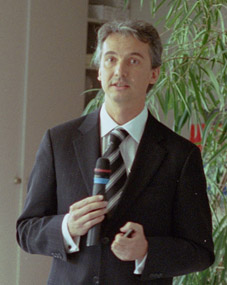
Patrick Janot during the award ceremony. (Photo Schwemling, Paris)
On 25 November, Patrick Janot of the CERN Physics Department received the CNRS silver medal for IN2P3 (Institut national de physique nucléaire et de physique des particules). This prize, one of the most prestigious awarded by the French research centre, is given to scientists for the 'originality, quality and importance of their work, as recognised both nationally and internationally'.
Patrick Janot joined the ALEPH collaboration, one of the four experiments at LEP, then under construction, in 1987. First a CERN Fellow, he went on to work for the CNRS at LAL in 1989. Together with his team, he developed innovative algorithms for the reconstruction of events. This work and others earned him the bronze CNRS medal in 1993, which is awarded to scientists for their first achievements. In 1997, he became a permanent physicist at CERN, where he continued to work for ALEPH. He was appointed LEP scientific co-ordinator for the last two years of the accelerator's operations in 1999 and 2000. It is especially for his work during this period and his 'central role in the search for the Higgs boson' that Patrick Janot has been recognised by the French institute. Among other things, he distinguished himself by proposing innovative ideas to push the machine' performance to its limits and to achieve an energy of 209 GeV while at the same time optimising luminosity. 'It is in part thanks to his talent, his dedication and his enthusiasm that the LEP II teams were able to experience such a thrilling final year of operations', says IN2P3 in the press release announcing the prize.
Patrick Janot, 43, has been a member of the CMS collaboration for the last four years.
Other (French)
Patrick Janot lors de la remise de sa médaille. (Photo Schwemling, Paris)
Le 25 novembre dernier, Patrick Janot du Département de physique du CERN a reçu la médaille d'argent du CNRS pour l'IN2P3 (Institut national de physique nucléaire et de physique des particules). Ce prix, l'un des plus prestigieux du centre de recherche français, récompense un chercheur pour « l'originalité, la qualité et l'importance de ses travaux, reconnus sur le plan national et international ».
Patrick Janot intègre en 1987 la collaboration ALEPH, l'une des quatre expériences du LEP alors en construction. D'abord boursier au CERN, il devient chercheur du CNRS au LAL en 1989. Il développe avec son équipe des algorithmes novateurs de reconstruction des événements. Ces travaux, entre autres, lui valent la médaille de bronze du CNRS en 1993, récompensant « le premier travail d'un chercheur ». En 1997, il devient physicien permanent au CERN, travaillant toujours pour ALEPH. Il est nommé coordonnateur scientifique du LEP au cours des deux dernières années de fonctionnement de l'accélérateur, en 1999 et 2000. C'est plus particulièrement pour ses travaux durant cette période et son « rôle central dans la recherche du boson de Higgs » que Patrick Janot a été distingué par l'institut français. Il s'est notamment illustré en proposant des idées novatrices pour pousser les performances de la machine dans leurs retranchements et atteindre une énergie de 209 GeV tout en optimisant la luminosité. « C'est en partie grâce à son talent, son travail acharné et son enthousiasme que les équipes du LEP II ont pu vivre cette exaltante dernière année de fonctionnement », mentionne l'IN2P3 dans le communiqué annonçant le prix.
Patrick Janot, 43 ans, est depuis quatre ans membre de la collaboration CMS.
Files
na-2005-136_Janot-medaille-web.jpg
Files
(49.1 kB)
| Name | Size | Download all |
|---|---|---|
|
md5:48d2480a0fc9956cfe0f3eace30bd967
|
49.1 kB | Preview Download |
Additional details
Identifiers
- CDS
- 913495
- CDS Report Number
- BUL-NA-2005-136
- Aleph number
- 000038949MMD
Related works
- References
- Other: 000038940 (Other)