Lord Shiva Statue Unveiled
Authors/Creators
Description
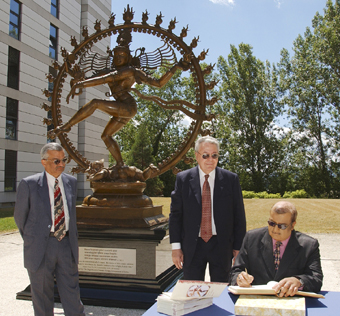
On 18 June, CERN unveiled an unusual new landmark, a 2m tall statue of the Indian deity Lord Shiva.
The Director-General and Dr. Kakodkar watch as Mr.Chandrasekhar signs the Guest Book.
The statue is a gift from India, celebrating CERN's long association with India which started in the 1960's and continues strongly today. It was unveiled by the Director General, Dr Robert Aymar, His Excellency Mr K. M. Chandrasekhar, Ambassador (WTO-Geneva) and Dr Anil Kakodkar, Chairman of the Atomic Energy Commission and Secretary, Dept of Atomic Energy, India.
In the Hindu religion, this form of the dancing Lord Shiva is known as the Nataraj and symbolises Shakti, or life force. As a plaque alongside the statue explains, the belief is that Lord Shiva danced the Universe into existence, motivates it, and will eventually extinguish it. Carl Sagan drew the metaphor between the cosmic dance of the Nataraj and the modern study of the 'cosmic dance' of subatomic particles.
The statue was made in India. The original sculpture was a wax model, around which a soil mould was made. Melting the wax left a hollow into which liquid metal was poured. Once cooled, the mould was split and the statue polished and given its antique finish.
The statue is on permanent display in the square between buildings 39 and 40, a short distance from the Main Building.
Other (French)
Le 18 juin, le CERN a inauguré un nouvel ouvrage, plutôt inhabituel : une statue de 2 m de hauteur représentant la divinité indienne Shiva.
Le Directeur général et M. Kakodkar regardent M.Chandrasekhar signer le Livre d'Or.
Cette statue, offerte par l'Inde, honore une collaboration de longue date entre le Laboratoire et l'Inde, qui a débuté dans les années 60 et n'a aujourd'hui rien perdu de sa vigueur. Elle a été inaugurée par le Directeur général, M. Robert Aymar, Son Excellence M. K. M. Chandrasekhar, Ambassadeur (WTO-Genève) et M. Anil Kakodkar, Président du Commissariat indien à l'Energie atomique et Secrétaire du Département de l'Energie atomique de l'Inde.
Dans la religion hindoue, ce dieu Shiva danseur est connu sous le nom de Nataraj et symbolise la force de vie (Shakti). Comme l'explique la plaque près de la statue, selon la croyance, le dieu Shiva en dansant donne vie à l'Univers, lui confère sa raison d'être, pour finalement l'anéantir. Usant d'une métaphore, Carl Sagan a comparé la danse cosmique de Nataraj à l'étude moderne de la « danse cosmique » des particules subatomiques.
La statue a été réalisée en Inde. La sculpture originale, un modèle en cire, a été recouverte d'un moule en terre. En fondant, la cire a laissé un espace dans lequel un métal liquide a été versé. Une fois refroidi, le moule a été fendu et la statue polie a reçu son fini antique.
La statue est visible en permanence sur le square entre les bâtiments 39 et 40, à proximité du Bâtiment principal.
Files
na-2004-122_0406040_01.jpg
Files
(156.3 kB)
| Name | Size | Download all |
|---|---|---|
|
md5:f38c02b6cd5a0c790da41e5172a6178a
|
156.3 kB | Preview Download |
Additional details
Identifiers
- CDS
- 745737
- CDS Report Number
- BUL-NA-2004-122
- Aleph number
- 000015642MMD
Related works
- References
- Other: 000015635 (Other)