CERN has a new Management team
Authors/Creators
Description
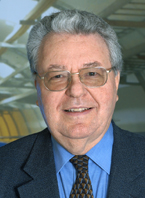
Dr Robert Aymar succeeded Professor Luciano Maiani as CERN's Director-General on 1 January 2004. At its 126th Session, chaired by Professor Maurice Bourquin, the CERN Council elected Professor Enzo Iarocci as the new President of Council. In his last presentation to the Council, Professor Maiani reported on CERN's activities during the year and on progress with the LHC Project.
Robert Aymar, Director-General
The new CERN structure
Council formally approved the new CERN structure presented by the incoming Director-General, Robert Aymar. This structure was implemented on 1 January 2004 for a period of five years. The Organization's Directorate comprises Robert Aymar, Director-General, Jos Engelen, Chief Scientific Officer (CSO), and Andre Naudi, Director of Finance and Human Resources (Chief Financial Officer - CFO).
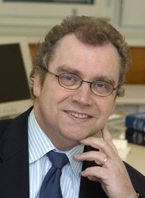
Andre Naudi, Director of Finance and Human Resources
Dr Aymar's career to date has focussed on fundamental research in plasma physics and its applications in controlled thermonuclear fission. In 1977, he was appointed Head of the Tore Supra fusion research project, which he directed from its design in 1977 through to its operation in 1988. In 1990, he was appointed Head of Fundamental Research at the French Atomic Energy Agency (CEA). In July 1994, he became Director of the International Thermonuclear Experimental Reactor (ITER) project, and ITER International Team Leader in July 2001. He is familiar with the challenges presented by the LHC project, as he chaired the international scientific committee that assessed and recommended the project for approval in 1996. He also chaired the External Review Committee set up by the Council in December 2001 to review the CERN programme.
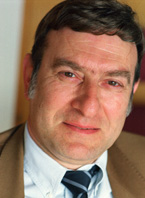
Jos Engelen, Chief Scientific Officer
Dr Engelen was formerly Director of the Netherlands National Institute for Nuclear Physics and High Energy Physics, NIKHEF, and Mr Naudi was CERN's Director of Finance in the last administration.
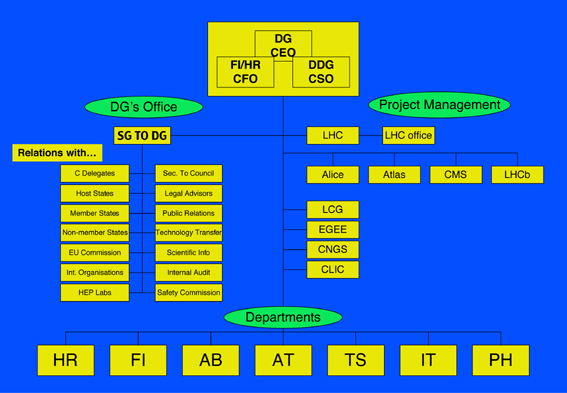
"The new structure is well adapted to CERN's current objectives", said Dr Aymar. "It ensures continuity and builds on existing strengths." CERN's fifteen divisions have been regrouped into a smaller number of departments (see organisational chart), while functions including safety, technology transfer and public communication will be moved to the Director-General's Office.
Senior Staff as of the 1st January 2004 (for a period of two years)
Head of the Accelerators and Beams Department: Steve Myers
Head of the Accelerator Technology Department: Philippe Lebrun
Head of the Technical Support Department: Paolo Ciriani
Head of the Information Technology Department: Wolfgang von Rüden
Head of the Department of Physics: Wolf-Dieter Schlatter
Head of the Finance Department: Patrick Geeraert
Head of the Human Resources Department ad interim: Werner Zapf
LHC Project Leader: Lyn Evans
Maximilian Metzger was appointed Secretary-General to the Director-General for a period of three years from 1 March 2004. Hans Hoffmann took up this position ad interim on 1 January 2004.
Elections
Enzo Iarocci (IT) was elected President of Council for a period of one year from 1 January 2004. Professor Iarocci is the author of numerous publications on experimental particle and astroparticle physics, and is best known for his development in the late 1970s of a new type of particle detector, the streamer tube. After having participated in the NUSEX experiment on proton decay in the Mont Blanc tunnel in the early 1980s, he was co-spokesman of the Italian-American MACRO experiment at Italy's Gran Sasso Laboratory. Director of the Frascati Laboratory near Rome from 1990 to 1996, he played an important role in the construction of DAFNE, a very high intensity electron-positron storage ring designed for the study of the symmetry between matter and antimatter. He takes over from Professor Maurice Bourquin (CH) as President of Council.
Eivind Osnes (NO) was elected Vice-President of Council for a period of one year from 1 January 2004.
Janet Seed (GB) and Martin Steinacher (CH) were elected Chairman and Vice-Chairman of the Finance Committee, respectively, for a period of one year from 1 January 2004.
Joël Feltesse (FR) was re-appointed Chairman of the Scientific Policy Committee for a period of one year from 1 January 2004.
Alain Blondel (FR), Peter Dornan (GB), Rolf-Dieter Heuer (DE) and Agnieszka Zalewska (PO) were appointed members and Paolo Strolin (IT) was re-appointed member of the Scientific Policy Committee for a period of three years from 1 January 2004.
Fernando Bello (PT) was elected Chairman of the Tripartite Employment Conditions Forum (TREF) for a period of one year from 1 January 2004.
Jeffrey Down (GB) was elected member of the CERN Audit Committee for a period of three years from 1 January 2004.
LHC status report
Professor Maiani began his last presentation to Council with a comprehensive review of the LHC Project. The experiments, ATLAS, CMS, ALICE and LHCb, are all on schedule to be ready for LHC start-up in 2007. Challenges continue to be encountered, as is inevitable with such an ambitious scientific project, but the experimental collaborations are becoming adept at overcoming them. "Old concerns have been overcome, new ones have appeared" he concluded, "but there are no show-stoppers on the horizon".
Turning to LHC computing, Professor Maiani congratulated the international team that successfully launched Phase 1 of the LHC Computing Grid (LCG-1) in September. When the LHC starts up, as Professor Maiani reminded delegates, the LCG will have to handle data equivalent to a 20-km-high pile of CD-ROMs every year. In 2003, the Enabling Grids for e-science in Europe (EGEE) initiative, funded by the European Union, was launched. The LCG will be the first concrete example of an operational e-science Grid, and a test bed for EGEE.
The LHC machine itself passed a number of important milestones in 2003. The first octant of dipole magnets was completed, the first transfer line magnet was installed on 17 December and the first magnet for the LHC itself is scheduled to be installed early in 2004. "It has been a good year for the LHC project," summed up Professor Maiani. Overall, the project's cost is stable and its schedule unchanged, with the first beam planned for April 2007 and first collisions the following June.
Review of the year's activities
In reviewing the rest of the year's activities, Professor Maiani reminded Council that the LHC project now accounts for over 80% of the Laboratory's budget. Nevertheless, he described a full programme of fixed-target experiments, the highlight of which was the observation by the NA49 experiment of a new exotic particle probably composed of four quarks and an antiquark (normal nuclear constituents, protons and neutrons, are made up of three quarks only, and for a long time scientists believed that exotic states with more quarks could not exist). Accelerator R&D, although limited, also saw some remarkable achievements in 2003. For example, CERN's compact linear collider study (CLIC) demands extreme stability; tests in 2003 achieved stability to just 0.5 of a nanometre.
The CERN Globe of Innovation
Following the issue of the construction permit for CERN's new Globe of Innovation by the Geneva authorities on 12 December, Council agreed to the negotiation of contracts for architectural services with the building's original architect, Groupe H (CH), for engineering services with the original contractor, Charpente Concept (CH), and for reassembly work with the Coopérative de l'Industrie du Bois (CH). The Globe of Innovation, originally a pavillion at the Swiss national exhibition in 2002, will play a key role in CERN's 50th anniversary celebrations this year. From 2005 onwards, it will house a new exhibition and networking centre for CERN.
EIROforum and the European Union
CERN has enjoyed a long and fruitful collaboration with the European Union. As long ago as 1985, the European Commission was granted Observer Status at CERN
Council, and in 1994 an agreement to "promote co-operation between the Commission of the European Communities and CERN in research and technological development" was signed. This collaboration took a step forward in 2003 when the seven members of EIROforum1 signed a Statement of Intent with the European Commission confirming their commitment to developing a European Research Area. "The EIROforum members are working together towards the EU's ambitious Lisbon goals," said Professor Maiani, "and we are fully committed to developing Europe as a knowledge-based society with a powerful and sustainable economy."
In bidding farewell to Professor Maiani at the end of his term of office, many delegations from Member and Observer States congratulated him on steering CERN through a difficult period. The Director-General, as one delegation put it, had shown remarkable calm in a storm, and the Laboratory's staff had demonstrated the true strength and cohesion of the Organization.
1 Founded in 2000, EIROforum comprises Europe's seven leading intergovernmental research organisations: CERN, EFDA, EMBL, ESA, ESO, ESRF and ILL. The Directors-General of these organisations meet formally twice a year, while working groups covering areas such as outreach organise joint activities.
The new CERN organisational chart.
| Directorate | |
| DG CEO | Director General Chief Executive Officer |
| FI/HR CFO | Finance/Human Resources Chief Financial Officer |
| DDG CSO | Deputy Director General Chief Scientific Officer |
| DG's Office | |
| SG | Secretary General |
| Project Management | |
| LCG | LHC Computing Grid |
| EGEE | Enabling Grids for e-science in Europe |
| CNGS | CERN Neutrinos to Gran Sasso |
| CLIC | Compact Linear Collider study |
| Departments | |
| HR | Human Resources |
| FI | Finance |
| AB | Accelerators and Beams |
| AT | Accelerator Technology |
| TS | Technical Support |
| IT | Information Technology |
| PH | Physics |
Technical info
Cover articleOther (French)
Robert Aymar a pris ses fonctions de Directeur général du CERN le 1er janvier 2004, succédant ainsi à Luciano Maiani. Le Conseil du CERN, lors de sa 126e session présidée par le professeur Maurice Bourquin, a élu son successeur à la Présidence, M. Enzo Iarocci. M. Maiani a, dans sa dernière présentation au Conseil, fait un rapport sur l'activité du CERN durant l'année écoulée et les progrès du projet LHC.
Other (French)
Robert Aymar a pris ses fonctions de Directeur général du CERN le 1er janvier 2004, succédant ainsi à Luciano Maiani. Le Conseil du CERN, lors de sa 126e session présidée par le professeur Maurice Bourquin, a élu son successeur à la Présidence, M. Enzo Iarocci. M. Maiani a, dans sa dernière présentation au Conseil, fait un rapport sur l'activité du CERN durant l'année écoulée et les progrès du projet LHC.
Robert Aymar, Directeur général
La nouvelle structure du CERN
Le Conseil a approuvé formellement la nouvelle structure du CERN présentée par le nouveau Directeur général Robert Aymar. Cette structure est effective depuis le 1er janvier 2004 pour une période de 5 ans. Le Directoire de l'Organisation est composé de Robert Aymar, Directeur général, de Jos Engelen, Directeur scientifique (CSO), et de Andre Naudi, Directeur des finances et des ressources humaines (CFO).
Andre Naudi, Directeur des finances et des ressources humaines
La carrière de M. Aymar s'est concentrée jusqu'à présent sur la recherche fondamentale en physique du plasma et ses applications à la fusion thermonucléaire contrôlée. En 1977, il a été nommé Directeur du programme Tore Supra de recherche sur la fusion, qu'il a dirigé depuis sa conception en 1977 jusqu'à son exploitation en 1988. En 1990, il a été nommé Directeur de la Recherche fondamentale au Commissariat français à l'Energie atomique (CEA). En juillet 1994, il a été nommé Directeur du projet de Réacteur thermonucléaire expérimental international (ITER) et chef de l'équipe internationale d'ITER en juillet 2001. Il connaît bien les défis que doit relever le projet LHC pour avoir assuré la présidence du comité scientifique international qui avait évalué le projet et recommandé son approbation en 1996. Il a présidé également un Comité d'examen externe créé par le Conseil en décembre 2001 pour examiner le programme du CERN.
Jos Engelen, Directeur scientifique
M. Engelen était précédemment Directeur de l'Institut national de physique nucléaire et de physique des hautes énergies des Pays-Bas (NIKHEF) et M. Naudi était le Directeur des Finances du CERN dans la précédente organisation.
«La nouvelle structure est bien adaptée aux objectifs actuels du CERN» a déclaré M. Aymar. «Elle assure une continuité et s'appuie sur les atouts existants.» Les quinze divisions actuelles du CERN sont regroupées en un plus petit nombre de départements (voir organigramme), et des fonctions comme la sécurité, le transfert de technologie et l'information du public sont transférées au Bureau du Directeur général.
Personnel supérieur au 1er janvier 2004 (pour une période de 2 ans)
Chef du Département Accélérateurs et faisceaux : Steve Myers
Chef du Département Technologie des accélérateurs : Philippe Lebrun
Chef du Département Support technique : Paolo Ciriani
Chef du Département Technologie de l'information : Wolfgang von Rüden
Chef du Département de physique : Wolf-Dieter Schlatter
Chef du Département des finances : Patrick Geeraert
Chef par intérim du Département des ressources humaines : Werner Zapf
Chef du projet LHC : Lyn Evans
Maximilian Metzger a été nommé Secrétaire général auprès du Directeur général pour une période de trois ans à compter du 1er mars 2004. Hans Hoffmann assure l'intérim de ces fonctions depuis le 1er janvier 2004.
Elections
Enzo Iarocci (IT) a été élu Président du Conseil pour une période d'un an à compter du 1er janvier 2004. Le professeur Iarocci est l'auteur de nombreuses publications sur la physique expérimentale des particules et l'astrophysique, et il est connu surtout pour avoir mis au point à la fin des années 70 un nouveau type de détecteur de particules, le tube à plasma. Après avoir participé à l'expérience NUSEX sur la désintégration du proton dans le tunnel du Mont Blanc au début des années 80, Iarocci a été le porte-parole conjoint de l'expérience italo-américaine MACRO au Laboratoire italien du Gran Sasso. Directeur du Laboratoire de Frascati, près de Rome, de 1990 à 1996, E. Iarocci a joué un rôle important dans la construction de DAPHNE, un anneau de stockage électron-positon de très haute intensité conçu pour l'étude de la symétrie entre la matière et l'antimatière. Il succède au professeur Maurice Bourquin (CH) à la présidence du Conseil du CERN.
Eivind Osnes (NO) a été élu Vice-Président du Conseil pour une période d'un an à compter du 1er janvier 2004.
Janet Seed (GB) et Martin Steinacher (CH) ont respectivement été élus Présidente et Vice-Président du Comité des finances pour une période d'un an à compter du 1er janvier 2004.
Joël Feltesse (FR) a été réélu Président du Comité des directives scientifiques pour une période d'un an à compter du 1er janvier 2004.
Alain Blondel (FR), Peter Dornan (GB), Rolf-Dieter Heuer (DE) et Agnieszka Zalewska (PO) ont été élus membres et Paolo Strolin (IT) a été réélu membre du Comité des directives scientifiques pour une période de trois ans à compter du 1er janvier 2004.
Fernando Bello (PT) a été élu Président du Forum tripartite sur les conditions d'emploi (TREF) pour une période d'un an à compter du 1er janvier 2004.
Jeffrey Down (GB) a été élu membre du Comité d'Audit pour une période de trois ans à compter du 1er janvier 2004.
Rapport sur le projet LHC
Le professeur Maiani a commencé sa dernière présentation au Conseil par un tour d'horizon complet du projet LHC. Les expériences, ATLAS, CMS, ALICE et LHCb, suivent le programme prévu, afin d'être prêtes pour la mise en service du LHC en 2007. Des défis subsistent, ce qui est inévitable pour un projet scientifique aussi ambitieux, mais les collaborations d'expérimentateurs deviennent habiles à les relever. «Les anciens sujets d'inquiétude ont été surmontés, et de nouveaux apparaissent» a conclu Maiani, «mais il n'y a pas d'incident majeur à l'horizon».
Passant à l'informatique pour le LHC, le professeur Maiani a félicité l'équipe internationale qui a lancé avec succès la phase 1 du projet de Grille de calcul pour le LHC (LCG-1) en septembre. Lorsque le LHC démarrera, a rappelé le professeur Maiani aux délégués, le LCG devra traiter chaque année un volume de données équivalent à une pile de cédéroms haute de 20 km. C'est en 2003 que l'Initiative pour la réalisation de grilles de calcul pour la science en ligne en Europe (projet EGEE), financée par l'Union européenne, a été lancée. L'équipe du LCG offrira le premier exemple concret d'une grille opérationnelle pour la science en ligne, ainsi qu'un banc d'essai pour EGEE.
Quant à la machine LHC, elle a franchi plusieurs étapes importantes en 2003. Le nombre d'aimants dipolaires achevés permettra d'équiper le premier octant. Le premier aimant de la ligne de transfert a été installé le 17 décembre et le premier aimant du LHC lui-même devrait être installé au début de 2004. «Ce fut une bonne année pour le projet LHC» a résumé le professeur Maiani. Dans l'ensemble, le coût du projet est stable et son calendrier inchangé, un premier faisceau est prévu en avril 2007 et les premières collisions suivront en juin.
Examen des activités de l'année
Passant en revue le reste des activités de l'année, le professeur Maiani a rappelé au Conseil que le projet LHC représente maintenant plus de 80% du budget du Laboratoire. Il a cependant décrit un programme complet d'expériences avec des cibles fixes, dont l'élément majeur a été l'observation par l'expérience NA49 d'une nouvelle particule exotique probablement composée de quatre quarks et d'un antiquark (les constituants normaux du noyau, les protons et les neutrons, sont constitués de trois quarks uniquement, les scientifiques ont pendant longtemps considéré que des états exotiques avec un plus grand nombre de quarks ne pouvaient pas exister). Les activités de R&D sur les accélérateurs, quoique limitées, ont connu aussi quelques résultats remarquables en 2003. Ainsi, l'étude sur le collisionneur linéaire compact du CERN (CLIC) nécessite une machine extrêmement stable. Or au cours d'essais en 2003 on a obtenu une stabilité à 0,5 nanomètre près.
Le Globe de l'innovation du CERN
A la suite de la délivrance du permis de construire relatif au futur Globe de l'Innovation du CERN par les autorités genevoises le 12 décembre, le Conseil a accepté la négociation de contrats pour des services d'architecture avec l'architecte initial du bâtiment, Groupe H (CH), pour des services techniques avec l'entreprise initiale, Charpente Concept (CH) et pour les travaux de réassemblage avec la Coopérative de l'Industrie du Bois (CH). Le Globe de l'Innovation, qui était initialement un pavillon de l'Exposition nationale suisse de 2002, jouera un rôle de premier plan dans les cérémonies du cinquantième anniversaire du CERN cette année. A partir de 2005, il abritera un nouveau centre d'exposition et de communication du CERN.
EIROforum et l'Union européenne
Le CERN bénéficie depuis longtemps d'une fructueuse collaboration avec l'Union européenne. Dès l'année 1985, le statut d'Observateur au Conseil du CERN a été accordé à la Commission européenne et un accord visant à «promouvoir la coopération entre la Commission des Communautés européennes et le CERN en matière de recherche et de développement technologique» a été signé en 1994. Cette collaboration a fait cette année un nouveau pas en avant lorsque les sept membres d'EIROforum1 ont signé avec la Commission européenne une Déclaration d'intention confirmant leur engagement à développer un Espace européen de la recherche. «Les membres d'EIROforum oeuvrent ensemble à la réalisation des objectifs ambitieux de l'UE définis à Lisbonne» a déclaré le professeur Maiani «et nous engageons toutes nos forces pour faire de l'Europe une société du savoir, dotée d'une économie puissante et durable.»
En faisant leurs adieux au professeur Maiani à la fin de son mandat, de nombreuses délégations des Etats membres et observateurs l'ont félicité d'avoir guidé le CERN dans une période difficile. Le Directeur général, a déclaré l'une d'elles, a fait preuve d'un calme remarquable dans la tempête, et le personnel du Laboratoire a démontré toute la force et la cohésion de l'Organisation.
1 Fondé en 2000, EIROforum réunit sept organisations scientifiques intergouvernementales de premier plan : le CERN, l'ESO, l'EFDA, l'EMBL, l'ESA, l'ESRF et l'ILL. Les Directeurs généraux de ces organisations se rencontrent officiellement deux fois par an, et des groupes de travail constitués dans des domaines comme la sensibilisation du public organisent des activités communes.
Le nouvel organigramme du CERN.
| Directoire | |
| DG CEO | Directeur général Fonctionnaire exécutif supérieur |
| FI/HR CFO | Finances/Ressources humaines Directeur des finances et des ressources humaines |
| DDG CSO | Directeur général adjoint Directeur scientifique |
| Bureau de la Direction générale | |
| SG | Secrétaire général |
| Direction du projet | |
| LCG | Grille de calcul LHC |
| EGEE | Réalisation de grilles pour la science en ligne en Europe |
| CNGS | Neutrinos du CERN vers le Gran Sasso |
| CLIC | Etude sur le collisionneur linéaire compact |
| Départements | |
| HR | Ressources humaines |
| FI | Finances |
| AB | Accélérateurs et faisceaux |
| AT | Technologie des accélérateurs |
| TS | Support technique |
| IT | Technologie de l'information |
| PH | Physique |
Files
na-2004-001_0303016_01.JPG
Additional details
Identifiers
- CDS
- 704586
- CDS Report Number
- BUL-NA-2004-001
- Aleph number
- 000014620MMD
Related works
- References
- Other: 000005159 (Other)
- Other: 000001788 (Other)
- Other: 000014500 (Other)