News from the Library: Nucleonica - web-driven nuclear science
Authors/Creators
Description
Most of us are familiar with the Karlsruhe Nuclide Chart. It spreads from wall to wall and tells you all about decay chains of all known nuclides and isotopes.
The good news is that this resource is freely available here, the homepage of a suite of resources for nuclear science: a mass activity calculator, a decay engine, dosimetry and shielding calculations, range and stopping power calculations, gamma spectrum generator and analyzer, a virtual cloud chamber and a packaging calculator to name a few. All these programmes have been tested and approved by leading world experts.
You can register to access these programmes here. A basic license is free, so anybody who is serious about Nuclear Science should register as soon as possible!
A Premium account gives even more options in the calculations and utilities. If you think a premium account to Nucleonica would be useful for your work and for CERN in general, please contact CERN Library.
Access the resource here.
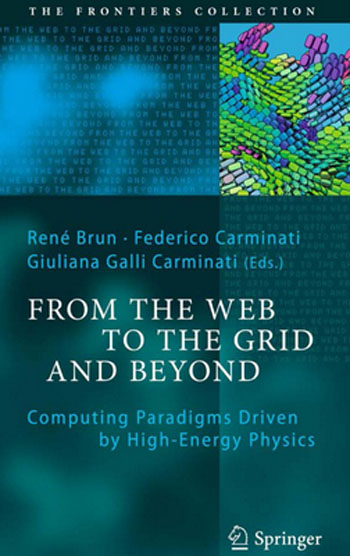
| Literature in Focus: "From the Web to the Grid and Beyond: Computing Paradigms Driven by High-Energy Physics", ed. by René Brun, Federico Carminati, Giuliana Galli Carminati Springer, 2012. Born after World War II, large-scale experimental high-energy physics has found itself limited ever since by available accelerator, detector and computing technologies. Accordingly, HEP has made significant contributions to the development of these fields, more often than not driving their innovations. The invention of the World Wide Web at CERN is merely the best-known example out of many. This book is the first comprehensive account to trace the history of this pioneering spirit in the field of computing technologies. It covers everything up to and including the present-day handling of the huge demands imposed upon grid and distributed computing by full-scale LHC operations - operations which have for years involved many thousands of collaborating members worldwide and accordingly provide the original and natural testbed for grid computing concepts. This book takes the reader on a guided tour encompassing all relevant topics, including programming languages, software engineering, large databases, the Web, and grid and cloud computing. The important issue of intellectual property regulations for distributed software engineering and computing is also addressed. Aptly, the book closes with a visionary chapter of what may lie ahead. "From the Web to the Grid and Beyond" |
Other (French)
Nous connaissons, pour la plupart, la Carte des nucléides de Karlsruhe. Avec cette ressource, vous savez tout sur les chaînes de désintégration de tous les nucléides connus et des isotopes.
La bonne nouvelle est que cette ressource est disponible gratuitement sur ce site web, où vous trouvez un ensemble de programmes utiles pour la physique nucléaire : calculateurs d'activité de masse, de désintégration, calculs de dosimétrie, générateur et analyseur de spectre gamma, chambre à brouillard virtuelle, pour n'en nommer que quelques-uns. Toutes ces ressources ont été testées et approuvées par des experts mondiaux.
Vous pouvez vous inscrire pour accéder à ces programmes ici. La licence de base est gratuite, toute personne intéressée par la physique nucléaire est donc invitée à s'inscrire dès que possible !
Un compte Premium donne encore plus d'options dans les calculs et les fonctionnalités. Si vous pensez qu'un compte Premium à Nucleonica serait utile pour votre travail et pour le CERN en général, n'hésitez pas à contacter la Bibliothèque du CERN.
Accès à la ressource ici.
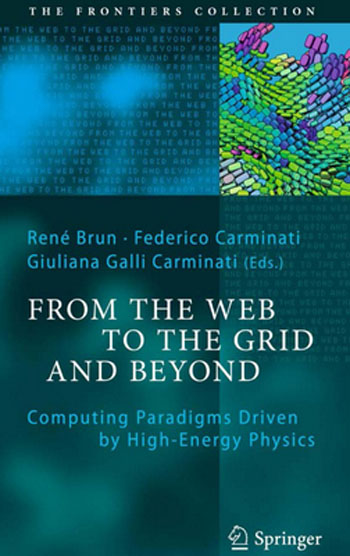
| Focus littéraire : From the Web to the Grid and Beyond: Computing Paradigms Driven by High-Energy Physics, ed. par René Brun, Federico Carminati, Giuliana Galli Carminati Springer, 2012. Née après la Seconde Guerre mondiale, la physique des hautes énergies (HEP) expérimentale à grande échelle s'est toujours trouvée limitée par les technologies disponibles dans les domaines des accélérateurs, des détecteurs et de l'informatique. En conséquence, la physique des particules a apporté des contributions marquantes à leur développement, et a souvent conduit à d'importantes innovations. L'invention du World Wide Web au CERN est l'exemple le plus connu, parmi tant d'autres. Ce livre est le premier compte rendu détaillé sur l'histoire de cet esprit pionnier dans le domaine des technologies informatiques. Il couvre toute l'aventure jusqu'à aujourd'hui, y compris les énormes contraintes imposées à la grille de calcul et à l'informatique distribuée par les opérations à grande échelle du LHC - des opérations qui, pendant des années, ont impliqué plusieurs milliers de collaborateurs à travers le monde et qui, en conséquence, représentent un banc d'essai naturel et original pour les concepts de grid computing. Ce livre entraîne le lecteur dans une visite guidée qui comprend divers sujets, y compris les langages de programmation, le génie logiciel, les bases de données, le Web, le grid et le cloud computing. La question essentielle de la réglementation de la propriété intellectuelle pour le génie logiciel distribué et l'informatique est également abordée. Le livre se termine judicieusement avec un chapitre visionnaire qui présente ce qui pourrait nous attendre dans le futur. From the Web to the Grid and Beyond |
Files
web-grid-book_1_image.jpeg
Files
(135.4 kB)
| Name | Size | Download all |
|---|---|---|
|
md5:5ae7c7961e1f606667ecb8019a6717d0
|
67.7 kB | Preview Download |
|
md5:5ae7c7961e1f606667ecb8019a6717d0
|
67.7 kB | Preview Download |
Additional details
Identifiers
- CDS
- 1428532
- CDS Report Number
- BUL-NA-2012-078
Related works
- Is published in
- Periodical issue: 1jk30-b7p60 (CDS)
- Periodical issue: 685k7-rj938 (CDS)