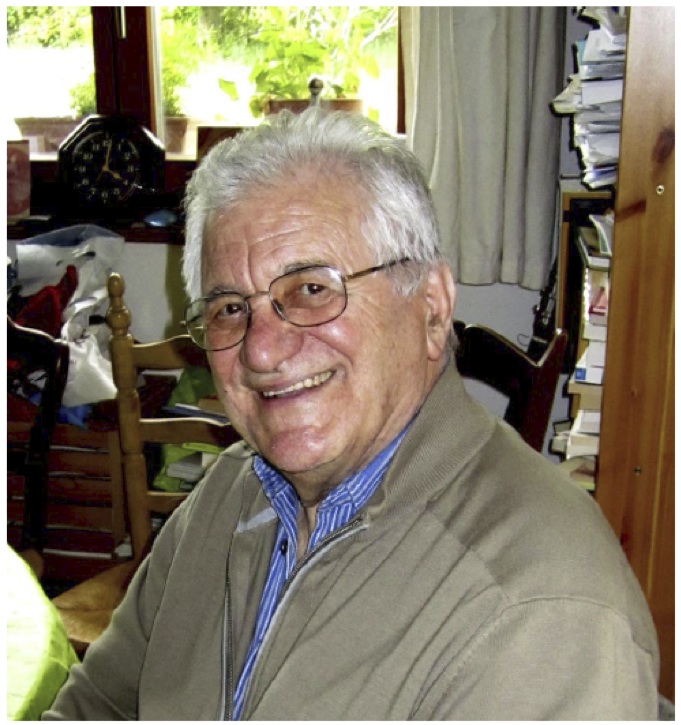
Luigi Mazzone (1926-2014)
Authors/Creators
Description
Luigi Mazzone, one of the first engineers recruited by CERN, a very good
friend and a dynamic and cheerful colleague, left us peacefully on 17 October.
Born in Cairo in 1926 to Italian parents, Luigi grew up in the multi-cultural environment that was a distinctive feature of Egypt in those years, and he often liked to reminisce about it when talking to friends. Back in Italy during the war, he went to secondary school in Sienna and then studied civil engineering, first at the University of Rome and then in Pisa, where he graduated in 1951.
In 1954, while working in Rome, Luigi was selected to join the group of scientists, engineers and technicians who were moving to Geneva from all over Europe to build CERN and its accelerators even before the official creation of the Laboratory. At CERN, he joined Peter Preiswerk’s group, which was responsible for the planning and construction of buildings and for setting up the new Laboratory’s services and infrastructure. He spent several years on this activity, demonstrating his professional competence, ingenuity and enthusiasm.
When the Proton Synchrotron became operational, Luigi developed a special interest in the technique of liquid hydrogen targets, which were an important component of many high-energy experiments, and more generally in all aspects of cryogenics. Among the many targets that he designed and built, the most impressive was the target built for the NA4 experiment in the late 1970s. This target, 40 metres long, was located along the axis of a large number of magnetised iron toroids and could be filled with either liquid hydrogen or deuterium. This target was unique at the time, and probably still is today, demonstrating the very high level of expertise that Luigi had achieved in this field.
In the years that followed, Luigi was responsible for the gas purification systems of the LEP detectors and for the purification of the liquid argon used by the ICARUS experiment. The argon purity required by ICARUS was a real technical challenge, which Luigi overcame successfully.
Even after his retirement, Luigi devoted a lot of his time to teaching cryogenics theory and techniques in the CERN Cryolab. Transferring his knowledge was for him a duty and a pleasure. His courses were much attended and appreciated.
Luigi Mazzone was a friendly and charming person, always ready to help and always offering enriching discussions and useful suggestions. While remembering this dear colleague and friend, we express all our sympathy to his wife, Beatrice, his sons, Roberto and Sergio, and to his grandchildren.
His friends and former colleagues
Other (French)
Luigi Mazzone, l’un des premiers ingénieurs recrutés par le CERN, un ami très cher et un collègue dynamique et enjoué, nous a quittés paisiblement le 17 octobre.
Né au Caire en 1926, de parents italiens, Luigi a grandi dans l’environnement multiculturel qui caractérisait l’Égypte de ces années, et il se plaisait souvent à évoquer avec ses amis des souvenirs de cette époque. Après son retour en Italie pendant la guerre, il a fréquenté l’école secondaire à Sienne et a étudié ensuite le génie civil, d’abord à l’Université de Rome, puis à Pise, où il a obtenu son diplôme en 1951.
En 1954, alors qu’il travaillait à Rome, Luigi a été sélectionné pour rejoindre le groupe de scientifiques, d’ingénieurs et de techniciens qui affluaient à Genève, de toute l’Europe, pour construire le CERN et ses accélérateurs, avant même la création officielle du Laboratoire. Au CERN, il a intégré le groupe de Peter Preiswerk, qui était responsable de la planification et de la construction des bâtiments, ainsi que de la création des services et de l’infrastructure du nouveau laboratoire. Il a exercé ces activités pendant plusieurs années, pendant lesquelles il a démontré ses compétences professionnelles, son ingéniosité et son enthousiasme.
Quand le Synchrotron à protons est devenu opérationnel, Luigi a développé un intérêt particulier pour la technique des cibles à hydrogène liquide, qui étaient une composante importante de nombreuses expériences à haute énergie, et plus généralement pour tous les aspects de la cryogénie. Parmi les nombreuses cibles qu’il a conçues et construites, la plus impressionnante était la cible créée pour l’expérience NA4 à la fin des années 1970. Cette cible, longue de 40 mètres, était située le long de l'axe d'une longue série de toroïdes en fer magnétisé, et pouvait être remplie soit d’hydrogène liquide soit de deutérium. Cette cible était unique à l’époque, et elle l’est probablement encore aujourd’hui, ce qui démontre le très haut niveau de compétence atteint par Luigi dans son domaine.
Pendant les années qui ont suivi, Luigi a été responsable des systèmes de purification des gaz des détecteurs LEP et de la purification de l’argon liquide utilisé par l’expérience ICARUS. Le très haut degré de pureté exigé par ICARUS pour l’argon représentait un véritable défi technique, que Luigi a relevé avec succès.
Même après sa retraite, Luigi a consacré une grande partie de son temps à enseigner la théorie et les techniques de cryogénie au Cryolab du CERN. Transmettre son savoir était pour lui un devoir et un plaisir. Ses leçons attiraient un auditoire nombreux et étaient très appréciées.
Luigi Mazzone était quelqu’un d’amical et d’attachant, toujours prêt à apporter son aide, à participer à des discussions enrichissantes et à faire des suggestions utiles. Nous gardons un souvenir ému de ce collègue et ami très cher, et exprimons toute notre sympathie à son épouse, Beatrice, à ses fils, Roberto et Sergio, et à ses petits-enfants.
Ses amis et anciens collègues
Files
Luigi_Mazzone_image.jpg
Files
(161.0 kB)
| Name | Size | Download all |
|---|---|---|
|
md5:8550da6153bbd3614c692c4630b20751
|
161.0 kB | Preview Download |
Additional details
Identifiers
- CDS
- 1975944
- CDS Report Number
- BUL-NA-2014-269
Related works
- Is published in
- Periodical issue: 5735t-fw731 (CDS)
- Periodical issue: azf5k-7t672 (CDS)
- Periodical issue: b325q-azf82 (CDS)
- Periodical issue: tcyqb-1qy93 (CDS)