Interview with Cédric Villani
Authors/Creators
Description
On 21 May this year, CERN had the pleasure of welcoming the mathematician Cédric Villani as part of the series of lectures organised by the Groupement des Français du CERN. The CERN Bulletin took the opportunity to ask him a few questions.
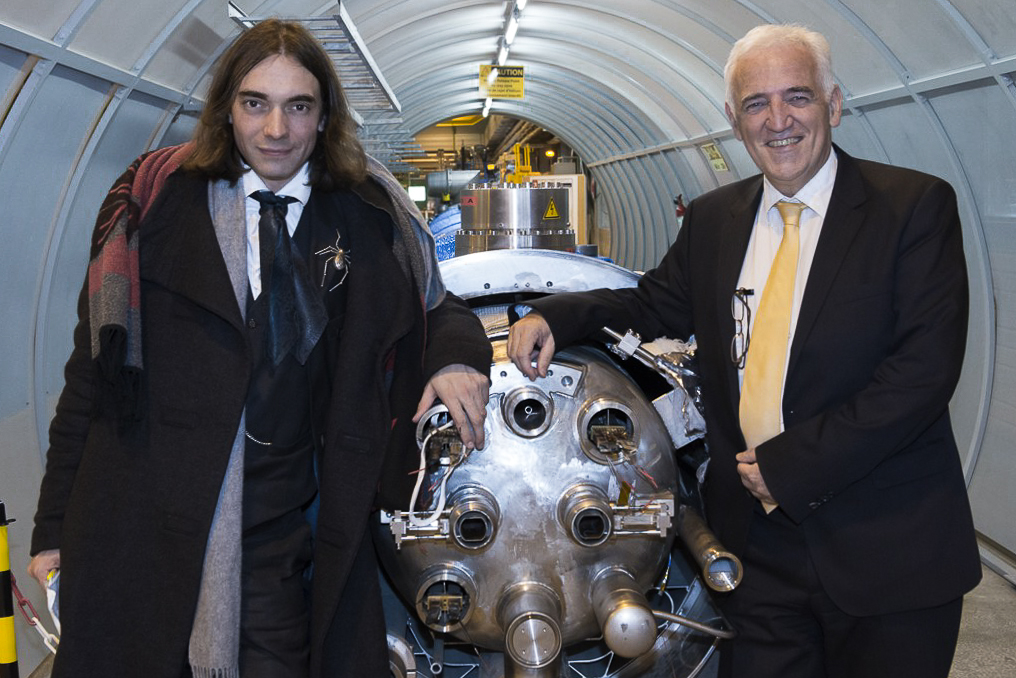
Cédric Villani (left), at SM18, alongside Frédérick Bordry, head of CERN’s Technology Department, is the director of the Institut Henri Poincaré and professor at the Université Claude Bernard Lyon 1. He was awarded the Fields Medal in 2010 for his work on Landau damping and the Boltzmann equation.
CERN Bulletin: This is your first visit to CERN – how have you found it?
Cédric Villani: It has been instructive and moving, both because of the theoretical research that CERN makes possible and because of the technological feat that it represents – truly a technological work of art!
CERN Bulletin: You are currently working on Riemannian geometry problems. Is there any link between this work and the research carried out at CERN?
Cédric Villani: All the work that I’ve done in mathematical physics builds on classical physics problems – problems that do not require me to draw on quantum mechanics, relativistic mechanics, infinitesimal or infinite quantities. In this sense, my work is completely unrelated to CERN’s research. That said, a page in the history of physics is being written here now, and one can’t help being interested.
CERN Bulletin: CERN enjoys an undeniably cosmopolitan working environment. Do you think that this is an asset for scientific research?
Cédric Villani: European cooperation comes into its own when there is a large project to be realised for which it's really essential to pool our expertise, whether for CERN, ITER or ESA and so on. CERN is a very good example of what the countries of Europe can do when they join forces.
CERN Bulletin: The discovery of the Higgs boson is the successful culmination of many years of research. What are your thoughts on the subject?
Cédric Villani: The discovery of the Higgs boson is an extraordinary accomplishment! The verification of this theory has required the deployment of considerable resources; it is pretty impressive, all of this technology built to serve the human mind. Putting it rather more grandiosely, we could say that it is a real triumph of the human mind over what we don’t understand. After the event, critics will say that it was a bit of a let-down in the end, as it is exactly what was expected. What are we going to do now?! I have confidence in my high energy colleagues to answer that question; they will find worthwhile projects to take on and fascinating theories to test.
CERN Bulletin: If you could uncover the answer to one of the mysteries of mathematical physics, which one would you choose?
Cédric Villani: Phase transition, without a doubt. What is its ultimate mathematical genesis? That’s an essential question. It’s not a yes or no question - we know that phase transitions occur - it's more a question of how. For mathematicians, the more important question is often “Why is such-and-such a phenomenon true?” rather than “Is this phenomenon true?”
CERN Bulletin: What would you be doing if you hadn't pursued mathematics?
Cédric Villani: As a child, my passion was palaeontology. It’s a very difficult discipline, involving a lot of painstaking work. Imagination, tenacity and rigour are the three qualities of both the palaeontologist and the mathematician. In mathematics, imagination is perhaps the most important; in palaeontology, it is undoubtedly tenacity.
Interview by Anaïs Schaeffer
Other (French)
Le 21 mai dernier, le CERN a eu le plaisir d’accueillir le mathématicien Cédric Villani dans le cadre du cycle de conférences organisées par le Groupement des Français du CERN. Le Bulletin du CERN était sur le coup. Rencontre.
Cédric Villani (à gauche), au SM18, aux côtés de Frédérick Bordry, chef du département Technologie du CERN. Cédric Villani est directeur de l’Institut Henri Poincaré et professeur à l’Université Claude Bernard de Lyon. Il a été décoré de la médaille Fields en 2010 pour ses travaux sur l’amortissement de Landau et l’équation de Boltzmann.
Bulletin du CERN : C’est votre première visite au CERN... Verdict ?
Cédric Villani : Ce fut instructif et émouvant, à la fois à travers les recherches théoriques que le CERN permet, mais aussi par l'exploit technologique qu'il représente – une véritable œuvre d'art technologique !
Bulletin du CERN : Vous travaillez actuellement sur des problèmes de géométrie riemannienne. Ces travaux ont-ils un lien avec les recherches menées au CERN ?
Cédric Villani : Toute ma carrière de physique mathématique est bâtie sur des problèmes de physique classique, problèmes pour lesquels on n’a pas besoin de mécanique quantique, de relativité, d’infiniment petit ou d’infiniment grand. En ce sens, mon travail est complètement étranger à ce qu’il se passe au CERN. Il n’empêche, une page de l’histoire de la physique s’écrit ici actuellement, et on ne peut que s’y intéresser.
Bulletin du CERN : Le CERN jouit d’un environnement de travail pour le moins cosmopolite. Pensez-vous que ce soit un atout pour la recherche scientifique ?
Cédric Villani : La coopération européenne trouve tout son sens quand il y a un gros projet à réaliser, pour lequel il faut vraiment mettre des compétences en commun : c’est le CERN, c’est ITER, c’est l’ESA… D’ailleurs, le CERN est un très bel exemple de ce que peut faire l’Europe quand elle unit ses forces.
Bulletin du CERN : La découverte du boson de Higgs couronne de nombreuses années de recherche. Quel est votre sentiment à ce sujet ?
Cédric Villani : La découverte du boson de Higgs est un accomplissement extraordinaire ! La vérification de cette théorie a nécessité la mise en œuvre de moyens considérables, c’est assez impressionnant, toute cette technologie mise au service de l’esprit humain. Si on veut être un peu grandiloquent, on dira que c’est un vrai triomphe de l’esprit humain sur l'incompréhensibilité du monde. Après, ceux qui sont critiques diront que c’est assez décevant finalement, car c’est exactement comme on l’avait prévu. Qu’est ce qu’on va faire maintenant ?! Pour ça, je fais confiance à mes collègues des hautes énergies, ils trouveront bien de quoi s’occuper, et des théories passionnantes à tester.
Bulletin du CERN : Si vous pouviez lever le voile sur un mystère de physique mathématique, lequel choisiriez-vous ?
Cédric Villani : Très certainement celui du changement d’état. Quel en est le ressort mathématique ultime, voilà une question essentielle. C’est un problème que je ne pose pas sous la forme « oui ou non » - on sait que les changements d’états se font - c’est plutôt « comment ? ». Pour les mathématiciens, cette question est souvent plus importante : « Pourquoi tel phénomène est vrai ? », plutôt que « Ce phénomène est-il vrai ? ».
Bulletin du CERN : Et si vous n’aviez pas fait de mathématiques ?...
Cédric Villani : Mon amour d’enfance était la paléontologie. Cette discipline est très difficile, très fastidieuse. Imagination, ténacité, rigueur : ce sont les trois qualités du paléontologue, comme du mathématicien. En mathématiques, il faut peut-être mettre l’imagination en premier ; en paléontologie, c’est sans doute la ténacité.
Propos recueillis par Anaïs Schaeffer
Files
CedricVillani_image.jpg
Files
(546.6 kB)
| Name | Size | Download all |
|---|---|---|
|
md5:0fe62985548d280aeecc99620c137029
|
546.6 kB | Preview Download |
Additional details
Identifiers
- CDS
- 1551225
- CDS Report Number
- BUL-NA-2013-112
Related works
- Is published in
- Periodical issue: dp3ag-dhp97 (CDS)
- Periodical issue: daj25-hx064 (CDS)