Two Nobel Prizes connected to CERN
Authors/Creators
Description
The 2003 Nobel Prizes in Physics and in Physiology or Medicine, announced last week, both have connections with particle physics and CERN.
Alexei Abrikosov, Vitaly Ginzburg and Anthony Leggett have received the prize in physics for their "pioneering contributions to the theory of superconductors and superfluids". The most important superconducting materials technically have proved to be those known as type II superconductors, which allow superconductivity and magnetism to exist at the same time and remain superconductive in high magnetic fields. The coils for the superconducting magnets in CERN's Large Hadron Collider are made from niobium-titanium alloy - a type II superconductor.
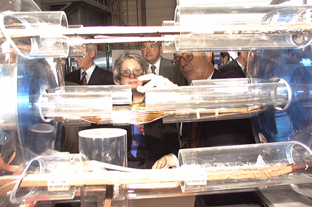
The LHC will operate thanks to magnets made of type II superconductors. Here, superconducting cables for the LHC are on display during a VIP visit.
Abrikosov, who is now at the Argonne National Laboratory, was working at the Kapitsa Institute for Physical Problems in his native Moscow when he succeeded in formulating a new theory to explain the behaviour of type II superconductors. This theory was based on work in the 1950s by Ginzburg at the P N Lebedev Physical Institute in Moscow.
The helium used to cool the LHC magnets is the common isotope, helium-4, which is superfluid at 1.9 K, the operating temperature of the LHC. However helium also exists as a rarer isotope, helium-3, which becomes superfluid only at very much lower temperatures around 2 mK. The contribution of Leggett, now at the University of Illinois, Urbana, has been to develop the decisive theory, while at Sussex University in the UK in 1970s, to explain superfluidity in helium-3.
Paul Lauterbur from Urbana, Illinois, and Peter Mansfield of Nottingham in the UK have been rewarded with Nobel prize in medicine or physiology for their discoveries in magnetic resonance imaging. The nuclear resonance phenomenon used in magnetic resonance imaging was first demonstrated, for protons, in 1946 by Felix Bloch and Edward Mills Purcell, who received the Nobel prize in Physics in 1952. Bloch went on to be the first Director General of CERN. Today MRI is used to examine almost all organs of the body, and is especially valuable in imaging the brain and spinal cord.
Other (French)
Les Prix Nobel 2003 de physique et de physiologie ou de médecine, annoncés la semaine dernière, ont tous deux un lien avec le physique des particules et le CERN.
Alexei Abrikosov, Vitaly Ginzburg et Anthony Leggett ont reçu le Prix Nobel de physique pour leurs «travaux pionniers dans le domaine théorique des supraconducteurs et des superfluides». Les matériaux supraconducteurs les plus importants du point de vue technique sont les supra-conducteurs dits de type II, qui permettent la coexistence de la supraconductivité et du magnétisme et restent supraconducteurs malgré la présence de puissants champs magnétiques. Les bobines des aimants supraconducteurs du LHC du CERN sont constituées d'un supra-conducteur de type II, un alliage de niobium et de titane.
Le LHC fonctionnera grâce à des aimants constitués de supraconducteurs de type II. Ici, les câbles supraconducteurs du LHC sont montrés lors d'une visite officielle.
Alexei Abrikosov, qui est maintenant au Laboratoire National d'Argonne (Etats-Unis), travaillait à l'Institut Kapitsa des problèmes physiques dans sa ville natale de Moscou lorsqu'il réussit à formuler une nouvelle théorie expliquant le comportement des supraconducteurs de type II. Cette théorie était basée sur des travaux dans les années 50 de Vitaly Ginzburg à l'Institut de Physique P.N. Lebedev à Moscou.
L'hélium utilisé pour refroidir les aimants du LHC est l'hélium-4, isotope courant, superfluide à 1.9 Kelvin, la température de fonctionnement du LHC. Cependant l'hélium existe aussi sous une forme plus rare, l'isotope hélium-3, devenant superfluide à des températures plus basses d'environ 2 mK. La contribution d'Anthony Leggett, aujourd'hui Professeur à l'Université de l'Illinois, à Urbana (Etats-Unis), fut de développer une théorie décisive pour expliquer la superfluidité de l'hélium-3, alors qu'il était à l'Université du Sussex (Grande-Bretagne), dans les années 70.
Paul Lauterbur d'Urbana (Etats-Unis) et Peter Mansfield de Nottingham (Grande-Bretagne) ont reçu le Prix Nobel de médecine ou de physiologie pour leurs découvertes sur l'Imagerie par Résonance Magnétique(IRM). Le phénomène de résonance nucléaire utilisé dans l'IRM fut pour la première fois démontré pour des protons en 1946 par Félix Bloch et Edward Mills Purcell, lauréats du Prix Nobel de physique en 1952. Félix Bloch devint le premier Directeur Général du CERN. Aujourd'hui l'IRM est utilisée pour examiner presque tous les organes du corps et a démontré son efficacité pour l'imagerie du cerveau et de la moelle épinière.
Files
na-2003-128_9802027_02.JPG
Files
(88.6 kB)
| Name | Size | Download all |
|---|---|---|
|
md5:d3f30ab43f29f255211c7ad5a47584f4
|
88.6 kB | Preview Download |
Additional details
Identifiers
- CDS
- 647300
- CDS Report Number
- BUL-NA-2003-128
- Aleph number
- 000014044MMD
Related works
- References
- Other: 000000300 (Other)