CERN's new seat at the United Nations
Authors/Creators
Description
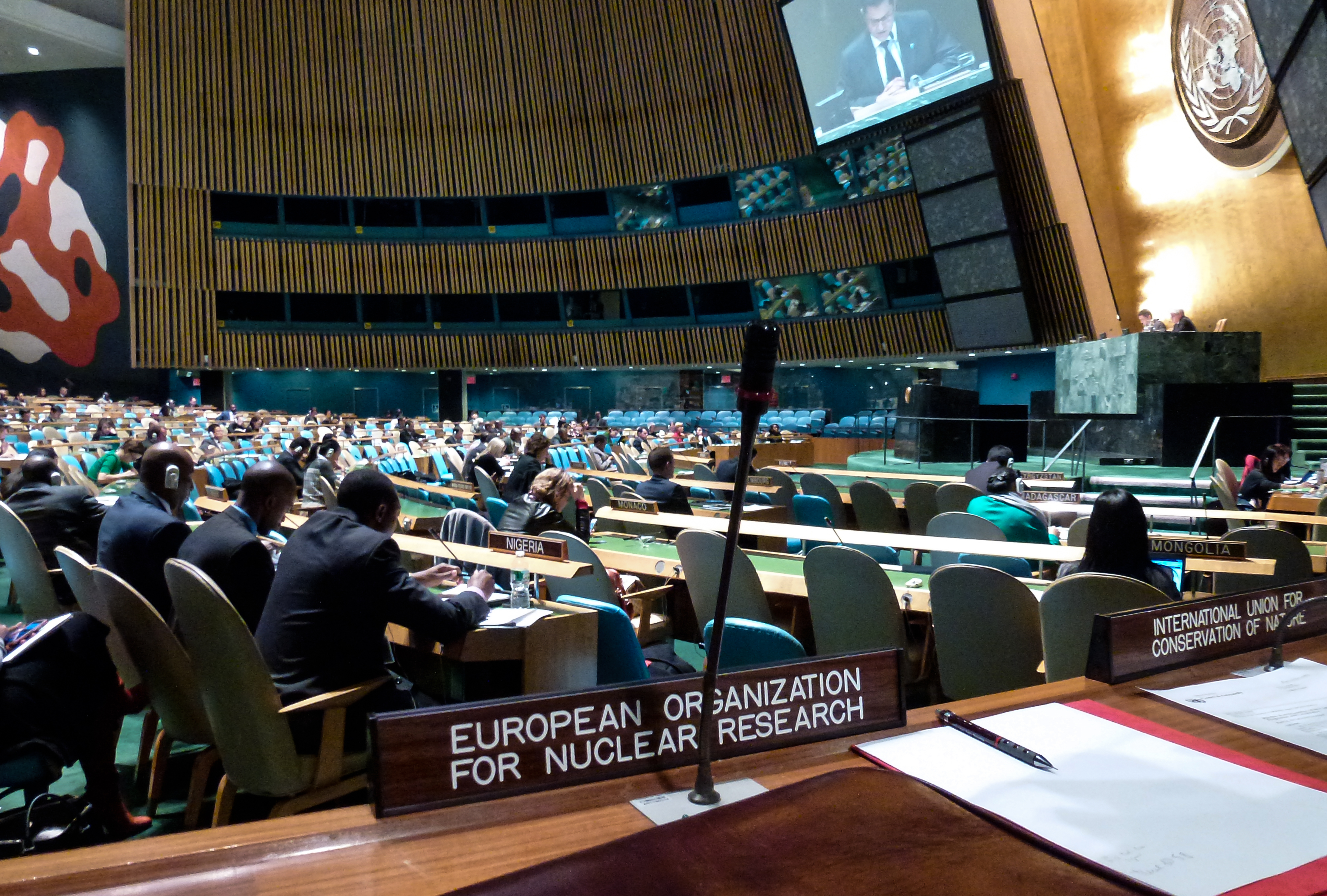
At the end of December, the General Assembly of the United Nations in New York granted CERN Observer status. As the only science organisation to acquire this prestigious status in the Assembly, CERN hopes to be able to raise awareness about the importance of fundamental science for society more effectively.
“Both CERN and the United Nations are committed to promoting science as a driving element for society. Both organisations promote dialogue between different cultures and can propose concrete models for peaceful cooperation towards objectives that benefit society as a whole,” says Maurizio Bona, CERN's officer in charge of relations with international organisations. Although the basic motivations are clear, obtaining the prestigious status from the UN was a long process that required negotiations and diplomatic work. Following some preliminary contacts with Switzerland starting in spring 2012, the resolution to grant observer status to CERN was jointly submitted in mid-August 2012 by the Organization's two Host States, Switzerland and France and then co-sponsored by CERN’s eighteen other Member States as well as by several non-Member States. It is worth noting that requests to grant Observer status to intergovernmental organisations cannot be put forward by the organisations concerned, but only by Member States of the United Nations.
CERN already engages in a several relations with the United Nations and several of its agencies. The presence of CERN, an intergovernmental organisation, as a permanent Observer at the UN General Assembly is a natural step forward. “Our presence at the Assembly was felt to be so natural by everybody that the Organization’s sign and seat were prepared before the formal adoption by the General Assembly and were made available as soon as the positive vote actually took place,” says Maurizio Bona, who attended the General Assembly session on 14 December. “The meeting with UN Secretary General, Ban Ki-moon, and our Director-General on Monday 17 December was extremely friendly and lasted longer than officially planned. Mr Ban Ki-moon encouraged CERN to actively cooperate with the United Nations, in particular on his initiative on science for sustainable development, and expressed a wish to visit CERN soon.”
United Nations Secretary-General Ban Ki-moon (left) and CERN Director-General Rolf Heuer (Image: Evan Schneider/UN).
To fulfill its mission, the UN and its agencies are involved, in different ways, in many fields of science, technology and innovation, as well as in education. With the recently updated and more effective institutional relationships, CERN hopes to strengthen and broaden its contribution to various ongoing UN initiatives. As an example, in the coming months CERN is planning to contribute to the implementation of ECOSOC's 2013 theme, “science, technology and innovation, and the potential of culture, for promoting sustainable development and achieving the Millennium development goals”.
“Several of the United Nation’s initiatives are happening in areas where CERN has no Member States,” says Maurizio Bona. He concludes: “The seat at the UN Assembly is not a static throne but a privileged position that will open new doors for us to reach a wider audience and raise awareness about the scientific world and its positive influence on society in a more global community.”
Other (French)
Fin décembre, l’Assemblée générale des Nations Unies à New York a accordé au CERN le statut d’observateur. Seule organisation scientifique à jouir de ce prestigieux statut auprès de l’Assemblée, le CERN espère parvenir à mieux faire comprendre l’importance de la science fondamentale pour la société.
« L’Organisation des Nations Unies et le CERN assurent toutes deux activement la promotion de la science en tant que moteur de progrès dans la société. Toutes deux favorisent le dialogue entre des cultures différentes et sont à même de proposer des modèles concrets de coopération à des fins utiles à l’ensemble de la société », explique Maurizio Bona, responsable au CERN des relations avec les organisations internationales. Même si les motivations premières sont évidentes, l’accès à ce prestigieux statut a toutefois été le fruit d’un long processus de négociations et de relations diplomatiques. Après des contacts préliminaires avec la Suisse au printemps 2012, la résolution par laquelle le CERN accède au statut d’observateur auprès de l’Assemblée générale des Nations Unies a été soumise à la mi-août 2012 par la Suisse et la France, les deux États hôtes du Laboratoire, avec le soutien des dix-huit autres États membres ainsi que de plusieurs États non-membres. Une organisation internationale ne peut demander elle-même à accéder au statut d’observateur. La demande doit être soumise par des États membres de l’Organisation des Nations Unies.
Le CERN interagit déjà avec l’Organisation des Nations Unies et plusieurs de ses institutions spécialisées. La présence du CERN, organisation intergouvernementale, en tant qu’observateur permanent auprès de l’Assemblée générale des Nations Unies est une évolution naturelle. « Notre présence à l’Assemblée semblait tellement aller de soi pour tous que la place de l’Organisation était déjà prévue avant l’adoption officielle de la résolution par l’Assemblée générale, et a été matérialisée immédiatement après le vote, explique Maurizio Bona, qui a participé à la session de l’Assemblée générale du 14 décembre. La rencontre entre le Secrétaire général de l’Organisation des Nations Unies, M. Ban Ki-moon, et le Directeur général du CERN, le 17 décembre, fut très cordiale et plus longue que ne le prévoyait le planning officiel. M. Ban Ki-moon a encouragé le CERN à coopérer activement avec les Nations Unies, en particulier à l’égard de son initiative sur les sciences pour le développement durable, et a émis le souhait de visiter le Laboratoire prochainement. »
Le Secrétaire général des Nations Unies, Ban Ki-moon (à gauche), avec le Directeur général du CERN, Rolf Heuer (Image : Evan Schneider/UN).
Dans le cadre de leurs missions, l’ONU et ses institutions spécialisées jouent un rôle chacune à sa manière dans de nombreux domaines de la science, de la technologie et de l’innovation, ainsi que dans l’éducation. Grâce à ces nouvelles relations institutionnelles plus efficaces, le CERN espère renforcer et élargir ses contributions à différents projets en cours de l’ONU. Ainsi, dans les mois à venir, le CERN prévoit de participer aux travaux sur l’un des thèmes du Conseil économique et social (ECOSOC) pour 2013 : « la science, la technologie, l’innovation et le potentiel de la culture pour promouvoir le développement durable et atteindre les objectifs du millénaire pour le développement ».
« Plusieurs projets des Nations Unies sont menés dans des régions géographiques qui ne comptent aucun État membre du CERN », poursuit Maurizio Bona. Et il conclut : « Ce siège auprès de l’Assemblée des Nations Unies n’est pas une pure formalité diplomatique, mais bien une position privilégiée qui nous donnera accès à un public plus large et permettra de faire connaître le monde scientifique et son influence positive sur la société dans un monde globalisé. »
Files
20121217_cern_un_image.jpg
Files
(6.7 MB)
| Name | Size | Download all |
|---|---|---|
|
md5:a445b60cf0e316bc4588fd8968d69ce2
|
52.1 kB | Preview Download |
|
md5:641966614018ce7a5562d52eacaa70a1
|
6.7 MB | Preview Download |

Additional details
Identifiers
- CDS
- 1505238
- CDS Report Number
- BUL-NA-2013-006
Related works
- Is published in
- Periodical issue: 63zm8-2jm85 (CDS)
- Periodical issue: we4sa-r0s55 (CDS)