Farewell to a magnetic year at CERN
Authors/Creators
Description
For the past four years, successive teams of Indian technical engineers have been spending a year each at CERN to test magnets for the LHC. As the operation approaches completion, three individuals tell us their experiences away from home.
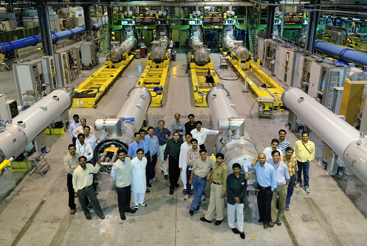
Some of the Indian technical engineers in the SM18 test hall.
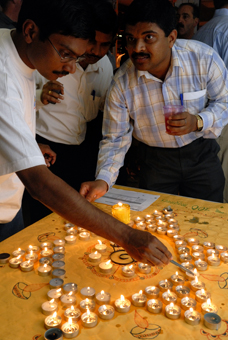
On a dark autumn night, a special celebration took place inside a small room in the vast test hall of SM18, the magnet test facility for the LHC in Saint Genis Pouilly. This may well be the last time this particular soirée at CERN will be juxtaposed with the tranquillity of the French countryside. Inside, beautifully arranged candles flickered with a warm glow to illuminate the faces of jovial guests. Welcome to Diwali, the Indian Festival of Lights. For the past four years, there has been a community of Indian technical engineers at SM18. They brought with them their families and traditions, adding an Indian flavour to CERN's cultural mix.
The SM18 community celebrated Diwali with a party, and lit candles to represent the remaining magnets still to be tested. Diwali takes place on the date of the new moon, between the months of Asvina and Kartika on the Hindu calendar (usually in October or November).
India collaborates with CERN as a non-member State. As part of an agreement to contribute to the LHC machine construction, they provided trained specialists to carry out a large proportion of the cryogenic magnet tests. The laborious operation of testing what will be a total of 1706 superconducting magnets takes place in three shifts around the clock. When it finally draws to a close, the project would have seen a total of 90 Indian specialists through the operation, most of them working on the magnet tests. Each Indian spends exactly one year at CERN. As the remaining number of magnets to be tested descends into double figures, the Indian community is gradually shrinking in size with its members returning home.
To fulfil their roles at CERN, the technical engineers, all specialists in their own fields, had to take a leave of absence from their regular jobs. In India, Praveen Deshpande designs instruments for accelerators and lasers, while Sampathkumar Raghunathan and Charudatta Kulkarni work on the research and development of nuclear instrumentation. For Praveen, the best part about working at CERN was the interaction with different people, 'I'm exposed to many people and agencies here, which I don't get to at home working in a small design section.' The logistics of implementing large-scale projects was an eye opener. 'We were all amazed by the way things are planned. The template approach with documentation and foresight is important in a big job like this,' added Sampathkumar. Charudatta agreed, and further identified excellent leadership skills as an important lesson he learned.
Although the job of testing magnets is essentially repetitive, it is also surprisingly challenging mentally. They were able to contribute ideas to improve the operation, which were taken on board and implemented. The procedures are therefore being continuously upgraded. The technical engineers were also able to use their free time to further their own knowledge. 'Vinod Chohan (the SM18 operations team leader) initiated a secondary line of activity, as long as this did not interfere with our main job,' explained Charudatta. 'Everyone was given the name of someone at CERN who works in a similar field to contact, if we wish. This is for our intellectual development. Because we work in R&D, it is important that we are up to date with new developments, so we are not left behind when we return a year later.'
On their days off, the SM18 community organised group visits to tourist destinations. They also celebrated Indian festivals, such as Diwali, and even formed teams for cricket matches. Many of the technical engineers brought their families over, and some of their children attended local schools. For example, Sampathkumar's wife, two children, and his mother moved to Switzerland for nine months. His seven-year-old daughter attended a French school for a full academic year. 'They all enjoyed living here. My daughter also learned a lot of French. It's an added asset. She likes the practical way of teaching and learned all sorts of activities.' Despite the favourable contrast to an academically focused education in India, the language barrier can present problems for everyday life. Praveen's six-year-old son would bring home documents from school in French, which he needed help in translating from French speakers, such as their CERN colleagues. The rotating shift work made it difficult to learn the language formally, as Charudatta pointed out, 'I very much regret not having been able to learn French.'
At the end of a remarkable year, the technical engineers are looking forward to returning home, enriched by their experiences. Memories of the CERN work culture, new friendships, and the natural beauty of Switzerland will echo fondly in their minds. They hope to incorporate what they have learnt at CERN into their work, in particular the methods of coordinating and managing large-scale projects. However, the experience extends far beyond a professional level. 'I very much admire the interpersonal trust here, not just at work, everywhere. This is a good humanitarian quality. I would like to do this back home,' said Charudatta.
The magnet test has facilitated international friendships and even reunited lost ones from home. Praveen met friends he knew from 13 years ago when he was undergoing training, but had since lost touch with, as well as colleagues who work for the same establishment in India he has never met due to the size of the organisation. Some CERN employees who also took part in the magnet tests have already arranged a group visit next year to India. Charudatta was encouraged by the sense of camaraderie, 'I was able to make good friends with my European colleagues. Now I realise that all humans are equal and similar, even though there are small cultural differences. So I feel I can freely interact with people. This is the best education.' Energised by a new-found confidence, he declared. ' You really feel like you are out of a small pond, and the world is your limit.'
Other (French)
Au cours des quatre dernières années, des ingénieurs-techniciens indiens se sont succédés au CERN, chacun restant une année pour tester les aimants du LHC. Alors que l'exercice touche à sa fin, trois d'entre eux nous livrent leurs impressions sur cette expérience à l'étranger.
Une partie des ingénieurs-techniciens indiens dans le hall d'essai SM18.
Par une sombre nuit d'automne, une fête un peu particulière s'est déroulée dans une petite salle à l'intérieur du gigantesque hall d'essai du bâtiment SM18, l'installation d'essai des aimants du LHC. Cela pourrait bien être la dernière fois qu'une telle soirée est organisée au CERN. A l'intérieur du bâtiment, le scintillement de bougies joliment disposées illumine chaleureusement les visages des invités. Bienvenue à Diwali, la fête indienne des lumières. Ces quatre dernières années, des ingénieurs-techniciens indiens ont travaillé dans le bâtiment SM18, ont fait connaître leur famille et leurs traditions et ont apporté une touche indienne à la mixité culturelle de l'Organisation.
Le personnel travaillant au SM18 a fêté Diwali et allumé des bougies représentant les aimants devant encore être testés. Diwali a lieu le jour de la nouvelle lune, entre les mois Asvina et Kartika du calendrier hindou (en général, en octobre ou en novembre).
L'Inde collabore avec le CERN en tant qu'État non-membre. Dans le cadre d'un accord de collaboration prévoyant une contribution de ce pays à la construction de la machine LHC, celui-ci a mis à la disposition du Laboratoire des spécialistes qualifiés pour tester une grande partie des aimants cryogéniques. Une tâche considérable puisque ce sont au total 1706 aimants supraconducteurs qu'il aura fallu mettre à l'épreuve 24 heures sur 24, par roulement de trois équipes. À la fin des opérations, non moins de 90 spécialistes indiens auront été mis à contribution, la plupart pour des essais magnétiques. Comme le nombre d'aimants devant encore être éprouvés se compte désormais en dizaine, la communauté indienne du CERN se réduit, à mesure que ses membres retournent au pays.
Pour venir travailler au CERN, les ingénieurs-techniciens indiens, tous spécialistes dans leur domaine d'activité, ont dû demander un détachement de leur établissement d'origine. En Inde, Praveen Deshpande conçoit des instruments pour des accélérateurs et des lasers; Sampathkumar Raghunathan et Charudatta Kulkarni, quant à eux, participent à des travaux de recherche et de développement dans le domaine de l'instrumentation nucléaire.
Au CERN, Praveen Deshpande a surtout apprécié de pouvoir communiquer avec différents interlocuteurs «Ici, je suis en contact avec beaucoup de personnes et d'instituts, ce qui n'est pas le cas en Inde dans le petit bureau d'études où je travaille.» La logistique requise pour mettre en oeuvre des projets de grande envergure fut une révélation. «Nous avons tous été stupéfiés par la manière dont les choses sont planifiées.» «Dans des projets de cette ampleur, il est important d'avoir des modèles documentés et d'être prévoyant», ajoute Sampathkumar Raghunathan. Un impératif que reconnaît aussi Charudatta Kulkarni, qui estime également avoir appris l'importance de bien diriger.
Tester des aimants est une activité très répétitive, mais aussi étonnamment stimulante au plan intellectuel. Les ingénieurs-techniciens indiens ont fait des propositions pour optimiser le processus, qui ont été prises en compte. Les procédures sont donc améliorées en permanence. Ils ont également pu mettre à profit leur temps libre pour approfondir leurs connaissances. «Vinod Chohan (chef de l'équipe du groupe Opérations au SM18) a ainsi pu organiser un ensemble d'activités secondaires, dans la mesure où elles n'interféraient pas avec nos tâches principales, explique Charudatta Kulkarni. On nous a donné à tous le nom d'une personne travaillant au CERN dans un domaine similaire au nôtre, que nous pouvions contacter. Un bon point pour notre épanouissement intellectuel. Nous travaillons dans le secteur de la R&D. Nous devons donc nous tenir au fait des évolutions afin de ne pas être dépassé lorsque nous repartirons».
Pendant leurs jours de congé, les ingénieurs-techniciens indiens du SM18 ont organisé des visites de groupe vers des destinations touristiques. Ils ont également célébré les fêtes indiennes, comme Diwali, et même formé des équipes pour des matchs de cricket. Beaucoup sont venus avec leur famille et certains de leurs enfants ont été inscrits dans les établissements de la région. Ainsi, l'épouse de Sampathkumar Raghunathan, ses deux enfants et sa mère ont passé neuf mois en Suisse. Sa fille de sept ans a fréquenté un établissement français durant toute l'année scolaire. «Tout le monde a apprécié son séjour ici. Ma fille a également appris le français. Un atout pour elle. Elle a aimé l'aspect pratique de l'enseignement et a découvert toutes sortes d'activités.»
Même si les avantages sont évidents par rapport à un enseignement purement scolaire en Inde, la barrière de la langue peut poser des difficultés dans la vie de tous les jours. Le fils de Praveen Deshpande (six ans) ramenait parfois à la maison des documents en français pour l'école qu'il a fallu faire traduire par des francophones, souvent des collègues du CERN. «Le travail par roulement a rendu difficile un apprentissage en bonne et due forme de la langue, souligne Charudatta Kulkarni. Je regrette beaucoup de ne pas avoir pu apprendre le français.»
Après une année formidable, les ingénieurs-techniciens ont hâte de rentrer chez eux, forts d'expériences enrichissantes. Ils se souviendront avec nostalgie de la culture de travail du CERN, de leurs nouvelles amitiés et de la beauté de la nature en Suisse. Ils espèrent pouvoir mettre en pratique dans leur travail les enseignements du CERN, notamment la manière de coordonner et de gérer des projets de grande envergure. Toutefois, l'expérience dépasse de loin le simple cadre professionnel. «J'admire énormément la confiance mutuelle qui prévaut ici, pas uniquement au travail, mais dans tous les domaines. Des relations humaines de qualité, que j'aimerais pouvoir reproduire chez moi» indique Charudatta Kulkarni.
Les essais magnétiques ont favorisé les amitiés internationales et ont permis également de retrouver des amis perdus de vue. Praveen Deshpande a ainsi revu des connaissances qu'il s'était faites il y a 13 ans, alors qu'il était en formation, mais avec lesquelles il avait perdu contact. Il a même pu rencontrer des collègues qui travaillent dans le même établissement que lui en Inde, mais qu'il n'avait jamais eu l'occasion de croiser étant donné la taille de celui-ci.
Certains cernois qui ont participé aux essais des aimants ont déjà prévu une visite de groupe en Inde l'an prochain. Pour Charudatta Kulkarni, le sens de la camaraderie s'est avéré réconfortant: «Je me suis vraiment bien entendu avec mes collègues européens. Je me rends compte à présent que tous les êtres humains sont égaux et se ressemblent en dépit de certaines différences culturelles. J'ai le sentiment de pouvoir dialoguer librement avec les gens. C'est le meilleur enseignement que l'on puisse tirer.» Galvanisé par une confiance toute nouvelle, il déclare: «On a réellement l'impression d'être un poisson qui sort de son aquarium pour découvrir l'océan.»
Files
na-2006-164_0608005_01-web.jpg
Files
(304.1 kB)
| Name | Size | Download all |
|---|---|---|
|
md5:2f739c27c53519f5942aa51e45a93062
|
177.0 kB | Preview Download |
|
md5:48272c9d989575d1c2129a5ed8421cb7
|
127.1 kB | Preview Download |
Additional details
Identifiers
- CDS
- 999338
- CDS Report Number
- BUL-NA-2006-164
- Aleph number
- 000043892MMD
Related works
- References
- Other: 000043315 (Other)
- Other: 000043861 (Other)