Vacuum chambers full of ideas for the Swedish synchrotron
Authors/Creators
Description
CERN’s Vacuum, Surfaces and Coatings group has contributed to the development of vacuum chambers for the MAX IV synchrotron, which has just been officially opened in Sweden.
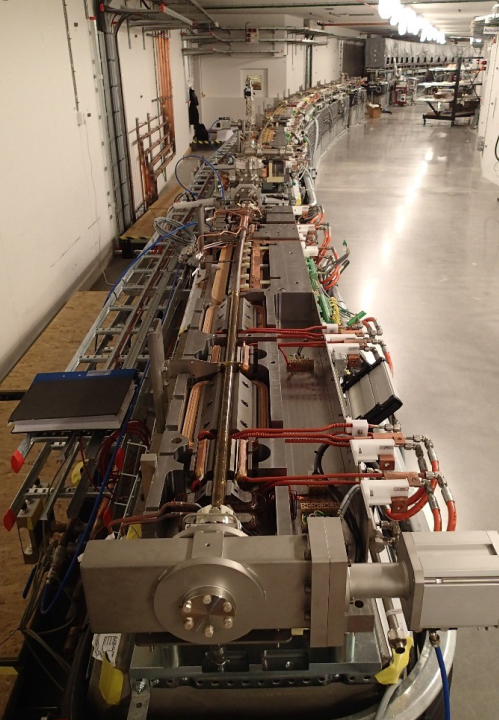
A section of the new 3 GeV MAX IV synchrotron at the time of installation. In the centre of the magnets you can see the vacuum chamber developed in collaboration with CERN. (Photo: Marek Grabski, MAX IV Vacuum group)
On 21 June, the King and the Prime Minister of Sweden officially opened MAX IV, a brand-new synchrotron in Lund, Sweden. The summer solstice, the longest day of the year, was deliberately chosen for the ceremony: MAX IV, a cutting-edge synchrotron, will deliver the brightest X-rays ever produced to more than 2000 users.
Some 1500 kilometres away, a team at CERN followed the opening ceremony with a touch of pride. The Vacuum, Surfaces and Coatings group in the Technology department (TE-VSC) participated in the construction of this new synchrotron. Its contribution lies at the very heart of the accelerator, in its vacuum chambers. The group developed the coating for most of the vacuum chambers in the larger of the two rings, which has a circumference of 528 metres and operates at an energy of 3 GeV.
The CERN group was brought in to develop the coating for the vacuum chambers using NEG (Non-Evaporable Getter) material. A thin, micrometric layer of NEG ensures a high-grade vacuum: it traps residual gas molecules and limits the release of molecules generated by the bombardment of photons. The technology was developed at CERN in the late 1990s for the LHC: six kilometres of vacuum chambers in the LHC, i.e. those at ambient temperature, are coated with NEG material. CERN’s expertise in the field is therefore unique and recognised worldwide.
Prototype of the surface treatment process, developed at CERN, to coat the vacuum chambers of the MAX IV synchrotron. (Photo: Pedro Costa Pinto/CERN)
“The MAX IV design was very demanding, as the cross-section of the vacuum chambers is very small, just 2.4 centimetres compared to 8 cm at the LHC,” explains Paolo Chiggiato, TE-VSC group leader. “In addition, some parts were geometrically complex.” Synchrotron light is extracted to experimental areas every 26 metres. At the extraction point, the chamber comprises two tubes that gradually diverge.
The CERN group began its involvement in the project in 2014 and developed the chemical surface treatment method used for almost all the vacuum chambers in the large ring of MAX IV. Treatment of the cylindrically symmetrical vacuum chambers was carried out by a European firm and a European institute, to which CERN had already transferred the technology in the past. The most complex chambers, around 120 in total, were treated at CERN. Two benches for sputtering, the coating technique used, were developed at CERN. “These benches are equipped with a wire whose material is deposited onto the surface of the chamber. For the MAX IV chambers, the wire had a diameter of 0.5 millimetres and its alignment was critical,” explains Mauro Taborelli, leader of the Surfaces, Chemistry and Coatings section in the TE-VSC group. “The procedure was all the more complicated because the extraction chambers, in which the photons are extracted, have a tiny vertical aperture, of around 1 millimetre,” confirms Pedro Costa Pinto, leader of the team responsible for the vacuum deposition process.
The vacuum chambers were delivered in 2014 and 2015. “It’s essential for us to participate in these types of project, which require lots of ingenuity, to be able to maintain and build on our know-how,” says Paolo Chiggiato. “By developing our expertise in this way, we will be ready for new projects at CERN.”
Other (French)
Le groupe Vide, surfaces et revêtements du CERN a contribué au développement des chambres à vide du synchrotron MAX IV, tout juste inauguré en Suède.
Une section du nouveau synchrotron de 3 GeV de MAX IV au moment de l’installation. On aperçoit au centre des aimants la chambre à vide développée en collaboration avec le CERN. (Photo : Marek Grabski, MAX IV Vacuum group)
Le 21 juin dernier, le roi et le premier ministre de Suède inauguraient MAX IV, un tout nouveau synchrotron, à Lund, en Suède. Le solstice d’été, jour le plus lumineux de l’année, avait été choisi à dessein pour la cérémonie : MAX IV, synchrotron de dernière génération, délivrera à plus de 2 000 utilisateurs des rayons X d’une brillance jamais égalée.
À quelque 1 500 kilomètres de là, une équipe du CERN suivait l’inauguration avec un brin de fierté. Le groupe Vide, surfaces et revêtements du département Technologie (TE-VSC) a en effet participé à la construction de ce nouveau synchrotron. Sa contribution se niche au cœur même de l’accélérateur, dans les chambres à vide. Le groupe a développé le revêtement de la plupart des chambres à vide du plus grand des deux anneaux, de 528 mètres de circonférence, et d’une énergie de 3 GeV.
Le groupe du CERN a été sollicité pour développer le revêtement des chambres à vide avec du matériau NEG (« Non Evaporable Getter »). D’une épaisseur micrométrique, la couche mince de NEG assure un vide poussé : elle piège les molécules de gaz résiduel et réduit la libération de molécules générées par le bombardement des photons. La technologie a été développée au CERN à la fin des années 1990 pour le LHC : six kilomètres de chambres à vide, les sections droites de l'accélérateur à température ambiante, en sont recouverts. Le CERN a ainsi acquis une expertise unique en la matière, mondialement reconnue.
Prototype pour le développement du traitement de surface au CERN des chambres à vide de MAX IV. (Photo : Pedro Costa Pinto/CERN)
« Le projet MAX IV était extrêmement exigeant car la section des chambres à vide est très petite, de seulement 2,4 centimètres contre 8 cm pour celle des chambres à vide du LHC, explique Paolo Chiggiato, le chef du groupe TE-VSC. De surcroît, certaines portions ont des géométries complexes. » La lumière synchrotron est en effet extraite vers des zones expérimentales tous les 26 mètres. Au point d’extraction, la chambre est formée de deux tubes qui divergent progressivement.
Impliqué dans le projet en 2014, le groupe du CERN a développé la technique de traitement chimique de surface des chambres à vide du grand anneau de MAX IV. Le traitement des chambres à vide à symétrie cylindrique a été réalisé par une firme et un institut européens vers lesquels le CERN avait déjà transféré la technologie dans le passé. Les chambres les plus complexes, environ 120 pièces, ont été traitées au CERN. Deux bancs de pulvérisation cathodique, la technique de revêtement, ont été développés au CERN. « Ces bancs sont dotés d’un fil dont le matériau est déposé sur la surface de la chambre. Pour les chambres de MAX IV, le fil présentait un diamètre de 0,5 millimètre et son alignement était critique », explique Mauro Taborelli, chef de la section Surfaces, chimie et revêtement du groupe TE-VSC. « Le procédé était d’autant plus compliqué que les chambres d’extraction, dans lesquelles les photons sont extraits, présentent une toute petite ouverture verticale, de l’ordre du millimètre », confirme Pedro Costa Pinto, chef de l'équipe dépôt sous vide.
Les chambres à vide ont été livrées en 2014 et 2015. « Participer à ce genre de projet exigeant, qui demande beaucoup d’ingéniosité, est essentiel pour maintenir et développer notre savoir-faire, se félicite Paolo Chiggiato. En développant ainsi notre expertise, nous serons prêts pour les nouveaux projets du CERN. »
Files
vacuum-chambers-MAXIV_image.jpg
Files
(318.3 kB)
| Name | Size | Download all |
|---|---|---|
|
md5:8cb26bc8f8823fadffcd0ac43080ca77
|
318.3 kB | Preview Download |
Additional details
Identifiers
- CDS
- 2162937
- CDS Report Number
- BUL-NA-2016-112
Related works
- Is published in
- Periodical issue: 3vqq4-3k004 (CDS)
- Periodical issue: xvevh-y4d17 (CDS)