Twenty years ago: The spring of the W and Z
Authors/Creators
Description
Between January and May 1983, CERN saw the signature of the W and Z bosons. This major discovery, which confirmed the electroweak theory, was the result of a daring technical gamble.
The spring of 1983 came early for CERN ... and blossomed well. In the four-month period between late January and early May, the Laboratory made two of its greatest discoveries: the W and Z bosons, the vectors of the electroweak force. The announcement was so sensational that the two scientists behind the discovery received the Nobel Prize for Physics only a year later. The Prize went to Carlo Rubbia, instigator of the SPS accelerator's conversion into a proton-antiproton collider and spokesman of the UA-1 experiment, and to Simon van der Meer, who invented the stochastic cooling technology vital to the collider's operation.
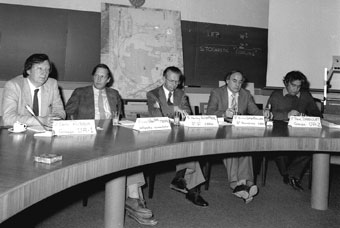
A press conference held at CERN on 25 January following the announcement of the discovery of the W boson. From left to right: Carlo Rubbia, spokesman of the UA-1 experiment, Simon van der Meer, inventor of stochastic cooling technology, Herwig Schopper, Director-General of CERN, Erwin Gabathuler, CERN Research Director, and Pierre Darriulat, spokesman of the UA-2 experiment.
To understand the importance of the discovery, we need to go back to three previous Nobel Prize winners. In 1979, Steven Weinberg, Abdus Salam and Sheldon Glashow received the Nobel Prize for having put forward in the 1960s the theory that the electromagnetic and weak forces were the result of a single interaction, known as the electroweak interaction. Until then, physicists had only four forces with which to describe natural phenomena: the electromagnetic force, the strong and weak nuclear forces and gravity. These forces are exerted between particles thanks to an exchange of elementary particles, the bosons. The electroweak theory predicts the existence of three massive bosons, the charged W+ and W- bosons and the neutral Z0 boson. The first evidence of this unified force had already been produced by CERN in 1973 when the Gargamelle experiment observed the neutral currents predicted by the electroweak theory.
But there was still no trace of the famous W and Z bosons, which were too large to be produced by the accelerators that existed at that time. The boson hunters were certainly not short of ideas, however. In 1976, David Cline, Peter McIntyre and Carlo Rubbia suggested modifying CERN's biggest accelerator, the SPS, measuring 6.9 km in circumference. Just commissioned, the accelerator was delivering particle beams onto fixed targets. Their idea was to convert it into a proton-antiproton collider, thus generating sufficient energy to produce the long hoped-for bosons.
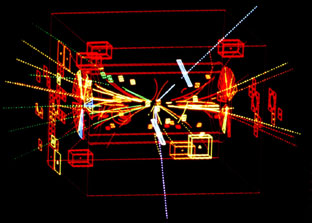
One of the first events revealing the Z boson, as recorded by the UA-1 detector in 1983. Here we see the decay of a Z boson into an electron-positron pair, whose traces are clearly visible (two straight lines, one on the right going upwards and the other shooting downwards slightly to the left).
The decision to convert an accelerator that had only just been commissioned into a complex collider, surrounded by uncertainties, was by no means an easy one, and the associated technical challenge was even less straightforward. Nevertheless, CERN managed to achieve this feat in the three-year period between 1978 and 1981, during which time the two experiments UA-1 and UA-2 were developed. The two detectors had the same main objective, the hunt for the Z and W bosons, but they differed in many ways. UA-1, led by Carlo Rubbia, was the first of the large-scale collaborations, consisting of around 130 physicists from 12 different institutes. Its detector, which was huge for the time, weighed no less than 2000 tonnes. It had numerous scientific goals and had to be capable of identifying many different types of particles moving in all directions. At 200 tonnes and with a collaboration of about fifty physicists from 6 different institutes, UA-2 was much more compact. The detector was specifically designed to look for the W and Z bosons by optimising the detection of the electrons and positrons produced from their decays.
The SPS produced its first collisions in July 1981. The data taken in 1981 and 1982 produced the first evidence of the particle jets produced in this kind of machine. In the last three months of 1982, round-the-clock data taking resulted in the recording of around a million events with the potential to reveal the W and Z bosons. On 21 January 1983, the discovery of the W+ and W- bosons was announced after the UA-1 collaboration observed 5 events revealing their signature. UA-2 confirmed the discovery by observing 4 similar events. Ten times more W bosons were produced during the Spring. In May, CERN announced the discovery of the third intermediate boson, the Z0. This was entirely logical since, aware of the W and Z production cross sections in the modes observable at that time, the physicists expected to discover the W bosons first and to detect ten times more of them than the Z bosons. At the same time, the expected theoretical properties were conclusively confirmed and the masses of the W and Z were estimated at 80 GeV and 91 GeV respectively, with an uncertainty of plus or minus 5 GeV.
The discovery of the W and Z bosons not only confirmed the electroweak theory but also validated the quantum chromodynamic electroweak standard model on which calculations of physics processes in this energy range are based. The discovery of the Z0 was also fundamental in boosting the scientific community's belief in the need to build the giant LEP accelerator, commissioned in 1989. A veritable Z factory - producing some 20 million of them - before becoming a W factory, the LEP measured the properties of both with extreme precision.
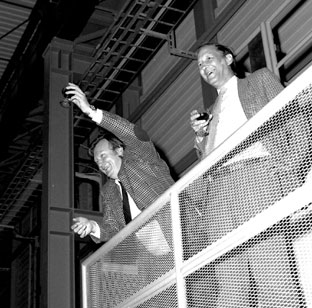
Carlo Rubbia (left) and Simon van der Meer, who were awarded the 1984 Nobel prize for physics for their roles in discovering the W and Z particles.
Technical info
Cover articleOther (French)
Entre janvier et mai 1983, le CERN vit la signature des bosons W et Z. Cette découverte majeure, confirmant la théorie électrofaible, fut réalisée au terme d'un audacieux pari technique.
Other (French)
Entre janvier et mai 1983, le CERN vit la signature des bosons W et Z. Cette découverte majeure, confirmant la théorie électrofaible, fut réalisée au terme d'un audacieux pari technique.
En 1983, le CERN connut un printemps précoce... et glorieux. En l'espace de quatre mois, entre fin janvier et début mai, le Laboratoire récolta deux de ses plus grandes découvertes, celles des bosons W et Z, vecteurs de la force électrofaible. L'annonce fut retentissante. Si retentissante qu'il ne fallut attendre qu'une année pour que les deux scientifiques à l'origine de la découverte ne reçoivent le Prix Nobel de Physique. En 1984, Carlo Rubbia, promoteur de la transformation de l'accélérateur SPS en collisionneur de protons et d'antiprotons et porte-parole de l'expérience UA-1, et Simon van der Meer, inventeur de la technique de «refroidissement stochastique» indispensable au fonctionnement du collisionneur, furent honorés par l'Académie Nobel.
Le 25 janvier 1983, le CERN organise une conférence de presse suite à l'annonce de la découverte du boson W. De gauche a droite : Carlo Rubbia, porte-parole de l'expérience UA1, Simon van der Meer, inventeur des techniques de refroidissement stochastique, Herwig Schopper, Directeur général du CERN, Erwin Gabathuler, Directeur de la recherche du CERN, et Pierre Darriulat, porte-parole de l'expérience UA-2.
Pour comprendre la portée de cette découverte, il faut remonter à trois autres lauréats du Prix Nobel.
En 1979, Steven Weinberg, Abdus Salam et Sheldon Glashow furent récompensés pour avoir proposé dans les années 60 une théorie selon laquelle les forces électromagnétique et faible découleraient d'une seule et même interaction, dite électrofaible. Jusqu'alors, la physique décrivait les phénomènes naturels par le biais de quatre forces : la force électromagnétique, les forces nucléaires forte et faible et la gravitation. Ces forces s'exercent entre les particules grâce à un échange de particules élémentaires, les bosons. La théorie électrofaible postule l'existence de trois bosons massifs, les W+ et W- chargés et le Z0 de charge nulle. Une première évidence de cette force unifiée fut déjà apportée par le CERN en 1973 lorsque l'expérience Gargamelle observa les courants neutres prédits par la théorie électrofaible.
Mais nulle trace encore des fameux bosons W et Z, si massifs qu'ils ne pouvaient être produits par les accélérateurs de l'époque. Les chasseurs de bosons ne manquaient cependant pas d'idées. En 1976, David Cline, Peter McIntyre et Carlo Rubbia proposèrent de modifier le plus grand accélérateur du CERN, le SPS de 6,9 km de circonférence, qui venait d'entrer en service. L'accélérateur envoyait alors des faisceaux de particules sur des cibles fixes. Leur idée fut de le transformer en collisionneur de protons et d'antiprotons, produisant alors une énergie suffisante pour créer les bosons espérés.
L'un des premiers événements révélant le Z enregistré par le détecteur UA-1 en 1983. Le Z se désintègre en une paire électron-positon dont les traces sont clairement visibles (les deux lignes droites, l'une partant vers le haut à droite et l'autre fusant vers le bas légèrement sur la gauche).
Convertir un accélérateur qui venait d'entrer en service en un collisionneur complexe, sur lequel pesait de nombreuses incertitudes, n'était pas une décision simple à prendre et encore moins un défi technique facile à relever. Le CERN réussit pourtant ce tour de force en l'espace de trois ans, entre 1978 et 1981. Parallèlement deux expériences furent élaborées : UA-1 et UA-2. Leur objectif principal, la chasse aux bosons Z et W, était similaire, mais les deux détecteurs différaient par bien des aspects. UA-1, porté par Carlo Rubbia, inaugurait l'ère des collaborations à grande échelle, regroupant environ 130 physiciens de 12 instituts. Son détecteur, immense pour l'époque, pesait pas moins de 2000 tonnes. Ses objectifs scientifiques étaient multiples. Le détecteur devait être capable d'identifier de nombreux types de particules et dans toutes les directions. UA-2 était bien plus compact - 200 tonnes - et rassemblait une cinquantaine de physiciens de 6 instituts. Le détecteur fut conçu plus spécifiquement pour rechercher les W et Z en optimisant la détection des électrons et des positons issus de leurs désintégrations.
En juillet 1981, le SPS enregistrait ses premières collisions. Les données prises en 1981-82 permirent la première mise en évidence des jets de particules produits dans ce type de machine. Lors des trois derniers mois de 1982, environ un million d'événements susceptibles de révéler les W et Z furent enregistrés 24 heures sur 24. Le 21 janvier 1983, la découverte des W+ et W- fut annoncée suite à l'observation par UA-1 de 5 événements révélant leur signature. UA-2 confirma la découverte avec l'observation de 4 événements similaires.
Au printemps, dix fois plus de W étaient créés. Dans le courant du mois de mai, le CERN annonça la découverte du troisième boson intermédiaire, le Z0. La logique était respectée, car sachant les sections efficaces de production des W et Z dans
les modes alors observables, les physiciens escomptaient trouver les W en premier et en détecter dix fois plus que de Z. Parallèlement, les propriétés théoriques attendues furent définitivement confirmées et les masses des W et Z furent estimées à 80 GeV et 91 GeV respectivement, avec une incertitude de plus ou moins 5 GeV.
La découverte des W et Z ne confirma pas seulement la théorie électrofaible. Elle permit également de valider le modèle standard électrofaible-chromodynamique quantique, à la base des calculs de processus physiques dans cette gamme d'énergie. La découverte du Z0 fut aussi fondamentale pour doper la confiance de la communauté scientifique sur l'intérêt de construire le gigantesque accélérateur LEP, mis en service en 1989. Véritable usine à Z - quelque 20 millions en furent produits - puis à W, le LEP en mesura avec une extrême précision les propriétés.
Carlo Rubbia (à gauche) et Simon van der Meer reçurent le prix Nobel de Physique en 1984 pour leur rôle dans la découverte des bosons W et Z.
Files
na-2003-050_8301243.jpg
Additional details
Identifiers
- CDS
- 615771
- CDS Report Number
- BUL-NA-2003-050
- Aleph number
- 000012768MMD
Related works
- Is referenced by
- Other: ADMBUL_0024715 (Other)
- References
- Photo: 0000728 (Other)
- Photo: 0000601 (Other)
- Photo: 0000179 (Other)