DESERTEC: energy for the planet
Authors/Creators
Description
The DESERTEC project, launched in 2007, aims to enable the countries of Europe, North Africa and the Middle East to cover a large part of their energy needs through the use of renewable energies by 2050. One of the instigators of this project is Gerhard Knies, former particle physicist at DESY (Deutsches Elektronen-Synchrotron). On several occasions he also took part in experiments at CERN, and on 3 February he returned to the Laboratory to present DESERTEC at a special colloquium.
The first stage of the project is to install solar power stations in the deserts of the North Africa and Middle East (MENA) region. Deserts are incomparable sources of clean energy and might hold the key to the planet's energy problem. The DESERTEC concept, presented at CERN on 3 February 2011, is quite simple - producing "clean" electricity by exploiting the massive quantities of solar power that beat down upon the deserts. "Our planet's deserts receive more energy in six hours than the whole of humanity consumes in one year! The idea of harnessing this is not new, but we now have the technologies to make it happen," explains Gerhard Knies, a retired German scientist with a long career in particle physics behind him.
The collaboration which founded the project was set up in 2003. Its members come from various fields of activity in many countries and are now united under the banner of the DESERTEC Foundation. "International cooperation is essential," he stresses. "We would also like to forge partnerships with major industries. If you can persuade leading industrialists to invest in a project, the politicians will follow suit."
A concentrating solar thermal power
plant (CSP) reflecting sunbeams onto
a receiver. Source: DESERTEC
Foundation, www.desertec.org
The initial aim is to install concentrating solar power stations (CSPs, see box) in the deserts of North Africa and the Middle East. Power stations of this kind have been used since the late 1980s in California and, more recently, in Nevada and Spain, and have already proved their worth. If a mere 0.3% of our planet's 40 million square kilometres of desert were equipped with them it would be enough to cover all mankind's present power needs! On the question of transportation, Gerhard is confident: "With a loss rate below 3% per 1,000 km, the technological advances being made today in the field of high-voltage DC power lines make it possible to transport electricity at low cost over long distances."
The DESERTEC Foundation is a non-profit organisation in which everyone can take part. Additional information is available here.
| How the DESERTEC project evolved In 2003, Gerhard Knies and Prince El-Hassan bin Talal of Jordan set up TREC, the Transmediterranean Renewable Energy Cooperation, an international network of researchers, economists and politicians which elaborated the DESERTEC concept and, several years later, set up a foundation of the same name. Supported by renewable energy research institutes from many countries (Morocco, Algeria, Libya, Egypt, Jordan and Yemen), by the German Aerospace Centre and by the Club of Rome, the DESERTEC project has since gone from strength to strength. In 2008, the DESERTEC Foundation supported the creation of the EU's Mediterranean Solar Plan and in 2009 it launched the industrial initiative Dii GmbH, which brings together partners from the industrial and financial sectors with a view to promoting the DESERTEC concept throughout Europe, North Africa and the Middle East. Subsequently, as a complement to Dii, the French government set up Medgrid (formerly Transgreen), a company dedicated to the construction of power lines in the Mediterranean region. Finally, last year, the DESERTEC university network (DUN) was born, an alliance of 18 universities and research centres in North Africa and the Middle East, whose purpose is to develop the concept in Europe, North Africa and the Middle East and, ultimately, throughout the world. |
| Concentrating solar power stations (CSPs) Heliothermal power plants operate according to the same principle as solar furnaces, using an array of mirrors. The sun's rays are focussed onto a receiver and used to super-heat water. As in a conventional power station, the resulting steam is used to feed electricity-generating turbines, but without the slightest carbon dioxide emission. With their additional heat-storage capability, CSPs can also produce electricity at night or when the sky is overcast and thus ensure a power supply perfectly matching society's needs. |
Other (French)
Lancé en 2007, le projet DESERTEC devrait permettre aux pays de la région EU-MENA (Europe, Moyen-Orient, Afrique du nord) de couvrir, d’ici à 2050, une grande partie de leurs besoins énergétiques grâce aux énergies renouvelables. Gerhard Knies, un ancien physicien des particules du synchrotron DESY (Deutsches Elektronen-Synchrotron), est un des instigateurs de ce projet. Il a également participé plusieurs fois aux expériences du CERN, où il est revenu présenter DESERTEC lors d’un colloque, le 3 février dernier.
Les carrés rouges représentent la surface de CSP nécessaire pour subvenir aux besoins énergétiques actuels du monde, de l’Europe et de la région MENA. Source : DESERTEC Foundation, www.desertec.org
Première étape du projet : installer des centrales thermiques solaires dans les déserts de la région MENA (Moyen-Orient, Afrique du nord). Sources incomparables d’énergie propre, les déserts ont peut-être la réponse au problème énergétique de la planète. Présenté au CERN le 3 février dernier, le concept DESERTEC est simple : produire de l’électricité « propre » en exploitant l’énorme quantité d’énergie solaire que reçoivent les déserts. « Les déserts de notre planète reçoivent en six heures plus d’énergie que n’en consomme l’humanité en toute une année ! L’idée d’en tirer profit ne date pas d’hier, mais aujourd’hui, nous possédons les technologies qui peuvent nous permettre de la concrétiser », explique Gerhard Knies, scientifique allemand fort d’une longue carrière en physique des particules, maintenant à la retraite.
La collaboration à l’origine du projet a démarré en 2003. Aujourd’hui réunis dans le cadre de la « Fondation DESERTEC », ses membres sont issus de divers secteurs d’activité de nombreux pays. « La coopération internationale est indispensable, souligne le chercheur. Par ailleurs, nous souhaitons aussi nous associer aux grandes industries. Il suffit en effet que des industriels réputés s’investissent dans un projet pour que les politiques en fassent autant... »
Une centrale thermique solaire à
concentration (CSP) réfléchissant les
rayons du soleil vers un récepteur.
Source : DESERTEC Foundation,
www.desertec.org
Dans un premier temps, l’objectif est d’installer des centrales thermiques solaires à concentration (ou CSP, voir encadré) dans les déserts du Moyen-Orient et d’Afrique du nord. Utilisées dès la fin des années 80 en Californie, et depuis peu, dans le Nevada et en Espagne, ces centrales ont déjà fait leurs preuves. Il suffirait d’équiper 0,3% des 40 millions de km2 de surfaces désertiques de notre planète pour couvrir les besoins mondiaux actuels en électricité ! Pour ce qui est du transport, Gerhard est confiant : « Avec une perte inférieure à 3% pour 1 000 km, les progrès technologiques réalisés dans le domaine des lignes de transmission en courant continu haute tension permettent aujourd’hui de transporter l’électricité sur de longues distances et à moindre coût. »
La fondation DESERTEC est à but non lucratif. Tout le monde peut s’y investir. Pour plus d’informations, visitez leur site web.
| L’histoire du projet DESERTEC En 2003, Gerhard Knies et le prince Hassan bin Talal de Jordanie créaient la Coopération transméditerranéenne pour l’énergie renouvelable - un réseau international de chercheurs, économistes et politiques à l’origine du concept DESERTEC et, quelques années plus tard, de la fondation du même nom. Fort du soutien des instituts de recherche sur les énergies renouvelables de nombreux pays (Maroc, Algérie, Libye, Égypte, Jordanie et Yémen), ainsi que du Centre aérospatial allemand et du Club de Rome, le projet DESERTEC connaît depuis un développement très prometteur. En 2008, la fondation DESERTEC soutient la création du Plan solaire pour la Méditerranée par l’Union européenne et, en 2009, lance l’initiative industrielle Dii GmbH. En réunissant des partenaires des secteurs industriel et financier, elle souhaite promouvoir le concept DESERTEC dans toute la région EU-MENA (Europe, Moyen-Orient, Afrique du nord). Par la suite, en complément de Dii GmbH, le gouvernement français crée la société Medgrid (anciennement Transgreen), destinée à favoriser la construction de lignes de transmission dans la région méditerranéenne. Enfin, l’année dernière, le Réseau Universitaire DESERTEC (DUN en anglais) voyait le jour. Alliant 18 universités et centres de recherche du Moyen-Orient et d’Afrique du nord, son but est de développer le concept aussi bien dans la région EU-MENA que, in fine, à travers le monde. |
| Les centrales thermiques solaires à concentration (CSP) Avec leurs nombreux miroirs collecteurs, les centrales héliothermiques fonctionnent sur le même principe que les fours solaires. Redirigés vers un récepteur-cible, les rayons du soleil permettent de chauffer de l’eau jusqu’à une très haute température. Comme dans une centrale conventionnelle, la vapeur ainsi générée alimente ensuite les turbines productrices d’électricité, et ce, sans la moindre émission de CO2. En offrant par ailleurs la possibilité de stocker la chaleur, les CSP sont également en mesure de produire de l’électricité la nuit ou par temps couvert, et peuvent ainsi assurer une distribution en parfait accord avec les besoins. |
Files
DESERTEC-Map-new-web(1)_image.jpg
_image.jpg?download=1)
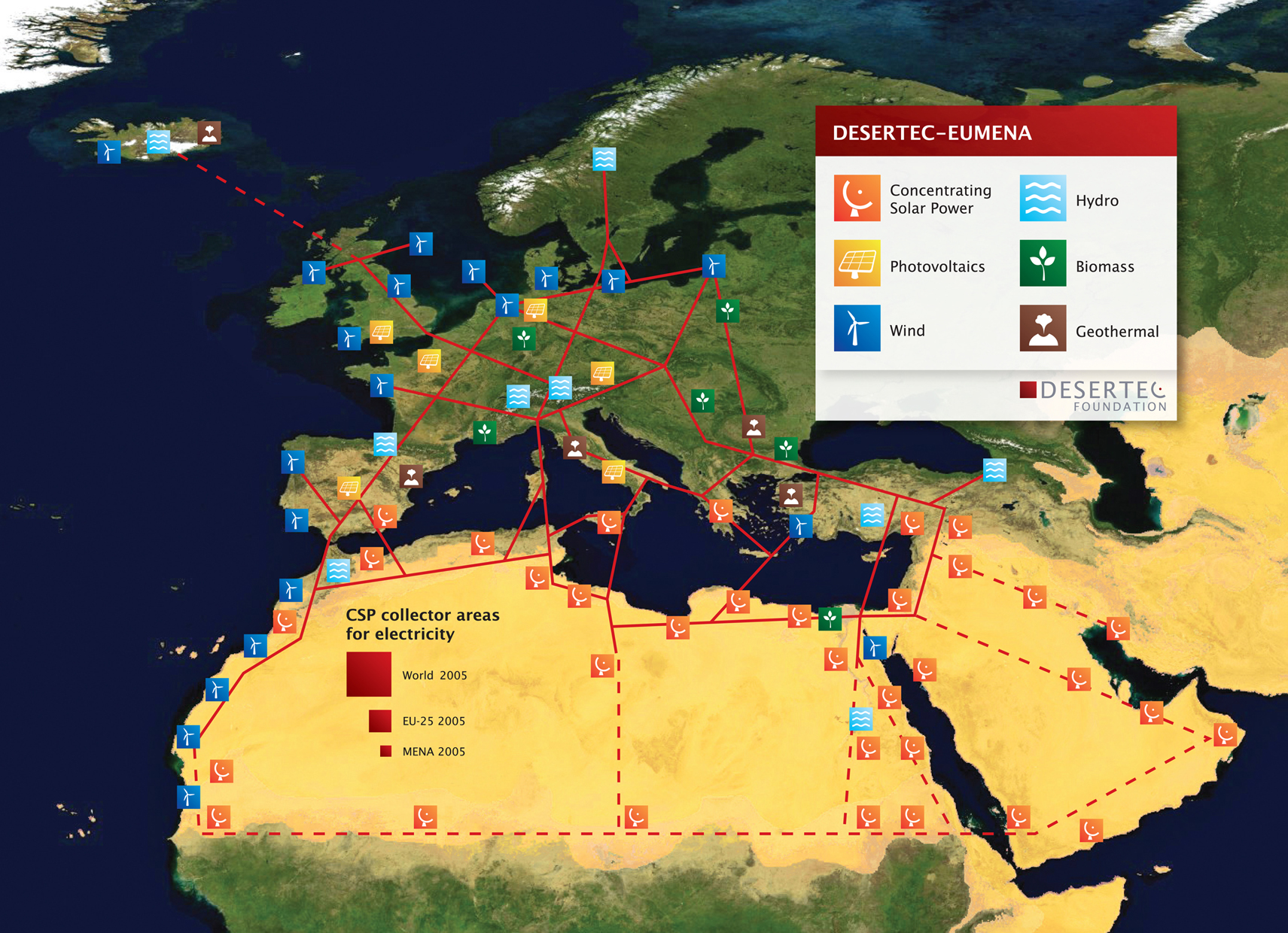
_image.jpg?download=1)
_image.jpg?download=1)
Additional details
Identifiers
- CDS
- 1331513
- CDS Report Number
- BUL-NA-2011-048
Related works
- Is published in
- Periodical issue: tyq45-fvd51 (CDS)
- Periodical issue: 9exw8-a7g69 (CDS)