Speaking about the Internet…
Authors/Creators
Description
Although a lot of people know that the Web was invented at CERN, not many people know that CERN has also played a central role in developing the Internet in Europe. In the early 1990s the European Internet network looked like a star, with CERN at its center. The Organization was also one of the founding members of the Internet Society, which celebrated its first 20 years in a conference held in Geneva from 22 to 24 April. CERN was a special guest.
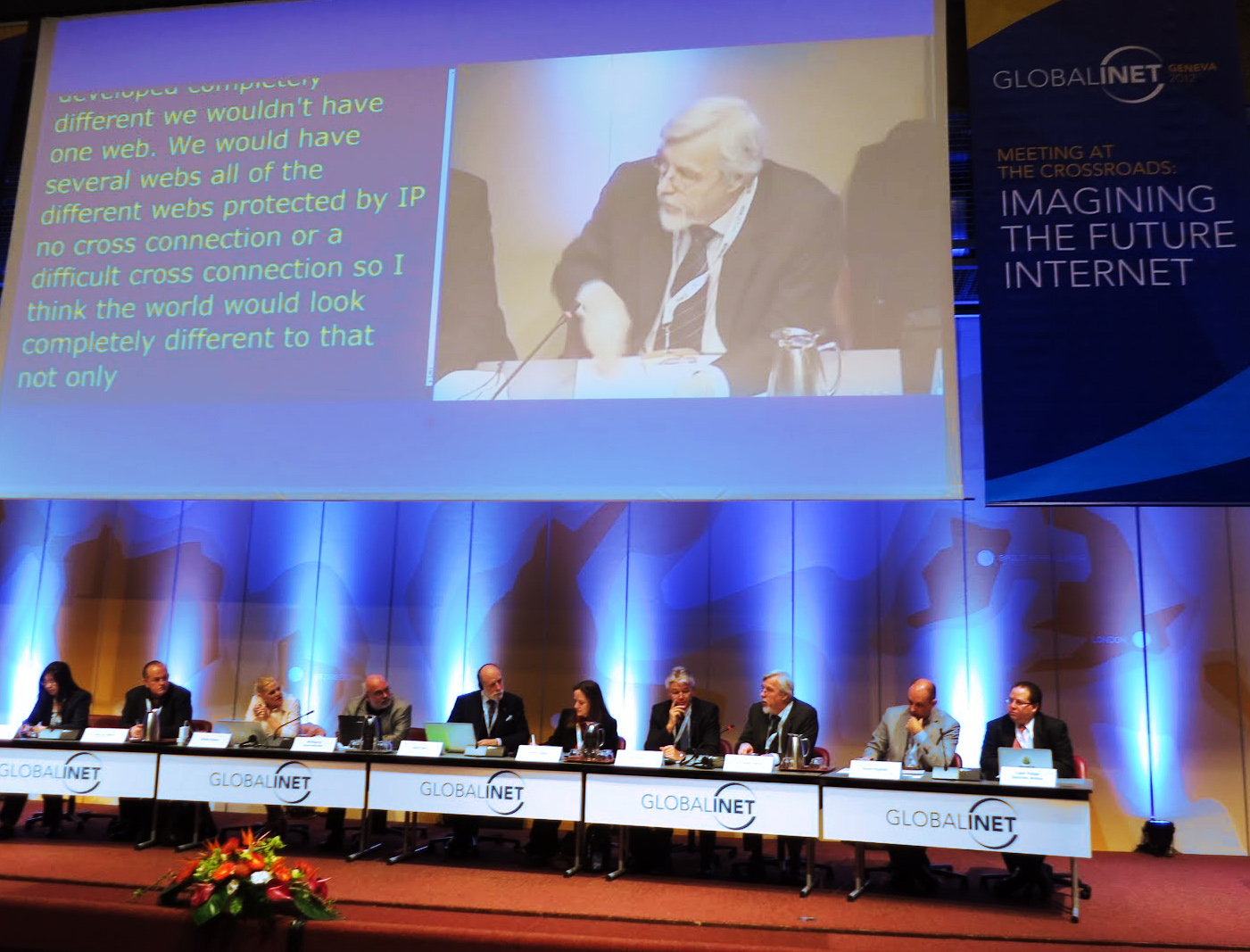
The Internet Society’s Global INET 2012 was a three-day international forum that celebrated the Internet Society’s 20th anniversary. The Society was created to provide a framework for the governance of the Internet, promote its development and keep it accessible to the largest possible number of users. “In 1992 CERN became a founding member of the Internet Society and it has remained a member ever since. CERN is also member of the Advisory Council,” says François Fluckiger from the IT Department who has represented CERN at the Advisory Council since its inception.
At that time CERN was the largest Internet hub in Europe, managing more than 80% of the international bandwidth available in Europe. In 1988 CERN also convened the historic meeting that led to the creation of the RIPE (Réseaux IP Européens), which still allocates IP addresses in Europe. “Today CERN is still one of the largest Internet hubs Europe-wide,” says François Fluckiger. “The role of CERN in the Internet Society also includes contributing to the organisation of the INET Conferences, which provide regional focus and allow the local Internet communities to get exposed to world-class technology and policy experts.”
In its role of world-scale forum, this year’s Global INET conference focused attention on the evolution of the Internet and the opportunities and challenges that could have a profound impact on its future. “The conference allowed participants to touch base on the impressive growth of the Internet over the last 20 years, and addressed important topics such as freedom of information and speech, Internet governance, and harnessing the Internet for economic transformation,” says Walda Roseman, ISOC Chief Operating Officer.
CERN was a special guest at the conference, with the participation of the Director-General who, together with Vint Cerf, the inventor of the Internet technology and first ISOC President, participated in the sessions on Digital Content, Intellectual Property and Innovation. The roundtable discussion was a good opportunity for CERN to present its philosophy in terms of the dissemination but also the protection of intellectual property. “CERN explained its policy on open access and licensing,” says François Fluckiger. “The Director-General also stressed the importance of maintaining an openness philosophy. This was certainly the approach that opened the way to the invention of the Web. It is of vital importance for scientific information to remain accessible to all countries and to every citizen.”
The Internet developed thanks to the contribution of universities and laboratories that not only invented the technology but also used it as a worldwide operational network at the researchers’ service. Many of the visionary minds that 20 years ago accepted the challenge of defining today’s worldwide information network gathered at the Global INET 2012 conference and discussed how they imagine the future. “It was a unique opportunity for the participants to network and put new ideas on the table,” confirms Walda. “Among other things, the participants were able to discuss the possibility of setting up an interplanetary Internet. This also demonstrates that the role of scientists and academia is still vital to the development of the network.” The organisers have set up a website where people can share their ideas and wishes on how the Internet should evolve. They welcome contributions from CERNois, so don't hesitate to visit: http://wishingtree.internetsociety.org/.
Other (French)
Comme chacun sait, le web a été créé au CERN ; ce qu’on ne sait pas toujours, c’est le rôle de premier plan que le Laboratoire a joué dans le développement d’Internet en Europe. Au début des années 90, le réseau Internet européen ressemblait à une étoile dont le centre était le CERN. L’Organisation est également l’un des membres fondateurs de l’Internet Society, qui, à l’occasion de son vingtième anniversaire, a organisé une conférence à Genève du 22 au 24 avril. Le CERN en était un invité d’honneur.
L’Internet Society a organisé, à l’occasion de son vingtième anniversaire, un forum international de trois jours, INET Global 2012. L’Internet Society a été créée pour établir un cadre de gouvernance d’Internet, promouvoir le développement du réseau et veiller à ce que le plus grand nombre puisse y avoir accès. « En 1992, le CERN a été un membre fondateur de l’Internet Society, et il est resté membre depuis. L'Organisation est également membre du Comité consultatif », explique François Fluckiger, du département IT, qui représente le CERN au sein de ce comité depuis sa création.
Le CERN était alors le cœur d'Internet en Europe, car il assurait la gestion de plus de 80 % de la bande passante mondiale disponible au niveau européen. En 1988, c’est le CERN qui a organisé la rencontre historique à l’origine du RIPE (Réseaux IP Européens), organisme chargé encore aujourd’hui d’attribuer les adresses IP à l'échelle européenne. « À ce jour, le CERN reste l’une des principales plateformes Internet au niveau européen, poursuit François Fluckiger. En tant que membre de l’Internet Society, il doit également participer à l’organisation des conférences INET, qui adoptent une perspective régionale et permettent aux communautés locales de découvrir les technologies de rang international et de côtoyer des spécialistes en matière de politique. »
L’édition 2012 de la conférence INET Global s'est intéressée à l'évolution d'Internet et aux nouveaux défis qui pourraient avoir des conséquences majeures sur son futur. « La conférence a permis aux participants de faire le point sur la croissance impressionnante qu’Internet a connu ces 20 dernières années, et d'aborder d'importants sujets tels que la liberté d'information et de la parole, la gouvernance d'Internet, et l'exploitation d'Internet pour la transformation économique », ajoute Walda Roseman, administratrice de l'ISOC.
Invité d'honneur de la conférence, le CERN était représenté par le Directeur général. Celui-ci, aux côtés de Vint Cerf, l'inventeur de la technologie d'Internet et premier Président de l'ISOC, a participé aux discussions sur le thème du contenu numérique, de la propriété intellectuelle et de l’innovation. La table ronde a été l’occasion pour le CERN de présenter sa philosophie en matière de diffusion des contenus mais aussi de protection de la propriété intellectuelle. « Le CERN a expliqué ses choix concernant le libre accès et la protection, explique François Fluckiger. Le Directeur général a également souligné l’importance de continuer de pratiquer une philosophie d'ouverture. C'est sans aucun doute à cet esprit que l’on doit la création du web. Il est fondamental pour l’information scientifique de rester accessible dans tous les pays et pour l’ensemble des citoyens. »
Internet a pu se développer grâce à la contribution des universités et des laboratoires qui, en plus d’inventer la technologie, l’ont utilisée comme réseau opérationnel au service des chercheurs à l'échelle internationale. Bon nombre des esprits visionnaires qui, il y a 20 ans, ont relevé le défi de mettre en place un réseau d’information mondial étaient présents à la conférence INET Global 2012 pour discuter de leur vision du futur. « Pour les participants, c'était une occasion exceptionnelle de tisser un réseau de relations et de présenter de nouvelles idées, souligne Walda Roseman. Ils ont ainsi pu débattre notamment de la possibilité d’élargir le réseau à l’espace. C’est aussi la preuve que les scientifiques et le monde universitaire jouent un rôle fondamental dans le développement du réseau. » Les organisateurs ont mis en ligne un site web où les internautes peuvent partager leurs idées et leurs souhaits pour l'évolution d’Internet. Les contributions des Cernois sont les bienvenues ; vous pouvez participer sur http://wishingtree.internetsociety.org/.
Files
INET_image.jpg
Files
(573.0 kB)
| Name | Size | Download all |
|---|---|---|
|
md5:397a6a1bdc8d92c72c27ba4ac775a018
|
573.0 kB | Preview Download |
Additional details
Identifiers
- CDS
- 1442997
- CDS Report Number
- BUL-NA-2012-150
Related works
- Is published in
- Periodical issue: 06pbh-gk208 (CDS)
- Periodical issue: kbctc-f7n21 (CDS)