LPI goes out on a high note
Authors/Creators
Description
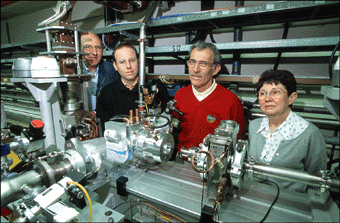
The LEP Pre-Injector's career came to a close with a new success : the PARRNe experiment. From left to right: Michel Decourtieux, Hervé Lefort, Jacques Obert and Geneviève Le Scornet, members of the PARRNe team, from the Institut de Physique Nucléaire at Orsay, France, behind their target installed at the LPI.
After 16 years of service, the LEP Pre-Injector (LPI) was finally closed down at Easter. The LPI was not only one of the essential building blocks of LEP, but it also supplied beams to a whole host of experiments. Here is a look back over some of the highlights of this success story.
On 12 April 2001, the curtain was finally brought down on the brilliant career of the LEP Pre-Injector (LPI), which had been supplying electrons and positrons to LEP for eleven years until last November - with 98% reliability! This little gem of an accelerator comprised two entities, the LEP Injector Linac (LIL), which produced electrons and positrons to be accumulated in the Electron Positron Accumulator (EPA) before subsequent injection into the PS, SPS and LEP.
But the LPI, which produced its first electron and positron beams in 1985, didn't only feed the LEP ring but also supplied beams to numerous experiments.
The first time the LPI was put to use was to calibrate LEP's L3 detector with a 'single electron'. This was an unusual request, to say the least, as the accelerator experts are always being asked to produce beams with ever increasing particle densities. 'We told them we could produce a hundred million particles or more...but less than that, we had just never done it before,' recalls LPI chief Louis Rinolfi. But his team pulled it off nonetheless. In 1988, a feasibility study was done, and a new beamline was specially built to supply electrons to the L3 detector, temporarily installed for testing in a purpose-built building near the LPI. This was the LPI's first great success.
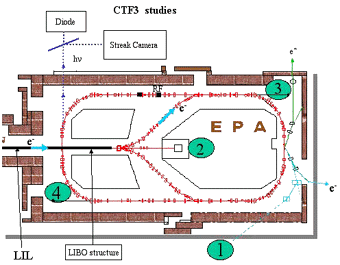
This new installation opened the way for a whole cluster of experimental areas to be built around the LPI (see diagram). Several LEP collaborations came to perform experiments and measurements at the LPI. At the end of 2000, a new type of accelerating cavity (LIBO) was tested for the medical project TERA (see Weekly Bulletin 4/2001). The LPI's beams have also been used for all the LHC detectors. In particular, CMS has been pursuing a study of optical fibres for its forward calorimeter throughout 2001.
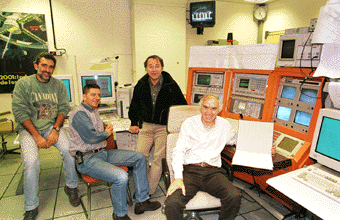
On 7 November, at 7.30 in the morning, the LPI sent its last lepton beam to LEP. In the LPI control room, from left to right: Simon Baird, Operations Group Leader, Bruno Dupuy, LPI supervisor, Romain Pittin, responsible for the LIL source, and Louis Rinolfi, head of the LPI.
The LPI even did overtime - several weeks in fact! Since the closure of LEP was postponed, the LHC-Vacuum team continued to use the LPI until the beginning of 2001 to study synchrotron radiation-related phenomena in the LHC vacuum chambers. This is because the photon spectra emitted by electron beams stored in the LPI, at 308 MeV, are the same as those that the LHC proton beams will emit at 7 TeV.
Other users also took advantage of the postponement, the most recent being the Institut de Physique Nucléaire at Orsay, France, which performed a highly successful experiment called PARRNe, aimed at the production of neutron-rich radioactive atoms using a 50 MeV electron beam. The beam which had initially been requested was supposed to reach an average intensity of 2 microamperes but thanks to the performance levels of the LPI, a current of 50 nanoamperes, forty times less intense, was enough to produce the sought-after krypton and xenon atoms by photo-fission in a Uranium-238 target. This new success was to be the LPI's final 'encore'.
'But in truth it has still not reached the end of the line', underlines Louis Rinolfi. In the coming months it will undergo extensive work to be converted into a test facility for CLIC, one of the possible options for a future accelerator. So in the autumn of 2001, the LPI zone will be re-baptised CTF3 (CLIC Test Facility 3).
Serving many experiments
Right up until its closure, the LPI played host to many experiments and installations. Here are some of the most recent ones:
1. Hippodrome Single Electron (HSE)
Electrons accelerated by LIL (LEP Injector Linac) are circulated in a hippodrome-style circuit. This area was inaugurated by L3 in 1988 to perform calibration measurements using a 'single electron' and its career came to an end with the 'LHC skin effect' experiment, which studied the RF shields in the ceramic vacuum chambers for the LHC.
2. LIL Experimental Area (LEA)
This area is located right at the point where the beam emerges from the LIL. CMS recently tested the optical fibres for one of its calorimeters here, using 500 MeV electrons.
3. et 4. Synchrotron Light Facilities SLF 92 and SLF 42
These facilities use the synchrotron radiation emitted by the electrons circulating inside the EPA. The SLF 92 area housed the COLDEX experiment, which studied the effects of synchrotron radiation in the LHC vacuum chambers. The SLF 42 area was used to perform tests on 'getter' strips, gas-molecule-absorbing material that will be used in the LHC.
This coming autumn, the LPI will be converted into a test facility for CLIC, one of the options for a future accelerator.
Other (French)
Le LPI (Pré-Injecteur du LEP) a clos son existence sur l'expérience PARRNe, une nouvelle réussite.Ci-dessus, de gauche à droite : Michel Decourtieux, Hervé Lefort, Jacques Obert et Geneviève Le Scornet, membres de l'équipe PARRNe, de l'Institut de Physique Nucléaire d'Orsay, derrière leur cible installée sur le LPI.
Après 16 ans de service, le LPI (Pré-Injecteur du LEP) a fermé ses portes à Pâques. Il fut non seulement une brique essentielle du LEP, mais il a également fourni une foule d'autres expériences. Retour sur une histoire jalonnée de réussites.
Le 12 avril 2001, le LPI (LEP Pre-Injector) a mis un terme à sa brillante carrière. Pendant 11 ans et jusqu'en novembre dernier, le LPI a fourni des électrons et positons au LEP, avec une fiabilité de 98% ! Ce petit bijou d'accélérateur était constitué de deux entités : l'accélérateur linéaire LIL (LEP Injector Linac) produisait les électrons et posi-tons qui étaient accumulés dans l'EPA (Electron Positron Accumulator) avant d'être injectés dans le PS, SPS puis le LEP.
Mais le LPI, qui a fourni ses premiers faisceaux d'électrons et de positons en 1985, n'a pas seulement alimenté la grande boucle du LEP. Il a mis ses faisceaux au service de nombreuses expériences.
La première fois que le LPI a été sollicité, ce fut par l'expérience L3 du LEP qui voulait calibrer son détecteur avec un « électron unique ». Une demande pour le moins inhabituelle. Car les spécialistes des accélérateurs sont toujours appelés à produire des densités toujours plus élevées de particules. « Nous leur avons répondu que nous pouvions produire cent millions de particules ou plus. Mais moins que cela, nous ne l'avions jamais fait », se souvient Louis Rinolfi, responsable du LPI. Son équipe a pourtant remporté le pari. En 1988, une étude de faisabilité a été réalisée. Une nouvelle ligne a été spécialement construite pour amener des électrons vers L3, installé le temps des tests dans un bâtiment spécialement construit près du LPI. Ce fut le premier grand succès.
Cette nouvelle installation a ouvert la voie à une série de zones expérimentales autour du LPI (voir schéma). Plusieurs collaborations du LEP sont venus effectuer des expériences et des mesures au LPI. A la fin de l'année 2000, un nouveau type de cavité accélératrice (LIBO) a été testé pour le projet médical TERA (voir bulletin 4/2001). Tous les détecteurs du LHC ont également fait appel à ses faisceaux. En particulier, CMS a continué en 2001 l'étude de fibres optiques pour son calorimètre à petits angles (Forward calorimeter).
Le 2 novembre 2000, à 7h30 du matin, le LPI envoyait son dernier faisceau de leptons vers le LEP. Dans la salle de contrôle du LPI, de gauche à droite : Simon Baird, chef de groupe Opération, Bruno Dupuy, superviseur LPI, Romain Pittin, en charge de la source LIL et Louis Rinolfi, responsable du LPI.
Le petit accélérateur a même fait des heures supplémentaires, ou plutôt des semaines. La fermeture du LEP ayant été reportée, l'équipe LHC-Vacuum a continué à l'utiliser jusqu'au début 2001 pour étudier les phénomènes liés au rayonnement synchrotron dans les chambres à vide du LHC. Un faisceau d'électrons stockés dans le LPI, à 308 MeV, émet en effet le même spectre de photons que ceux qui seront émis par les protons du LHC à 7 TeV.
D'autres utilisateurs ont profité de cette prolongation. Le dernier en date, l'Institut de Physique Nucléaire d'Orsay, y a réalisé une expérience fructueuse. Baptisée PARRNe, pour Production d'Atomes Radioactifs Riches en Neutrons, elle a utilisé un faisceau d'électrons à 50 MeV. Le faisceau demandé initialement devait atteindre une intensité moyenne de2 microampères. Grâce aux performances de l'installation, un courant de 50 nanoampères, soit quarante fois moins intense, a suffi pour produire par photo-fission dans une cible d'Uranium 238 les atomes recherchés de Krypton et de Xénon. Le LPI a écrit son épilogue sur cette nouvelle réussite.
« Pour autant, ce petit complexe d'accélérateurs n'a pas définitivement tourné la page », signale Louis Rinolfi. Dans les mois à venir, il va subir d'importants travaux pour se transformer en installation de test pour CLIC, une des options possibles pour un accélérateur du futur. A l'automne 2001, le LPI va entamer une deuxième vie sous un autre nom, CTF3 (CLIC Test Facility 3).
Au service de nombreuses expériences
Jusqu'à sa fermeture, le LPI a abrité de nombreuses expériences. Petite revue des dernières en date et des différentes installations.
1. HSE, Hippodrome Single Electron
Les électrons accélérés provenant du LIL (LEP Injector Linac) circulent ensuite dans un circuit en forme d'hippodrome. Inaugurée par L3 pour effectuer des calibrations avec un « électron unique » en 1988, cette zone a clos sa carrière avec l'expérience « LHC skin effect », qui étudie les blindages RF dans les chambres à vide céramiques pour le LHC.
2. LEA, LIL Experimental Area
Cette zone se trouve directement en sortie de l'accélérateur linéaire, le LIL. CMS y a récemment testé des fibres optiques, avec des électrons à 500 MeV, pour l'un de ses calorimètres.
3. et 4. SLF 92 et SLF 42, Synchrotron Light Facilities
Ces installations utilisent le rayonnement synchrotron émis par les électrons incurvés dans EPA. La zone SLF 92 a abrité l'expérience COLDEX, étudiant les effets du rayonnement synchrotron dans les chambres à vide du LHC. Et la zone SLF 42 a accueilli des tests sur les bandes de Getter, ce matériau qui absorbe les molécules de gaz et qui sera utilisé dans le LHC.
Le LPI se transformera à l'automne en CTF3, une installation de tests pour CLIC, l'une des options pour un accélérateur du futur.
Files
na-2001-003_1-01.GIF
Additional details
Identifiers
- CDS
- 45002
- CDS Report Number
- BUL-NA-2001-003
- Aleph number
- 000006484MMD
Related works
- Is referenced by
- Other: ADMBUL_0020750 (Other)