Deceleration project bursts out of the starting-blocks
Authors/Creators
Description
The starter's pistol was fired for the ELENA project on 28 September, with the kick-off meeting organised in collaboration with the Antiproton Decelerator Users Committee. With more than 90 scientists in attendance from 20 research centres throughout the world expressing their enthusiasm for the project…and some even more than that... the meeting was a great success.
"Our kick-off meeting was a really great success," says Stéphan Maury of the Beams (BE) Department, who is responsible for the ELENA (Extra Low ENergy Antiproton ring) project. PH Department's Walter Oelert, Chairman of the AD Users Committee and one of the instigators of the project, adds: "More than 90 participants showed up, over twice the number we were expecting! They were all very enthusiastic and eager to get ELENA off the ground." The meeting was attended by representatives of some twenty institutes from across the globe, all of whom had come to blow life into the ELENA project. But not only that – some of them also brought some excellent news.
"We were pleasantly surprised," Stephan Maury explains, "when, on the day of the meeting, three new experiments were proposed in the framework of the ELENA project. One is the fruit of a collaboration between the University of Tokyo and Aarhus University (Denmark), and consists in placing a target inside the ELENA ring; the second, promoted by GSI Darmstadt (Germany), aims to study spin changes of the proton; the third project, dubbed Gbar, was put forward by CEA Saclay (France) and involves measuring the gravitational behaviour of antihydrogen at rest. A formal proposal has already been submitted for the latter project which will be discussed at the SPS Experiments Committee on 25 October. The other two should be presenting technical files to the CERN scientific committees in the near future."
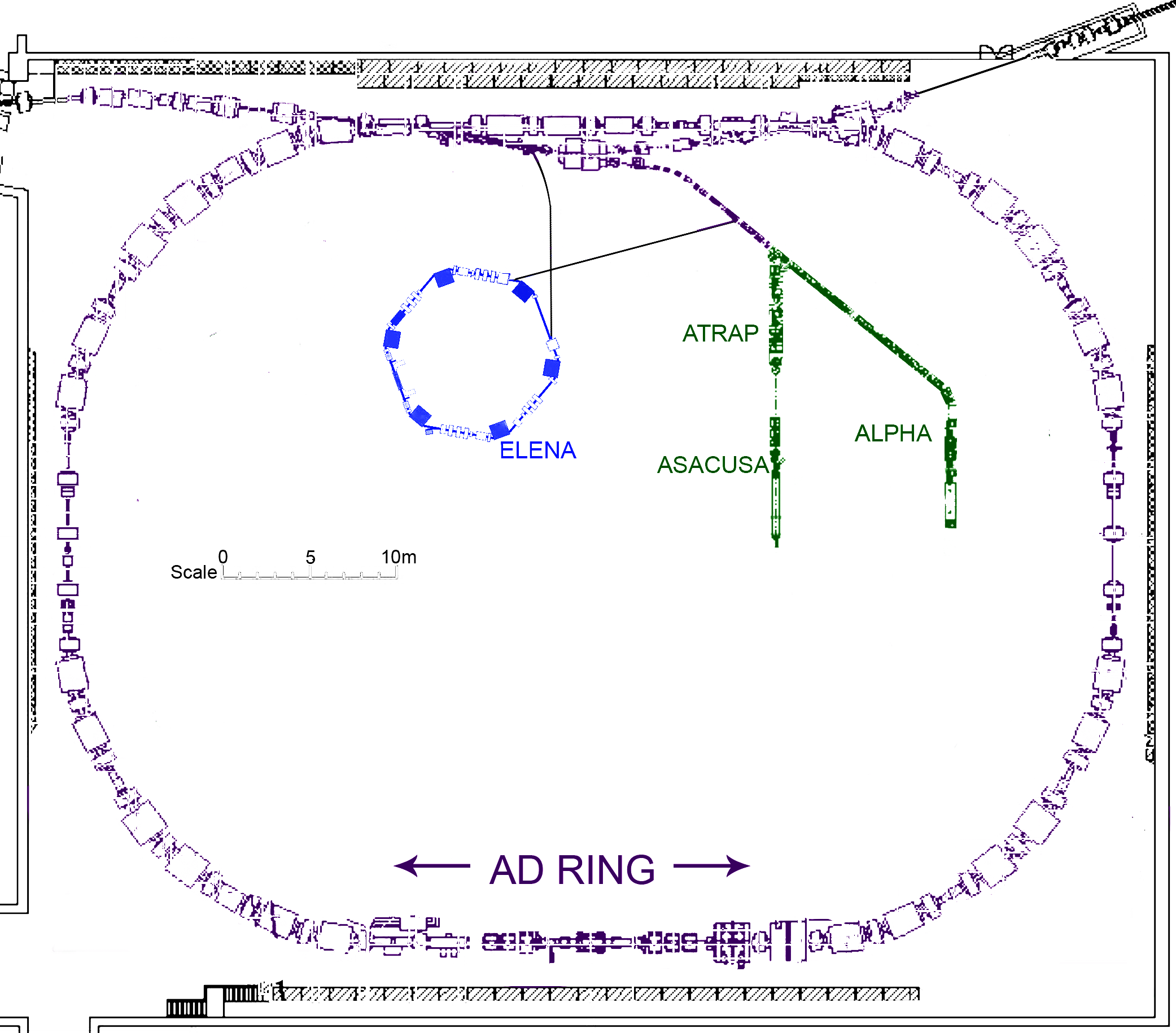
Should these new initiatives emerge as viable projects, the Antiproton Decelerator (AD) Hall where ELENA will be built and which already houses ALPHA, ASACUSA, ATRAP, ACE and soon the AEGIS experiment, will have to be converted to host them. "The future site of the ELENA ring is currently taken up by a platform. Our initial plan was simply to move this platform aside to make way for ELENA. But if we add these proposed new experiments we will need a whole new building, which will obviously need to be built!" Stéphan Maury explains.
Layout of the AD experimental hall: the Antiproton Decelerator ring (purple); the ALPHA, ASACUSA, and ATRAP experiments (green); the ACE experiment (not pictured); and the new ELENA ring (blue).
And this will obviously cost money. But things are moving on the budget front. "We've already collected 2.06 MCHF to date and an additional 2.35 MCHF is under discussion in the laboratories (outside CERN) involved in the ELENA project," Stéphan Maury notes. "With the project now officially launched, all these research centres should be able to clarify their proposals internally and come forward with their contributions in the near future. Take the example of the University of Brescia (Italy) – they made no promises at the outset but have now come forward with 50,000€ for the project.
In addition to cash contributions, certain institutes have pledged contributions in kind, such as equipment manufacture (notably the magnets and the electron cooling system) and the secondment of highly qualified personnel. In this regard, the project coordinators have had the pleasant surprise of seeing the number of outside members of the ELENA team increase from the initially expected 28 to 32. They will join forces with the CERN team and dedicate themselves to making the future decelerator facility a success.
All the ELENA project participants will get together again in six months' time with the aim of moving ahead on many fronts. For the time being, CERN's ELENA team is working on the technical design of the machine and should submit its Technical Design Report by next summer.
More information can be found on the ELENA project in CERN Bulletin n°30-31, or in the press release issued on 28 September for the project's kick-off meeting.
Other (French)
Le 28 septembre dernier a eu lieu la réunion de lancement du projet ELENA (Extra Low ENergy Antiproton ring), organisée en collaboration avec le Comité des utilisateurs du Décélérateur d’antiprotons (ADUC). Un véritable succès, puisque plus de 90 scientifiques issus de 20 centres de recherche à travers le monde ont fait le déplacement jusqu’au CERN, témoignant ainsi un grand intérêt pour le projet. Et certains n’étaient pas venus les mains vides…
« On peut dire que notre réunion de lancement a été une belle réussite », se félicite Stéphan Maury, du département Faisceaux (BE) du CERN et responsable du projet ELENA. « Il y a eu plus de 90 participants, deux fois plus que ce que nous attendions ! Tous étaient très enthousiastes et impatients d’utiliser ELENA », ajoute Walter Oelert, du département PH du CERN et président de l’ADUC, un des instigateurs du projet. Représentant une vingtaine d’institutions des quatre coins du globe, tous étaient venus pour les beaux yeux d’ELENA… mais pas seulement. Certains, en effet, ont ravi l’assistance avec d’excellentes nouvelles.
« Nous avons eu une grosse surprise, raconte Stéphan Maury. Le jour de la réunion, trois nouvelles expériences nous ont été proposées dans le cadre du projet ELENA : l’une est née d’une collaboration entre l'Université de Tokyo et l'Université Aarhus, au Danemark, et consisterait à placer une cible interne dans l’anneau d’ELENA ; la seconde, portée par le GSI de Darmstadt (DE), se propose d’étudier les changements de directions du spin du proton ; pour la troisième, baptisée Gbar et présentée par le CEA de Saclay, il s’agirait de mesurer le comportement gravitationnel de l’antihydrogène au repos. Pour cette dernière, un dossier a même déjà été envoyé, et sera discuté à la réunion du SPSC du 25 octobre prochain. Quant aux deux autres, ils devraient bientôt présenter des dossiers techniques aux comités scientifiques du CERN. »
Si ces trois initiatives prennent corps, le hall du Décélérateur d’antiprotons (AD), dans lequel sera construit ELENA et qui héberge déjà les expériences ALPHA, ASACUSA, ATRAP, ACE, et bientôt AEGIS, devra être réaménagé pour les accueillir. « Actuellement, une plateforme occupe l’emplacement destiné à l’anneau d’ELENA. Nous pensions simplement la décaler pour faire place à celui-ci, mais en tenant compte de ces possibles nouvelles expériences, il nous faudra l’installer dans un autre bâtiment… ce qui implique de construire un autre bâtiment ! », explique Stéphan Maury.
Plan du hall accueillant les expériences liées à l'AD : l'anneau décélérateur d'antiprotons AD (en violet) ; les expériences ALPHA, ASACUSA et ATRAP (en vert) ; et la nouvelle bague d'ELENA (en bleu). L'expérience ACE n'est pas représentée.
Ce qui a aussi un coût. Et justement, question budget, les choses sont en train de bouger. « À ce jour, nous avons pu réunir 2,06 millions de francs suisses, les 2,35 millions de francs suisses complémentaires étant actuellement sujets à discussion dans les divers laboratoires impliqués dans la construction d’ELENA (en dehors du CERN), indique Stéphan Maury. Et maintenant que le projet est officiellement lancé, tous ces centres de recherche devraient clarifier leurs propositions en interne pour rapidement apporter leur contribution. L’Université de Brescia (IT), qui n’avait pourtant fait aucune promesse de subvention, a d’ailleurs déjà débloqué 50 000 € pour le projet. »
Parallèlement au financement, certains instituts se sont engagés sur d’autres types de contributions, tels que la fabrication d’équipements (les aimants et le système de refroidissement par électrons, notamment), et la mise à disposition d’experts hautement qualifiés. Et sur ce dernier point, les coordinateurs du projet ont eu une agréable surprise, puisqu’initialement évalués à 28, les membres externes de l’équipe d’ELENA seront finalement 32 à venir renforcer les troupes cernoises, et à se vouer corps et âme au futur décélérateur.
Prévue dans six mois, la prochaine réunion d’ELENA rassemblera à nouveau toutes les parties prenantes du projet, et permettra d’y voir plus clair sur bon nombre de points. Pour l’heure, l’équipe « ELENA » du CERN planche sur les études techniques de la machine. Elle devrait rendre son rapport technique de conception (TDR) dès l’été prochain.
Plus d’informations sur le projet ELENA dans le Bulletin du CERN n°30-31, ou dans le communiqué de presse paru le 28 septembre à l’occasion de la réunion de lancement du projet.
Files
AD-ELENA-Ring_1_image.png
Additional details
Identifiers
- CDS
- 1391741
- CDS Report Number
- BUL-NA-2011-273
Related works
- Is published in
- Periodical issue: 8p131-2q993 (CDS)
- Periodical issue: zzc3v-hsz04 (CDS)