The ATLAS cavern in the spotlight
Authors/Creators
Description
On Wednesday, 4th June, the President of the Swiss Confederation, Pascal Couchepin, inaugurated the world's largest experimental cavern, which is to house the ATLAS detector in 2007, and announced Switzerland's gift to CERN of the "Palais de l'Equilibre".
The inauguration ceremony was a spectacular affair. The President of the Swiss Confederation, Pascal Couchepin, arrived on the Meyrin site by helicopter and then made a 100-metre descent underground to inaugurate the ATLAS cavern. Before the ceremony, Pascal Couchepin attended a presentation of the various LHC experiments, each given by its respective spokesman. "It is a great pleasure for me to go behind the scenes of such a project and to see so many young people making a contribution to scientific progress" he said. The ceremony, which marked the end of five years of work on the ATLAS experimental area, was attended by many local politicians and Member State ambassadors.
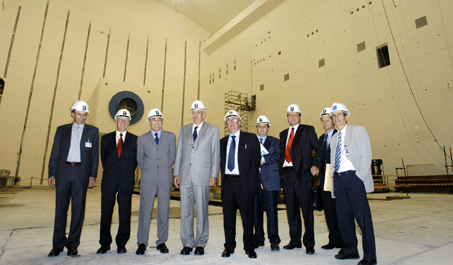
Before the inauguration, Pascal Couchepin visited the ATLAS cavern. From left to right: Peter Jenni, ATLAS spokesman; Maurice Bourquin, President of the CERN Council; Carlo Lamprecht, State councillor, Canton of Geneva; Pascal Couchepin, President of theSwiss Confederation; Luciano Maiani, CERN Director-General; Marzio Nessi, ATLAS technical coordinator; Arturo Henniger, ZSCHOKKE-LOCHER AG Director; Benno Baettig, personal advisor of President Couchepin; Jean-Luc Baldy, head of CERN Civil Engineering Group.
A project of exceptional dimension
140 000 m3 of rock excavated, 53 000 m3 of concrete cast, 6 000 tonnes of reinforcement, 40 000 m2 of shuttering: just a few of the mind-boggling facts and figures that underline the scale of the work done by the CERN Civil Contractors joint venture (comprising Zschokke Locher SA, Baresel AG and PAT). These companies were responsible for the surface buildings, the two shafts, the service hall and, finally, the ATLAS cavern. A. Henninger, a representative of the joint venture, praised the performance of the approximately 100-strong team which worked a total of 400,000 hours, constantly exposed to hazards of various kinds.
The key component of the assembly is the experimental cavern, whose design and dimensions are unique. "Measuring 53 metres in length, 30 metres wide and 35 metres in height (the size of a ten-storey building), the excavation work undoubtedly constitutes a world record for this special type of mixed molasse rock found in the Leman Basin" underlined Luciano Maiani. Two large shafts measuring 18 and 13 metres in diameter, respectively, provide access to the cavern, which willultimately house the ATLAS detector. It is perpendicularly linked to a service hall measuring 65 metres long and 20 metres in diameter.
A civil engineering first
Even if they didn't have to move mountains, the civil engineers were neverthelessrequired to use a lot of ingenuity in order to excavate and concrete the experimental cavern without damaging LEP, which was still in operation and whose path cut right through it. Indeed, it was not possible to dig too deep without raising the height of the tunnel. The project managers were therefore required to be inventive and to depart from a few rules of the trade, including the order in which the work was performed. For example, the surface buildings were built in April 1998, before the two shafts started to be excavated, whereas excavation work is normally done before work on the surface. The advantage of this approach was that the buildings provided cover for the excavation work, thus cutting down on the associated environmental nuisance.
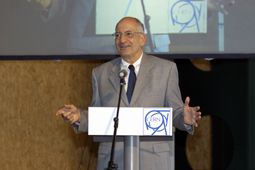
Pascal Couchepin, during his inauguration speech.
However, work on excavating the cavern had to start, irrespective of LEP operation, to avoid causing a delay in the schedule. It was decided to excavatethe top of the cavern to a depth of 12 metres, starting in May 2000, and to concrete the ceiling straight away. At this depth, the LEP beam was virtually unaffected. When the concreting was finished, a way of securing the 10,000 tonne ceiling to the rock had tobe found, a weight equivalent to that of the Eiffel Tower. The solution, adopted in August 2001, was to install thirty-eight steel cables, anchored in four small galleries 20 metres above, to suspend it. Each cable had to bear a weight of 220 tonnes, with the remaining load resting at the bottom of the walls of the shafts. The ceiling has not moved more than a few millimetres in the intervening two and a half years. Once this had been done, the excavation work was able to go ahead in September 2001.
The experimental cavern was completed on 15 April 2003 and handed over to the ATLAS collaboration. The last piece of concrete for the walls had been cast on 12 March. After some finishing work, mainly comprising renovation work on the surface buildings, the ATLAS experimental area will be completed on 20 June. The ATLAS collaboration will then take over for the installation of the detector.
The Palais de l'Equilibre becomes CERN's Globe of Innovation
In 2004, the elegant wooden dome of the Palais de l'Equilibre will dominate the entrance to CERN. During the inauguration of the ATLAS cavern, Pascal Couchepin announced that Switzerland would be giving CERN the famous building fromthe Expo.02 exhibition to mark the Organization's fiftieth anniversary. A gift of 4 million Swiss francs from the Swiss government will allow CERN to carry out the renovation work and begin to fit out the 27-metre-high globe. The gift is a mark of Switzerland'sesteem for the research conducted at CERN, says Pascal Couchepin.
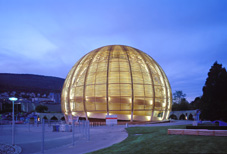
Built for Expo.02 at Neuchâtel, the Palais de l'Equilibre will be rebuilt at CERN and will become the Globe of l'Innovation (Photo © Peter Jantscher Neuchâtel, Expo.2).
The Palais de l'Equilibre is to become the Globe of Innovation, an approximately 1000 m2 exhibition area on two floors. It will promote CERN's research and its spin-offs for society. It will also be incorporated in the visits programme, which has been running for about twenty years and began with the Microcosm, which currently attracts around 30,000 visitors a year. The Globe of Innovation will also be a meeting place for CERN's partner companies, which will be able to take part in debates on the theme of emerging technologies.
Technical info
Cover articleOther (French)
Le Président de la Confédération suisse a inauguré le mercredi 4 juin, la plus grande caverne expérimentale au monde : celle qui abritera en 2007 le détecteur ATLAS. Pascal Couchepin a ensuite annoncé que le Palais de l'Equilibre était offert au CERN.
Other (French)
Le Président de la Confédération suisse a inauguré le mercredi 4 juin, la plus grande caverne expérimentale au monde : celle qui abritera en 2007 le détecteur ATLAS. Pascal Couchepin a ensuite annoncé que le Palais de l'Equilibre était offert au CERN.
Vertigineuse inauguration ! Arrivé en hélicoptère sur le site de Meyrin, Pascal Couchepin, le Président de la Confédération suisse, a plongé à 100 mètres sous terre pour inaugurer la caverne d'ATLAS. Avant la cérémonie, Pascal Couchepin a assisté à une présentation des différentes expériences du projet LHC par leur porte-parole. «C'est un grand plaisir de découvrir les coulisses d'un tel projet et de voir qu'autant de jeunes contribuent au progrès de la science», s'est-il félicité. De nombreuses personnalités politiques locales et les ambassadeurs des Etats membres étaient présents à cette inauguration qui concluait cinq années de travaux sur la zone expérimentale d'ATLAS.
Avant l'inauguration, Pascal Couchepin a visité la caverne d'ATLAS. De gauche à droite : Peter Jenni, porte-parole d'ATLAS ; Maurice Bourquin, Président du Conseil du CERN ; Carlo Lamprecht, Conseiller d'Etat du Canton de Genève ; Pascal Couchepin,Présidentde la Confédération suisse ; Luciano Maiani, Directeur général du CERN ; Marzio Nessi, coordinateur technique d'ATLAS ; Arturo Henniger, directeur de ZSCHOKKE-LOCHER AG ; Benno Baettig, Conseiller personnel du Président Couchepin ; Jean-Luc Baldy, chef du Groupe de Génie Civil du CERN.
Dimensions exceptionnelles
140 000 m3 de roches excavées, 53 000 m3 de béton coulé, 6 000 tonnes d'armature, 40 000 m2 de coffrage : ce sont quelques-uns des chiffres pharaoniques révélant l'ampleur des travaux effectués par le groupement Joint Venture Cern Civil Contractors (Zschokke Locher SA, Baresel AG et PAT). Ces entreprises ont réalisé les bâtiments de surface, les deux puits, la caverne de service, puis la grande la caverne expérimentale. Arturo Henniger, représentant du groupement, a salué la performance de l'équipe d'une centaine de personnes, qui a travaillé au total 400000 heures, constamment exposée à des dangers.
La pièce maîtresse de cet édifice est la caverne expérimentale, unique au monde par sa conception et ses dimensions. «Avec ses 53 mètres de long, 30 mètres de large et 35 mètres de haut (la taille d'un immeuble de 10 étages), elle représente à n'en pas douter un record mondial d'excavation dans ce type de roche particulière et hétérogène que constitue la molasse du bassin lémanique», a souligné le Luciano Maiani. Deux grands puits de 18 et 13 mètres de diamètre donnent accès à cette caverne qui accueillera le détecteur ATLAS. Elle est reliée perpendiculairement à une caverne de service, de 65 mètres de long et 20 mètres de diamètre.
Une première dans l'histoire du génie civil
S'il n'a pas eu à déplacer des montagnes, le génie civil a d déployer des monceaux d'ingéniosité. Car il s'agissait de creuser et bétonner la caverne expérimentale sans endommager le LEP - encore en exploitation - qui la traversait. Il était en effet impossible de creuser trop profond sans faire remonter le tunnel. Les maîtres d' oeuvre ont donc d faire preuve d'originalité et déroger à quelques règles de l'art, comme par exemple l'ordre des travaux. Les bâtiments de surface ont en effet été construits, en avril 1998, avant que les deux puits ne commencent à être creusés. Or généralement, les travaux d'excavation précèdent ceux de surface. La méthode comportait un avantage : creuser tout en étant abrité par les bâtiments et en protégeant l'environnement des nuisances liées aux travaux.
Pascal Couchepin, lors de son discours d'inauguration.
Mais les travaux d'excavation de la caverne devaient néanmoins commencer, en dépit du fonctionnement du LEP, afin de ne pas retarder le planning. Le choix fut alors d'excaver, à partir de mai 2000, la partie supérieure de la caverne sur 12 mètres de profondeur, et bétonner immédiatement la voûte. A cette profondeur, le faisceau du LEP n'a pratiquement pas été dévié. Lorsque le bétonnage fut terminé, il a fallu trouver une astuce pour maintenir contre la roche cette voûte de 10000 tonnes, l'équivalent du poids de la Tour Eiffel. L'idée fut d'installer, en ao t 2001, trente-huit câbles d'acier - ancrés 20 mètres plus haut dans quatre petites galeries - pour la suspendre. Chaque câble supportait 220 tonnes, le reste de la charge étant porté par la base des f ts des puits. En deux ans et demi, la vo te n'a bougé que de quelques millimètres. Les opérations d'excavation ont ainsi pu se poursuivre en toute sécurité, dès septembre 2001.
La caverne expérimentale était fin prête le 15 avril dernier et remise à la collaboration ATLAS. La dernière tranche de béton destinée aux murs avait été coulée le 12 mars. Après quelques finitions, notamment la rénovation des bâtiments de surface, la zone expérimentale d'ATLAS sera entièrement finalisée le 20 juin. C'est désormais au tour de la collaboration ATLAS de prendre le devant de la scène pour l'installation du détecteur.
Le Palais de l'Equilibre devient le Globe de l'Innovation au CERN
En 2004, l'élégante sphère de bois du Palais de l'Equilibre trônera aux portes du CERN. Pascal Couchepin a en effet profité de l'inaugurationde lacaverne d'ATLAS pour annoncer que la Suisse offrait le Palais de l'Equilibre d'Expo.02 au CERN pour son cinquantième anniversaire. Une donation du gouvernement suisse de 4 millions de francs suisses permettra de faire la rénovation et commencer l'aménagement de cette sphère de 27 mètres de haut. La Suisse entend ainsi concrétiser toute l'estime qu'elle porte aux recherches menées au CERN, selon Pascal Couchepin.
Edifié pour l'Expo.02 à Neuchâtel, le Palais de l'Equilibre sera remonté au CERN et deviendra le Globe de l'Innovation (Photo © Peter Jantscher Neuchâtel, Expo.2).
Le Palais de l'Equilibre sera transformé en Globe de l'Innovation, un espace d'exposition d'environ 1000 m2 répartis sur deux niveaux. Ce centre mettra en valeur les recherches du CERN et leurs répercussions dans la société. Il vient compléter le programme des visites déjà commencé il y a une vingtaine d'années avec le Microcosm, qui reçoit chaque année environ 30000 visiteurs. Le Globe de l'Innovation sera également un lieu de rencontres pour les entreprises partenaires du CERN qui pourront participer à des forums sur le thème des technologies émergentes.
Files
na-2003-066_0306001_02.JPG
Additional details
Identifiers
- CDS
- 621060
- CDS Report Number
- BUL-NA-2003-066
- Aleph number
- 000013095MMD
Related works
- Is referenced by
- Other: ADMBUL_0013095 (Other)