Round Two for Three ALICE Industrial Awards
Authors/Creators
Description
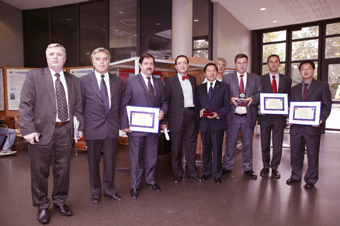
After the ALICE award ceremony (from left to right): Yuri Saveliev, Stanislav Burachas and Sergei Beloglovsky, of North Crystals; Maximilian Metzger, CERN's Secretary-General; Rang Cai of ATM; Jürgen Schukraft, ALICE spokesperson; Erich Pamminger and Daniel Gattinger of FACC; and Tiejun Wang of ATM.
One award winner is Advanced Technology and Materials (ATM), a young, privately-held Chinese company headquartered in Beijing, an offspring of a previously state-supported network of research institutes specializing in materials science. ATM has emerged as a leader in advanced materials such as tungsten alloys and refractive metals. They won a contract with ALICE to produce a variety of complex absorber parts fabricated from a high-density tungsten alloy. These parts, totalling more than seven tonnes, are the heart of a finely-tuned muon filter which has the task of absorbing thousands of hadrons produced in each LHC lead-lead collision, while only minimally disturbing the tell-tale muons emitted from quark-gluon matter. These pieces, located in the centre of the 15-metre-long muon spectrometer, had to be built with sub-millimetre precision in complex, interlocking shapes surrounding the delicate beam pipe of the collider: a true example of a "Chinese puzzle". The company was honoured for their outstanding collaboration, innovative technology, and on-time and to-specification delivery.
Fischer Advanced Composite Components (FACC) is also a young company, located in Upper Austria. For several years they have been a major manufacturer of composite parts for some of the biggest airplane builders. Recognizing the need for constant R&D, FACC has a unit dedicated to custom work. They won the partnership with ALICE to develop and manufacture the parts forming the cylindrical hull ("Field Cage") of the ALICE Time Projection Chamber, the world's largest, with a volume of nearly 100 cubic metres. The physics program requires that these detector enclosures represent "no" material that would disturb the "delicate" particles to be detected in the TPC. FACC developed and constructed these panels, which were made into 5-metre-long, 5-metre-diameter cylinders with sub-millimetre precision, to support tonnes of forces with essentially no deformation. Again, recognition was given for a successful completion of this unique project; it required a perfect match between CERN engineering competence and an enterprising, creative, high-tech company, willing to take risks and to explore novel avenues.
North Crystals, located in Apatity near Murmansk, Russia, was the third company selected for an ALICE Industry Award. It is also a young company, which successfully made the transition from a state-owned institute of the former Soviet Union to a world leader in advanced crystal technology. In a very short time this company has evolved into an ultra-modern establishment. The large halls are now filled with hundreds of gleaming, computer-controlled crystal-growing facilities. Among the spectrum of crystals developed and produced for telecommunication, medical imagery, and consumer electronics, North Crystals has also developed—in close collaboration with the Kurtchatov Institute, Moscow—crystals for state-of-the-art electromagnetic calorimeters. Already a key technology in LEP experiments, the more demanding applications at LHC required novel crystal technology, "crystallized" in the form of a lead-tungsten compound, PbWO4. The visual beauty of these crystals is only surpassed by the spectacular quality of their measurement properties. The same technology is also used on a considerably larger scale by CMS. North Crystals was honoured for their remarkably successful collaboration and development of these crystals, presently being assembled into the ALICE "PHOS" calorimeter.
CERN's Secretary General, Maximilian Metzger, in his remarks to conclude the award ceremony, pointed to the common denominator of these three companies: young, dynamic, high-tech, recognizing the importance of R&D and the potential leverage resulting from collaborating with leading research organizations. These three leaders in advanced, modern materials were honoured with the ALICE awards, beautifully sculptured from one of the oldest materials used by mankind to manufacture tools: Mexican obsidian. The awards were a token of recognition of the considerable efforts expended by these companies to contribute to ALICE's arsenal of instrumentation and to speed ALICE along on their LHC expedition to the origins of our Universe.
Technical info
Cover articleOther (French)
L'excellence de la collaboration entre l'industrie et les équipes des expériences du LHC est l'une des clés du succès de la préparation et de la réalisation des expériences. Il y a quelques semaines, la collaboration ALICE a remis sa deuxième série de prix à certains de ses partenaires industriels pour leurs contributions novatrices et remarquables aux importants systèmes de détection.
Other (French)
Après la cérémonie des trophées d'ALICE, de gauche à droite : Yuri Saveliev, Stanislav Burachas et Sergei Beloglovsky, de North Crystals ; Maximilian Metzger, Secrétaire général du CERN ; Rang Cai d'ATM ; Jürgen Schukraft, porte-parole d'ALICE ; Erich Pamminger et Daniel Gattinger de FACC ; Tiejun Wang d'ATM.
Advanced Technology and Materials (ATM), l'un des lauréats, est une jeune entreprise privée chinoise dont le siè ge est à Pékin et qui est née d'un ancien réseau public d'instituts de recherche spécialisés dans la science des matériaux. ATM s'est imposée comme l'un des leaders dans le domaine des matériaux de pointe tels que les alliages de tungstène et les métaux réfractaires. ATM a obtenu un contrat avec ALICE pour produire divers éléments d'ab-sorbeurs complexes en un alliage de tungstène haute densité. Ces éléments, pesant au total plus de sept tonnes, constitueront le coeur d'un filtre à muons de précision, qui aura pour fonction d'absorber les milliers de hadrons produits lors de chaque collision plomb-plomb du LHC en perturbant le moins possible les muons révélateurs émis par la matière quark-gluon. Situés au centre du spectromètre à muons de 15 m de longueur, ils devaient être construits avec une précision submillimétrique et leurs formes complexes devaient leur permettre de s'emboîter pour entourer le délicat tube de faisceau du collisionneur : un vrai casse-tête chinois ! L'entreprise a été récompensée pour sa remarquable collaboration, sa technologie novatrice et son respect tant du calendrier de livraison que des spécifications.
Fischer Advanced Composite Components (FACC), également une jeune entreprise, a son siège en Haute Autriche. Depuis plusieurs années, elle fabrique des pièces en matériaux composites pour les plus grands constructeurs aéronautiques. Ayant opté pour des activités soutenues en R&D, FACC dispose d'une unité spéciale pour le travail sur commande. La collaboration ALICE l'a sélectionnée comme partenaire pour développer et fabriquer les éléments formant l'armature cylindrique (« cage de champ ») de la chambre à projection tridimensionnelle (TPC) d'ALICE qui, avec son volume de près de 100 m3, est la plus grande du monde. Les objectifs de physique exigent que cette armature ne contienne pratiquement pas de matière, car celle-ci perturbe les précieuses particules que doit détecter la TPC. La FACC a mis au point et construit des panneaux - qui ont été assemblés pour former des cylindres de 5 m de longueur et 5 m de diamètre, avec une précision submillimétrique - capables de résister à des forces de plusieurs tonnes, pour ainsi dire sans d mesure de l'énergie. La même technologie est utilisée à beaucoup plus grande échelle par CMS. North Crystals a été mise à l'honneur pour la remarquable efficacité de sa collaboration avec le CERN, ainsi que pour le développement de ces cristaux, actuellement en cours d'assemblage dans le calorimètre « PHOS » d'ALICE.
Pour conclure la cérémonie de remise des prix, le Secrétaire général du CERN, Maximilian Metzger, a fait ressortir les dénominateurs communs entre ces trois entreprises : jeunesse, dynamisme, haute technologie et conscience de l'importance de la R&D et de l'effet de levier que peut avoir la collaboration avec des organisations de recherche de pointe. Les prix ALICE, magnifiquement ciselés dans l'un des plus anciens matériaux utilisés par l'espèce humaine pour fabriquer des outils, l'obsidienne mexicaine, ont été remis à ces trois chefs de file du domaine des matériaux de pointe. Les trois entreprises ont reçu ces prix en reconnaissance des efforts considérables qu'elles ont déployés pour contribuer à la panoplie des instruments d'ALICE et pour lancer la collaboration dans son expédition vers les origines de notre Univers à l'aide du LHC.
Files
na-2004-207_0409024_01.jpg
Files
(98.4 kB)
| Name | Size | Download all |
|---|---|---|
|
md5:6b701d723493ffa8e96069ecc9a05c3b
|
98.4 kB | Preview Download |
Additional details
Identifiers
- CDS
- 798284
- CDS Report Number
- BUL-NA-2004-207
- Aleph number
- 000034319MMD
Related works
- References
- Other: 000034283 (Other)