CERN School of Computing: reversing the roles
Authors/Creators
Description
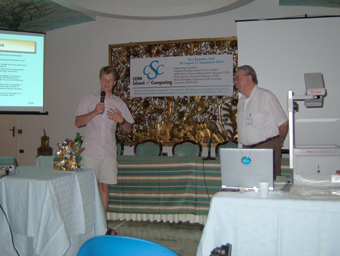
Robert Aymar, CERN's Director-General, gives the floor to Sebastian Lopienski, one of the 77 students at CSC2004.
The CERN Schools of Computing (CSC), which have been running since 1970, are two-week events organized once a year in one of the Member States, in collaboration with a national institute, to deliver theoretical and hands-on training to up to 80 students coming from all over the world. The objectives are to create a common knowledge background on key information technologies for young engineers/scientists collaborating in the CERN programme, as well as to transfer skills in computing techniques beyond particle physics.
An intriguing event called the "inverted CSC" will take place at CERN from the 23rd to the 25th of February. The Weekly Bulletin has interviewed François Fluckiger, the CSC Director.
Why this title, what is inverted?
Well, the answer is in the subtitle: "Where students turn into teachers". This is a three-day series of lectures, organized and delivered by selected students of the previous CSC, where the students go one step further, combining their skills and elaborating on CSC related subjects. This is a novel idea that we are experimenting with this year.
Where does this idea come from?
It comes from the observation that at regular CSCs the sum of the students' knowledge often exceeds that of the lecturer, and that it is common to find someone in the room who knows more on a particular topic than the lecturer. So why not to try and exploit this?
Who created the programme?
CSC2004 students made proposals via an electronic discussion forum. CSC organizers selected the best proposals and appointed their authors as theme coordinators. From this point on, they were on their own to design the content and invite other lecturers, all former CSC students.
Are you pleased with the result so far?
Extremely. We are impressed with the enthusiasm and level of innovation the young lecturers are showing. One of the ideas was to address novel concepts, rarely taught at CERN before, and this is well reflected in the programme. The response has been impressive: attendance is free but we recommend prior registration. The registration level exceeds all our predictions, and we are even starting to worry about the size of the room.
How does this event fit into the main school?
This is part of a programme to increase progressively the active involvement of CSC participants. At the main school, this includes interactive sessions, contests for students to present personal topics, as well as opportunities for interacting with special visitors. In 2004, the school was visited by the CERN's Director-General and other distinguished visitors. Students, whose names were drawn from a hat, could even have a separate lunch with them.
How do you see the CSC evolving?
In two directions. One is the programme for active involvement mentioned above. In this context, two years ago we created an optional examination at the end of the school. This is a difficult examination, giving a formal certificate of credits recognized by an increasing number of universities. The second is the universality of the school. From 2004, the school is being supported by the EU Marie Curie programme. This allows CERN, for a period of four years, to propose grants for students. In 2004, all participants received grants, including 15 students from less-developed countries who were fully supported.
For more:
Other (French)
Le Directeur général du CERN, Robert Aymar, passe la parole à Sebastian Lopienski, l'un des 77 étudiants de l'Ecole d'informatique du CERN en 2004.
Les Ecoles d'informatique du CERN (CSC), qui existent depuis 1970, sont des formations de deux semaines organisées chaque année dans l'un des Etats membres en collaboration avec un institut national. Elles dispensent une formation théorique et pratique à un maximum de 80 étudiants venus du monde entier. Elles visent à créer pour les jeunes ingénieurs et scientifiques qui collaborent au programme du CERN une base de connaissances communes dans le secteur clé des technologies de l'information et à transférer des compétences en techniques informatiques dans d'autres domaines que la physique des particules.
Une formation mystérieusement baptisée « CSC inversée » aura lieu au CERN du 23 au 25 février. Le Bulletin hebdomadaire a interviewé le Directeur de la CSC, François Fluckiger.
Pourquoi ce titre, qu'est-ce qui est inversé ?
La réponse est dans le sous-titre : « Les étudiants deviennent professeurs ». C'est une série de trois jours de conférences organisées et données par des étudiants sélectionnés de la précédente Ecole : il s'agit pour eux d'aller plus loin, d'associer leurs compétences et de développer des thèmes en rapport avec l'Ecole. C'est une idée neuve que nous expérimentons cette année.
D'où vient cette idée ?
Nous avons observé que dans les CSC périodiques, la somme des connaissances de étudiants dépasse souvent celle du conférencier et que fréquemment une personne de l'assistance en sait davantage que celui-ci sur un sujet particulier. Pourquoi ne pas essayer d'en tirer parti ?
Qui a créé le programme ?
Les étudiants de la CSC 2004 ont fait des propositions sur un forum de discussion électronique. Les organisateurs de la CSC ont sélectionné les meilleures propositions et désigné leurs auteurs comme coordinateurs thématiques. Ils étaient alors libres de définir le contenu et d'inviter d'autres conférenciers, tous anciens étudiants de l'Ecole.
Etes-vous satisfaits du résultat au stade actuel ?
Extrêmement. Nous sommes impressionnés par l'enthousiasme et le grand esprit d'innovation des jeunes conférenciers. L'une des idées était d'aborder des concepts novateurs, rarement enseignés au CERN auparavant, et c'est bien ce que reflète le programme. Les participants potentiels ont réagi massivement : en effet, la participation était libre, mais nous recommandions qu'on s'inscrive au préalable. Or le nombre d'inscriptions a dépassé toutes nos prédictions et nous commençons même à avoir des inquiétudes en ce qui concerne la capacité de la salle.
Quelle est la place de cette manifestation dans l'Ecole proprement dite ?
Elle fait partie d'un programme visant à accroître progressivement la participation active des étudiants de la CSC. Dans l'Ecole principale, il y a des sessions interactives, les étudiants sont mis en concurrence pour présenter des sujets qui leur sont propres et il existe des occasions de dialoguer avec des visiteurs particuliers. En 2004, le Directeur général du CERN et d'autres personnes de haut niveau avaient rendu visite à l'Ecole. Des étudiants tirés au sort ont même eu le privilège de déjeuner avec eux.
Comment voyez-vous l'évolution de la CSC ?
Dans deux directions. L'une est le programme de participation active déjà mentionné. Dans ce contexte, nous avions institué il y a deux ans un examen facultatif à la fin de l'Ecole. C'est un examen difficile, donnant lieu à un certificat officiel reconnu par un nombre croissant d'universités. La seconde est l'universalité de l'Ecole. Depuis 2004, l'Ecole est soutenue par le programme Marie Curie de l'UE. Cela permet au CERN de proposer, pour une période de quatre ans, des bourses aux étudiants. En 2004, tous les participants ont reçu une bourse, y compris quinze étudiants de pays en développement, qui ont été entièrement pris en charge.
Pour plus d'informations :
Files
na-2005-021_CSC.jpg
Files
(94.9 kB)
| Name | Size | Download all |
|---|---|---|
|
md5:c4dde335e5f8b3672f10c493c8a014e8
|
94.9 kB | Preview Download |
Additional details
Identifiers
- CDS
- 823381
- CDS Report Number
- BUL-NA-2005-021
- Aleph number
- 000034808MMD