A spin-off company helps to unlock the full potential of Invenio software
Authors/Creators
Description
In recent years, the success of Invenio meant that the team of software developers based in the CERN IT Department were receiving more and more requests to assist organisations in creating new Invenio installations, as well as providing support for them. The large number of support requests required a new solution. CERN therefore decided to help a team of budding young entrepreneurs to set up a company to provide specialist Invenio support.
What do the CERN Document Server, the CERN Open Data Portal, EUDAT’s B2SHARE, INSPIRE and Zenodo all have in common? Easy, they all run using the open-source software Invenio. The Invenio software suite is designed to support online digital libraries and document repositories. On the CERN Document Server, for instance, it manages around 1.5 million bibliographic records.
Since its launch in 2002, a highly active open-source community has grown around Invenio, with more than 50 developers contributing new code each year. Today, besides CERN, Invenio is being co-developed by an international collaboration comprising institutes such as DESY, EPFL, Fermilab and SLAC. It is being used by these organisations — as well as many others — to underpin a wide range of tools. “The large demand for the Invenio technology comes from both research organisations and private companies,” says Jean-Yves Le Meur, head of digital library services in the CERN IT Department, who also had the initial idea of outsourcing Invenio support. “After a short while, we realised that we could no longer keep up in terms of providing support ourselves on a best-effort basis.”
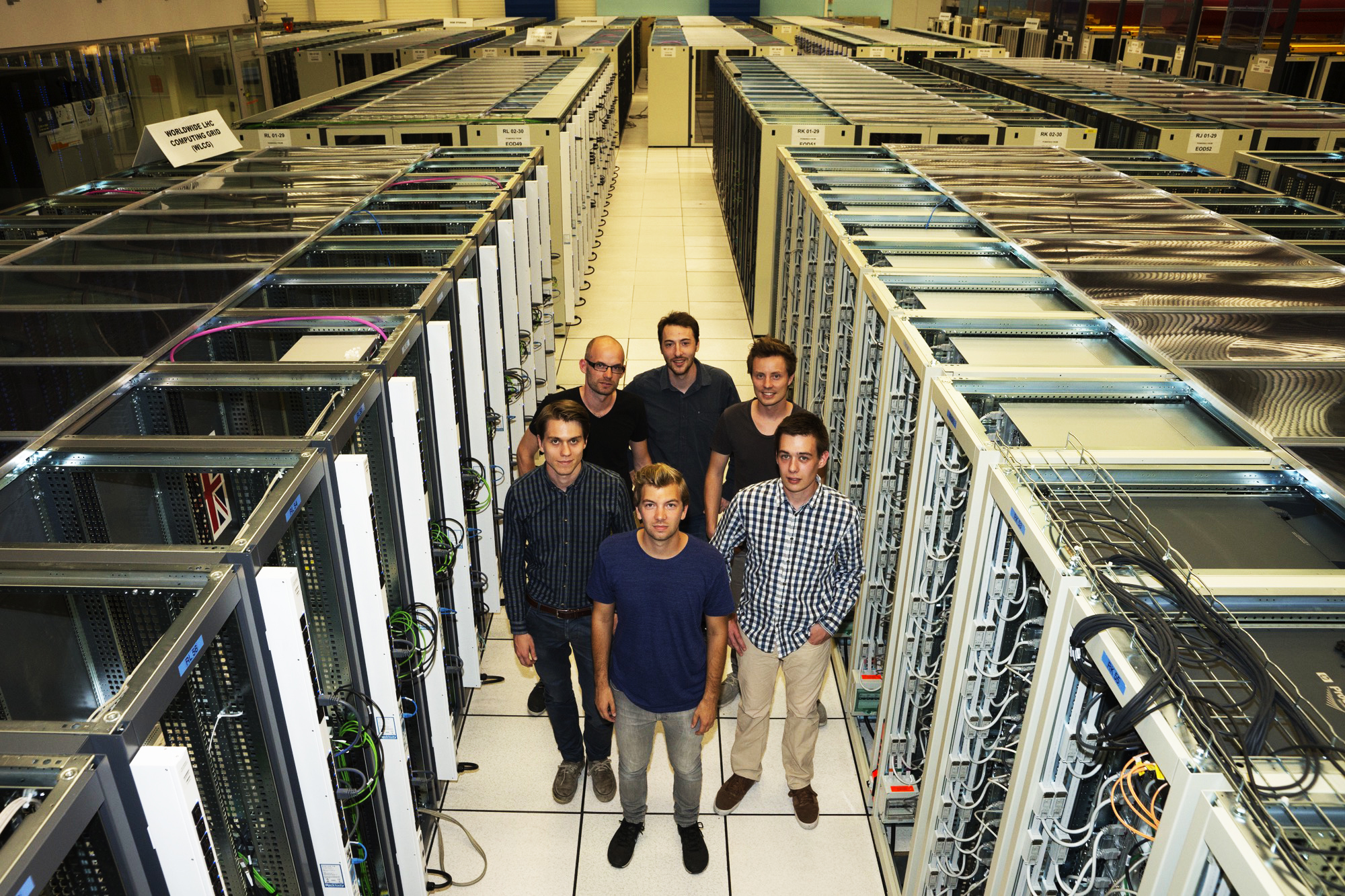
The solution came in 2012 from master's students at the School of Entrepreneurship (NSE) at the Norwegian University of Science and Technology (NTNU), who came to CERN for their annual ‘technology screening’ event, organised by the Knowledge Transfer Group. Throughout this week-long educational visit, the students assess the market potential of a range of selected CERN technologies. Alexander Nietzold and Kenneth Hole were among the NTNU students who came to CERN as part of this programme. Invenio was one of the technologies they learnt about and they decided to explore the possibility of setting up a company to provide support services for this software.
By May 2013, they had formally registered TIND Technologies as a company in Norway; by the end of the year, they already had their first customers. In February 2014, TIND signed an agreement with CERN for the provision of technical support by the Organization’s Invenio development team and the Knowledge Transfer Group.
Nietzold, Hole and two other NTNU colleagues were associated with CERN for one year, during which they developed and launched a cloud-based hosting service for Invenio. Today, they have contracts to host Invenio for the UNESCO International Bureau of Education, the California Institute of Technology and the Max Planck institute for Extraterrestrial Physics, as well as for a range of companies and other high-profile organisations. They also soon intend to launch a new Invenio application for managing and hosting research data.
Nietzold is the CEO of the company, which today is based in Trondheim, Norway. “Invenio is really flexible,” he explains. “It has a lot of application areas, so there’s a lot of potential for growth.”
“We’re pleased that the company has already grown to include eight members of staff,” says Hole. “We simply wouldn’t be where we are today without the fantastic support we’ve received from CERN, as well as from NTNU Discovery and Innovation Norway.”
Other (French)
Ces dernières années, le succès d'Invenio a conduit un nombre croissant d'organisations à solliciter l’aide de l'équipe de développeurs du département informatique du CERN pour réaliser des installations Invenio et fournir un appui pour celles-ci. Il devenait nécessaire de trouver une nouvelle solution pour répondre à toutes ces demandes. Le CERN a donc décidé d'aider une équipe de jeunes entrepreneurs à créer une entreprise offrant un appui spécifique aux utilisateurs du logiciel.
Quel est le point commun entre le serveur de documents du CERN, le Portail des données ouvertes du CERN, B2SHARE d’EUDAT, INSPIRE et Zenodo ? La réponse est simple : ils sont tous exploités avec le logiciel libre Invenio. Cette suite logicielle est utilisée pour la gestion de bibliothèques numériques et de répertoires de documents en ligne, par exemple les quelque 1,5 million de notices bibliographiques disponibles sur le serveur de documents du CERN.
Une communauté open source très active s'est organisée autour d'Invenio depuis son lancement en 2002, avec plus de 50 développeurs rédigeant de nouveaux codes chaque année. Aujourd’hui, le logiciel est co-développé grâce à une collaboration internationale qui comprend, outre le CERN, des instituts tels que le DESY, l'EPFL, Fermilab et le SLAC. Ces organisations, tout comme nombre d'autres, utilisent Invenio pour soutenir une vaste gamme d'outils. « La forte demande pour la technologie Invenio provient d'instituts de recherche, mais également de sociétés privées », précise Jean-Yves Le Meur, chef des services de bibliothèque numérique du département informatique du CERN, qui a été le premier à lancer l'idée de sous-traiter le service d’appui au logiciel Invenio. « Nous avons rapidement réalisé que malgré tous nos efforts nous ne pouvions plus suivre la demande d'assistance. »
Ce sont des étudiants en master à l’École d’entreprenariat (NSE) de l'Université norvégienne des sciences et technologies (NTNU) qui ont proposé une solution en 2012, dans le cadre d'un programme de veille technologique organisé chaque année par le groupe Transfert de connaissances du CERN. Au cours de ce programme éducatif, qui dure une semaine, les étudiants évaluent le potentiel commercial de diverses technologies développées au CERN. Alexander Nietzold et Kenneth Hole faisaient partie des étudiants de la NTNU qui y ont participé. Connaissant bien la technologie Invenio, ils ont étudié la possibilité de créer une entreprise offrant un service d'assistance pour ce logiciel.
En mai 2013, leur entreprise, TIND Technologies, voit officiellement le jour en Norvège et, à la fin de cette même année, elle conseille ses premiers clients. En février 2014, TIND signe un accord avec le CERN qui lui assure le soutien technique de l'équipe de développeurs d'Invenio du Laboratoire et du groupe Transfert de connaissances.
Pendant une année, Alexander Nietzold, Kenneth Hole et deux autres collègues de la NTNU ont collaboré avec le CERN afin de développer et lancer un service d'hébergement en nuage pour Invenio. Ils ont à présent des contrats d'hébergement avec le Bureau international d'Éducation de l'UNESCO, l'Institut de technologie de Californie et l'Institut Max Planck de physique extraterrestre, ainsi qu’avec diverses entreprises et d’autres grandes organisations prestigieuses. Ils prévoient en outre prochainement de lancer une nouvelle application Invenio, destinée à gérer et à héberger des données de recherche.
Alexander Nietzold est le directeur général de l’entreprise établie aujourd'hui à Trondheim, en Norvège. « Invenio est vraiment flexible, explique-t-il. Et comme il a de nombreux domaines d'application, il présente un fort potentiel de croissance. » « D'ailleurs notre entreprise compte déjà huit employés, souligne Kenneth Hole. Nous n’en serions tout simplement pas là aujourd’hui sans l'incroyable soutien du CERN, de NTNU Discovery et d’Innovation Norway. »
Files
TIND team photograph_image.jpg
Files
(2.2 MB)
| Name | Size | Download all |
|---|---|---|
|
md5:d1886afcce81a748986a5dc5b131fa29
|
2.2 MB | Preview Download |
Additional details
Identifiers
- CDS
- 2062869
- CDS Report Number
- BUL-NA-2015-238
Related works
- Is published in
- Periodical issue: yyy68-jw778 (CDS)
- Periodical issue: 52k5s-k7b81 (CDS)