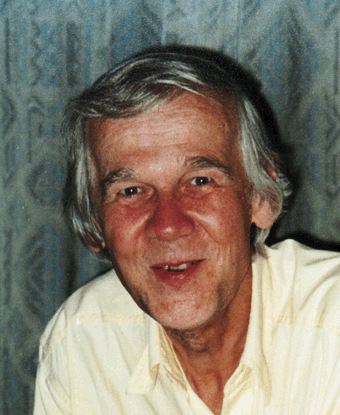
Frans HEYN 1944-2001
Authors/Creators
Description
It was with great sadness that we learned of the death of our friend and colleague Frans Heyn.
Frans passed away on 29 December, surrounded by his loved ones, after a battle against cancer lasting almost seven years. In early 1995 he had been told that he was in the advanced stages of the illness and that he had only a few weeks left to live.
We will all remember the fierce determination and remarkable courage with which Frans faced the situation. Drawing on his exceptional intellect and his early training as a biologist, he became an expert on his illness, capable of monitoring its clinical evolution, discussing it with the specialists on an equal footing and even influencing their decisions on treatment. Throughout these years, during which he defied the most pessimistic prognoses, Frans unfailingly continued to carry out his professional duties and responsibilities, right up to the last moment.
During this very long period, when he was rarely without physical pain, Frans, who was always attentive to the problems of his colleagues, set us a shining example of courage and dignity and taught us a lesson in life.
Frans Heyn, a Dutchman, was born in 1944 and completed his secondary education in Delft. He then spent a year on a student exchange programme at Dartmouth College, USA, where he studied philosophy, political science and French literature. He also improved his piano skills during this time. This was a crucial year of immersion in a totally different culture which, according to those who knew him best, made a major contribution to the exceptional ease with which he was able to communicate in the international sphere. Back home again, he enrolled at the University of Leiden, from which he graduated with a degree in biochemistry and plant physiology in 1970 and where he obtained his PhD in biochemistry in 1975 with a thesis on 'Protoplasts and DNA; Studies towards the genetic modification of plant cells'. From 1970 to 1976, he was a research associate in biochemistry at Leiden University and, from 1970 to 1974, a part-time lecturer in the biochemistry department. In 1976, he was appointed head of the Department of Physical and Biological Sciences at the Ministry of Education and Science in the Hague, with responsibility at the national ministerial level for (para-)university research in the fields of physics, mathematics, astronomy, chemistry, biology, earth sciences and medical sciences. Netherlands delegate to the CERN Finance Committee in 1976, he then became delegate to the Council and Committee of Council in 1980.
In January 1981, he joined the Organization as Director of Administration, a post he occupied throughout Professor Herwig Schopper's eight-year term of office as Director-General. With his usual meticulousness and conviction, Frans quickly set about reforming CERN's administrative functions, optimising procedures and equipping the Organization with powerful computerised management tools. In the safety field, he very quickly assessed the scale of the problems posed by the construction and subsequent operation of LEP and mapped out an efficient policy. From 1981 to the end of 1986, he chaired the Standing Concertation Committee with great panache.
In 1990, he became the first leader of the new AS Division, a post he held until his appointment to the role of adviser in the office of the Director-General, Professor Carlo Rubbia, where he remained in the same capacity under the next two Directors-General, Professors Chris Llewellyn-Smith and Luciano Maiani. Here, together with the Research Directors, in particular P. Darriulat, W. Hoogland, L. Foà, H. Hoffmann and R. Cashmore, Frans Heyn devoted a great deal of time and energy to relations with the European Union and the countries of the former Soviet Union. His personality, his ability to take a broader view and his exceptional network of diplomatic and scientific contacts enabled him to establish successful partnerships with Brussels. Frans was greatly involved in the ISTC and INTAS before they even officially came into being. Thanks to the ISTC, several CERN experiments, those at the LHC in particular, have benefited from advanced technologies and new sources of finance for equipment manufactured in Russia. Frans Heyn played a vital role within INTAS and, in particular, helped research teams to keep going at a time when the countries of the former Soviet Union were experiencing critical financial problems. Shortly before he died, he agreed to take part in a UNESCO task force responsible for defining a strategy for the revival of scientific cooperation in the Balkans. He was actively involved in this area, literally right up to the last moment.
We will remember Frans Heyn as a brilliant, enthusiastic, energetic and remarkable intellectual, a man of integrity with the capacity to understand and motivate those around him. One of his most remarkable gifts was undoubtedly his exceptional ability to apply, again and again and in the widest range of fields, the vast knowledge he had acquired and on which he never ceased to expand.
With his strong personality and unfailing commitment to the Organization's interests, which always dominated his thoughts and actions, Frans Heyn, a humanist, ardent European and polyglot, was a great supporter of CERN and an eminent proponent of European science.
We should like to express our heartfelt compassion to his wife Lucie, his children Sandra and Rémi, and all the other members of his family, and to offer them our deepest sympathy.
The notice of Frans Heyn's death which appeared in the 'General Information' section of Weekly Bulletin No. 3/2002 mistakenly referred to Franz Heyn. We should like to extend our apologies to his family.
Technical info
Cover articleOther (French)
C'est avec une immense tristesse que nous avons appris le décès de notre collègue et ami Frans Heyn.
Frans s'est éteint, entouré des siens le 29 décembre, au terme d'un combat de près de sept années. En effet, c'est au début de 1995 que Frans était informé qu'il était atteint d'un cancer à un stade avancé et que son espérance de vie n'excèderait pas quelques semaines.
Nous garderons tous en mémoire la volonté farouche et le courage exemplaire avec lequel Frans fit face à la situation. Mobilisant ses exceptionnelles qualités intellectuelles et sa formation initiale de biologiste, il devint un expert de sa maladie, à même d'en suivre cliniquement l'évolution, d'en discuter d'égal à égal avec les spécialistes, voire même d'influer sur leurs décisions thérapeutiques. Durant toutes ces années, où il déjoua les plus sinistres augures, Frans assuma sans faiblir ses tâches professionnelles et ses responsabilités, pratiquement jusqu'à son dernier souffle.
Pendant cette très longue période, où la douleur physique ne le quittait que rarement, Frans, qui resta toujours attentif aux problèmes de ses collègues, nous donna l'exemple du courage et de la dignité, en un mot, une leçon de vie.
Frans Heyn, de nationalité néerlandaise, est né en 1944 et a fait ses études secondaires à Delft. Au terme de celles-ci, dans le cadre d'un échange d'étudiant, il part un an aux Etats-Unis à Dartmouth College où il suit des cours de philosophie, de sciences politiques et de littérature française. Il profite également de ce séjour pour améliorer sa maîtrise du piano. Année cruciale d'immersion dans une culture totalement différente qui, selon ses proches, explique pour une large part son exceptionnelle aisance à communiquer dans la sphère internationale. De retour au pays, il s'inscrit à l'Université de Leyde : il en est diplômé en biochimie et en physiologie végétale en 1970 et obtient en 1975 son doctorat en biochimie « Protoplasts and DNA ; Studies towards the genetic modification of plant cells ». De 1970 à 1976, il est attaché de recherche en biochimie à l'Université de Leyde et de 1970 à 1974 chargé de conférences au Département de biochimie. En 1976, il est nommé directeur du Département des sciences physiques et biologiques au ministère de l'Education et de la Science de La Haye, responsable au niveau ministériel national de la recherche (para-) universitaire dans les domaines de la physique, des mathématiques, de l'astronomie, de la chimie, de la biologie, des sciences de la terre et des sciences médicales. Délégué des Pays Bas au Comité des Finances du CERN en 1976, il en est également le délégué au Conseil et au Comité du Conseil en 1980.
En janvier 1981 il rejoint l'Organisation en qualité de Directeur de l'Administration. Il occupera ce poste sans interruption pendant les huit années durant lesquelles le Professeur Herwig Schopper sera Directeur général du CERN. Homme de rigueur et de conviction, Frans s'attacha très vite à rénover les fonctions administratives, à optimiser les procédures et à doter l'Organisation d'une informatique de gestion performante. Dans le domaine de la sécurité, il prit très vite la mesure des problèmes que posait la construction puis l'exploitation du LEP et traça les lignes d'une politique efficace. De 1981 à fin 1986 il présida avec brio le Comité de concertation permanent.
En 1990 il portera sur les fonds baptismaux la Division AS qu'il dirigera jusqu'à ce qu'il soit appelé au cabinet du Directeur général, le Professeur Carlo Rubbia, en qualité de conseiller. Il occupera ce poste ensuite auprès des Directeurs généraux, les Professeurs Chris Llewellyn-Smith puis Luciano Maiani. Dans ce rôle, Frans Heyn s'est beaucoup investi, avec les Directeurs de la Recherche, et notamment P. Darriulat, W. Hoogland, L. Foa, H. Hoffmann et R. Cashmore, dans les relations avec l'Union Européenne et les pays de l'ex-Union Soviétique. Sa personnalité, sa hauteur de vue, son exceptionnel réseau de relations, tant au niveau diplomatique que scientifique, permirent de nouer de fructueuses collaborations avec Bruxelles. Frans s'est fortement impliqué dans ISTC et INTAS avant même leur naissance officielle. Grâce à ISTC plusieurs expériences au CERN, et en particulier celles du LHC, ont bénéficié de technologies de pointe et de nouvelles sources de financement pour de l'équipement fabriqué en Russie. Son rôle dans INTAS a été crucial et a notamment permis que des équipes de recherche ne soient démantelées, à un moment où les pays de l'ex-Union Soviétique souffraient de dramatiques problèmes financiers. Peu avant sa disparition, il avait accepté de participer à une 'task force' de l'Unesco chargée d'élaborer une stratégie pour revivifier la coopération scientifique dans les Balkans. Il y participa activement, littéralement jusqu'au dernier moment.
Frans Heyn laissera le souvenir d'un intellectuel brillant, enthousiaste, énergique, intègre, exemplaire et sachant comprendre et motiver. L'un de ses traits les plus remarquables fut sans doute son exceptionnelle capacité à utiliser, à réutiliser dans les domaines les plus variés, les vastes connaissances dont il était imprégné et qui s'élargissaient sans cesse.
Doté d'une forte personnalité, humaniste et Européen convaincu, polyglotte, constamment soucieux des intérêts de l'Organisation qu'il plaçait toujours au centre de ses préoccupations et de son action, Frans Heyn était un grand serviteur du CERN et un promoteur éminent de la science européenne.
A son épouse Lucie, à ses enfants Sandra et Rémi, ainsi qu'à tous les autres membres de sa famille, nous aimerions faire part de notre profonde compassion et leur adresser nos plus sincères condoléances.
Une erreur s'est glissée dans l'avis de décès publié dans les Informations générales du bulletin No 3/2002. Il fallait lire Frans Heyn et non Franz Heyn. Nous présentons toutes nos excuses à sa famille.
Files
na-2002-005_020404.gif
Files
(102.6 kB)
| Name | Size | Download all |
|---|---|---|
|
md5:0a69b9afe4e2903e51f82ddaa9691b26
|
102.6 kB | Preview Download |
Additional details
Identifiers
- CDS
- 45486
- CDS Report Number
- BUL-NA-2002-005
- Aleph number
- 000006968MMD
Related works
- Is referenced by
- Other: ADMBUL_0021685 (Other)