Physics Nobel prize 2004: Surprising theory wins physics Nobel
Authors/Creators
Description
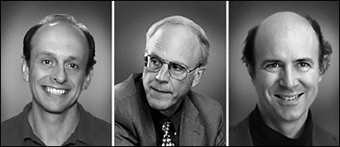
From left to right: David Politzer, David Gross and Frank Wilczek.
For their understanding of counter-intuitive aspects of the strong force, which governs quarks inside protons and neutrons, on 5 October three American physicists were awarded the 2004 Nobel Prize in Physics. David J. Gross (Kavli Institute of Theoretical Physics, University of California, Santa Barbara), H. David Politzer (California Institute of Technology), and Frank Wilczek (Massachusetts Institute of Technology) made a key theoretical discovery with a surprising result: the closer quarks are together, the weaker the force - opposite to what is seen with electromagnetism and gravity. Rather, the strong force is analogous to a rubber band stretching, where the force increases as the quarks get farther apart.
These physicists discovered this property of quarks, known as asymptotic freedom, in 1976. It later became a key part of the theory of quantum chromodynamics (QCD) and the Standard Model, the current best theory to describe the interactions of electromagnetism, the weak force, and the strong force. Experiments at CERN, most recently the precision studies at LEP, helped to validate the theory of asymptotic freedom and provide support for QCD.
Other (French)
De gauche à droite : David Politzer, David Gross et Frank Wilczek.
Pour leur compréhension d'une propriété de l'interaction forte, qui régit les quarks à l'intérieur des protons et des neutrons, trois physiciens américains ont reçu le prix Nobel de physique, le 5 octobre dernier. David J. Gross (Institut Kavli de physique théorique, Université de Californie, Santa Barbara), H. David Politzer (Institut de technologie de Californie, CalTech), et Frank Wilczek (Institut de technologie du Massachusetts, MIT) ont fait une découverte théorique avec une conséquence pour le moins surprenante : plus les quarks sont proches, plus l'interaction forte faiblit, contrairement à ce que l'on observe avec l'?é?lectromagnétisme et la gravité. A l'instar d'un morceau de caoutchouc en train d'être étiré, l'interaction forte devient plus intense à mesure quarks s'éloignent.
Ces trois physiciens mirent en évidence cette propriété des quarks connue sous le nom de « liberté asymptotique ». Cette propriété devint par la suite une partie clé de la théorie de la chromodynamique quantique (QCD) et du Modèle standard, la meilleure théorie actuelle pour décrire les interactions électromagnétique, faible et forte. Des expériences, et récemment les études de preecision du LEP, ont ai dé à valider la théorie de la liberté asymptotique et à fournir une base solide pour la QCD.
Files
na-2004-197_NobelPrize2004.jpg
Files
(38.7 kB)
| Name | Size | Download all |
|---|---|---|
|
md5:128843f399073cbb839f60843b8833b2
|
38.7 kB | Preview Download |
Additional details
Identifiers
- CDS
- 797142
- CDS Report Number
- BUL-NA-2004-197
- Aleph number
- 000034291MMD