Ideas that break through
Authors/Creators
Description
The EU-cofunded project ULICE (Union of Light Ion Centres in Europe) was launched in 2009 in response to the need to share clinical experience in hadron therapy treatment in Europe and knowledge of the associated complex technical aspects. After four successful years of activity the project is now over but the “transnational access” idea will survive thanks to an extension granted by the European Commission.
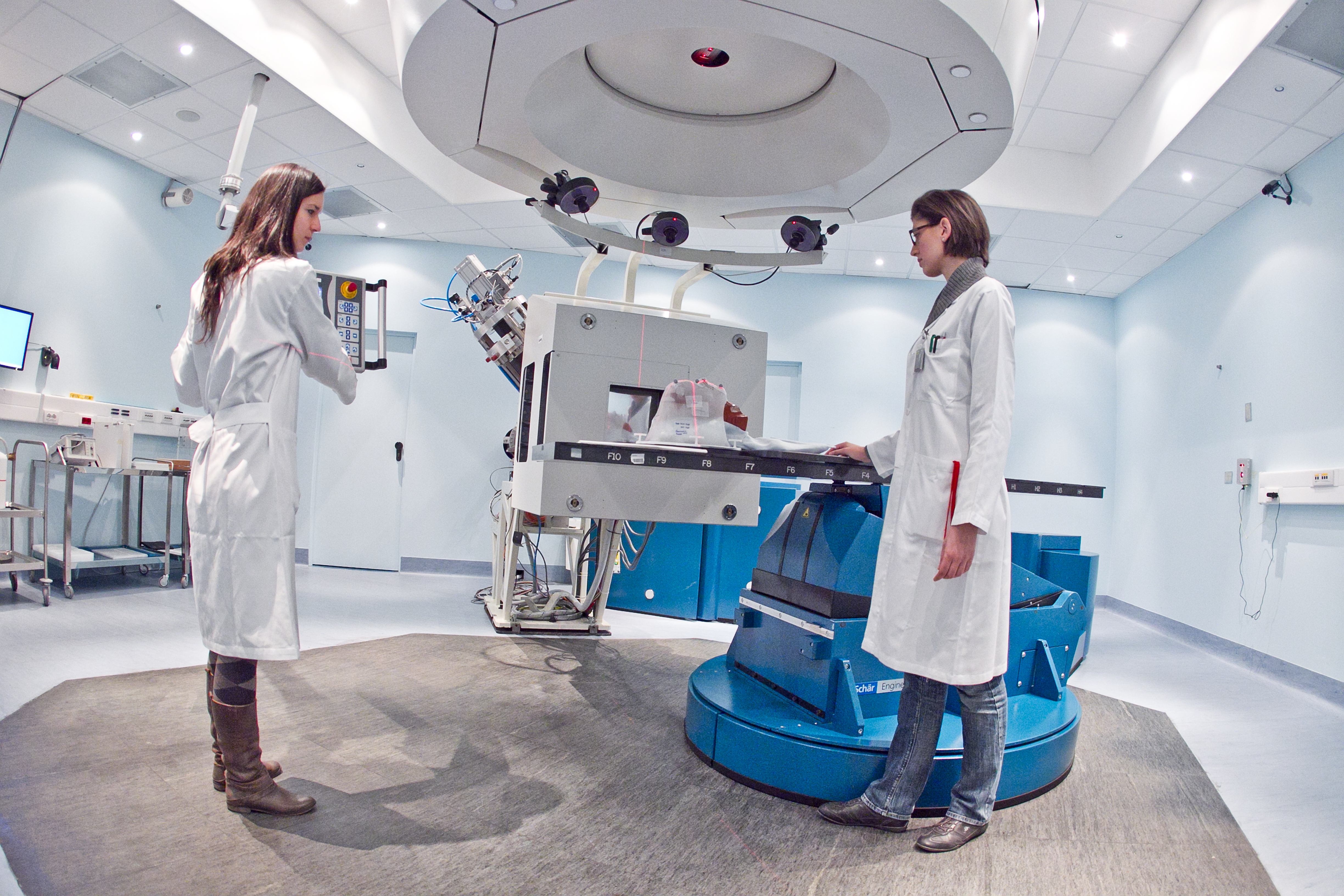
A treatment room at CNAO, the Italian centre for hadron therapy. CNAO is participating in ULICE’s transnational access initiative. Image: CNAO.
Until a few years ago, the landscape of hadron therapy in Europe was advancing in a fragmented way and facilities were being built without a common shared approach. EU-cofunded projects such as ENLIGHT, ULICE, PARTNER, ENVISION and ENTERVISION helped to build a unified platform where the different – private and public – stakeholders were able to share their views and practical experience in the field.
Today, although some of the above-mentioned projects are over, their legacy remains and has paved the way for new projects. One of the achievements of the recently completed ULICE programme was to provide patients and their referring physicians, as well as researchers, with free access to hadron beams at particle treatment facilities across Europe. “Existing facilities in Heidelberg and CNAO have agreed to provide a total of 691 hours of beamtime for research and clinical activity, after judging applications on scientific quality and clinical relevance,” says Manjit Dosanjh, who is in charge of life sciences at CERN and is the CERN representative in the ULICE consortium. “The clear benefit of such an activity has prompted the European Union to extend the ULICE project by 12 months to the end of August 2014.”
The extended beamtime is an important acknowledgement of the whole hadron-therapy community in Europe. Specialised centres for the treatment of tumours are acquiring precious experience, which is being shared by all the experts involved, thus greatly benefiting patients. New centres, such as MedAustron in Austria, are also important stakeholders in this process. The successful ideas, such as ULICE’s transnational access, will also be implemented in new facilities like ours,” says Ramona Mayer, Medical Director at MedAustron. “Our centre is approaching the operational phase and we will benefit a lot from the experience of four former PARTNER researchers to provide the best possible treatment for our future patients.”
Networking and sharing are key elements of hadron therapy because the field is developing fast and techniques have yet to be optimised. The efforts made by the European hadron-therapy community recently gained prestigious recognition when the European Commission chose the ENTERVISION programme as a “gold project” in the advertising campaign for Horizon 2020.
Watch the video about ULICE's Transnational Access initiative including interviews with doctors and hadron-therapy experts from various medical centres in Europe.
The second International Conference on Translational Research in Radio-Oncology and Physics for Health in Europe (ICTR-PHE) will take place from 10 to 14 February 2014 in Geneva. The abstract submission and early registration deadline is 30 September 2013.
Other (French)
Le projet ULICE (Union of Light Ion Centres in Europe), cofinancé par l’Union européenne, a été lancé en 2009 pour répondre à la nécessité de partager les expériences cliniques en matière d’hadronthérapie en Europe ainsi que les connaissances liées aux aspects techniques complexes de ce type de traitement. Après quatre années d’activité et de réussite, le projet est maintenant terminé, mais l’idée d’un « accès transnational » va perdurer grâce à une prolongation rendue possible par la Commission européenne.
Salle de traitementau CNAO, le centre d'hadron thérapie en Italie. Le CNAO participe à l'accès transnational d'ULICE. Image : CNAO.
Jusqu’à il y a encore quelques années, le paysage européen de l’hadronthérapie était divisé et les équipements étaient construits sans vision commune. Des projets cofinancés par l’UE tels que ENLIGHT, ULICE, PARTNER, ENVISION et ENTERVISION ont permis la mise en place d’une plateforme unifiée où les différents acteurs, publics et privés, peuvent partager leurs points de vue et leurs expériences sur le terrain.
Aujourd’hui, bien que plusieurs des projets mentionnés aient pris fin, leur héritage perdure et ouvre la voie à de nouvelles initiatives. L’une des réussites du programme ULICE, qui a pris fin récemment, a été d’offrir aux patients, aux physiciens référents ainsi qu’aux chercheurs un accès gratuit aux faisceaux de hadrons dans les centres européens de traitements par faisceaux de particules. « Les centres de traitement de Heidelberg en Allemagne et du CNAO en Italie ont accepté de fournir au total 691 heures de temps de faisceau pour la recherche et les activités cliniques, après avoir examiné les demandes d’utilisation selon des critères de qualité scientifique et de pertinence clinique, explique Manjit Dosanjh, conseillère en sciences de la vie au CERN et représentante du CERN au sein du consortium ULICE. Le bienfait évident d’une telle action a incité l’Union européenne à prolonger le projet ULICE pendant 12 mois, jusqu’à la fin août 2014. »
La prolongation de l’accès aux faisceaux est une reconnaissance importante pour l’ensemble de la communauté d’hadronthérapie en Europe. Les centres spécialisés dans le traitement des tumeurs acquièrent une expérience précieuse qui est mise en commun entre tous les experts concernés, pour le plus grand bénéfice des patients. De nouveaux centres de traitement, tel que MedAustron en Autriche, sont également des acteurs importants de ce processus. « Les idées qui réussissent, telles que l’accès transnational d’ULICE, seront également appliquées dans les centres comme le nôtre, déclare Ramona Mayer, directrice médicale au MedAustron. Notre centre approche de sa phase opérationnelle, et nous allons grandement profiter de l’expérience de quatre chercheurs qui ont participé à PARTNER pour offrir à nos futurs patients les meilleurs traitements possibles. »
Les notions de réseau et de partage sont importantes en hadronthérapie, car le domaine se développe rapidement et les techniques doivent encore être améliorées. Les efforts réalisés par la communauté européenne d’hadronthérapie ont récemment été récompensés par une reconnaissance prestigieuse de la Commission européenne, qui a choisi le programme ENTERVISION comme projet phare de sa campagne de communication sur le programme-cadre Horizon 2020.
Regardez la vidéo (en anglais seulment) sur l'« accès transnational » du projet ULICE.
La deuxième conférence ICTR-PH (International Conference on Translational Research in Radio-Oncology and Physics for Health in Europe) se tiendra du 10 au 14 février 2014 à Genève, en Suisse. La soumission des résumés et les préinscriptions sont ouvertes jusqu’au 30 septembre 2013.
Files
CNAO_34_image.jpg
Files
(6.0 MB)
| Name | Size | Download all |
|---|---|---|
|
md5:d2791a3ec8e575e52923e7033aa82269
|
6.0 MB | Preview Download |
Additional details
Identifiers
- CDS
- 1595293
- CDS Report Number
- BUL-NA-2013-180
Related works
- Is published in
- Periodical issue: 9jm7v-k8c63 (CDS)
- Periodical issue: 3834f-apy25 (CDS)